
The Cross vs the Sword
This Handbook is a footnote on the vision of John Wycliffe, that “You may know how one ought to behave in the household of God, which is the church of the living God, the pillar and buttress of truth.”
I Timothy 3:15
Copywrite Joseph L. Foreman 2020.
No, “How to behave in the household of God” was Paul to Timothy. What Wycliffe, the English Bible Translator in 1384, said was a footnote to Paul when he said, “With God’s word in the serf’s heart and His Holy Spirit, we will finally be able to become a Government of the People, by the People and for the People.” You are the child of those serfs who were transformed over the next 500 years into the beginnings of the self-government God’s Word and Spirit make possible. You will continue their growth in God’s Word.
--- JLF
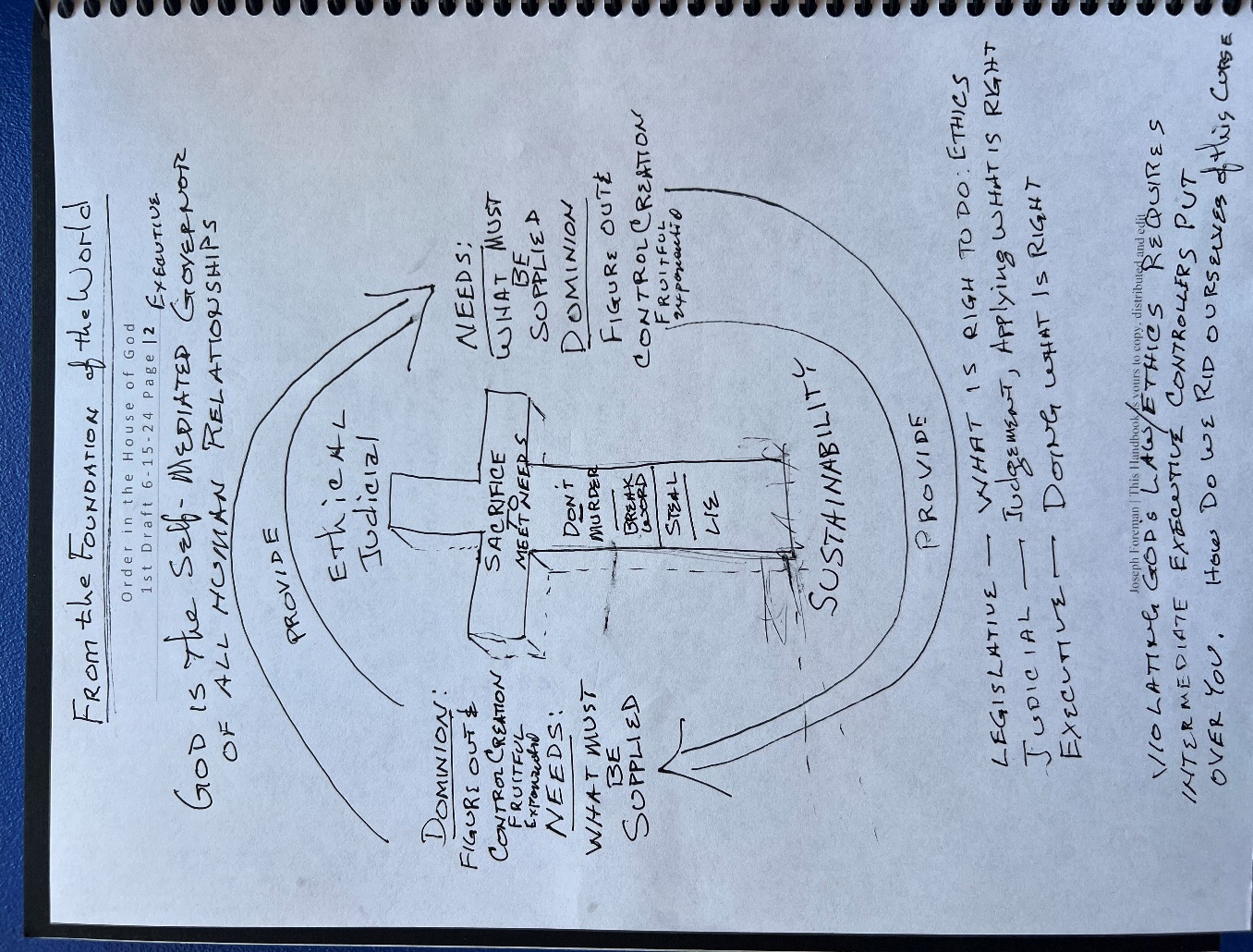
THE TRINITARIAN GOVERNMENT OF THE CROSS:
THE KINGDOM OF GOD
The Cross is necessary for there to be life at all even in an unfallen Creation. Jesus said, “The bread that I will give for the life of the world is my flesh.” The Cross is that ultimate exchange of nourishing love, independent of sin. It is the shape of sacrificial love. This exchange creates the unity Christ prayed for in the upper room — It is the Tree of Life, which is why “He is the Lamb slain before the foundation of the world” — He is the fruit of that tree. “My words are Spirit and they are Life.”
The Cross of Jesus Christ is not an afterthought or plan B in the event that sin enters into the world. The Cross is the foundation stone of all creation making a sustainable moral world possible.
“The Foundation of the World” means, that even with no sin, no fall, no original sin, and no Genesis 3:16 curse on all human endeavor in this world, the pattern of the cross is the design of everything in us and about us, the world and what we do with and in it. The cross is the structure of all social order.
“Be fruitful, multiply fill the earth, rule it” — the cross is the only way to fulfill that mandate. Dominion is the sacrificial service, not control, of others. It is the design of all exchange.
For peoples and cultures to exist, thrive, flourish there must be an ethical way for each generation to step into the dreams of those who came before and live those dreams using their dominion to meet needs in a way that creates a vision for those who follow to step into and continue the ever-growing ministry of all to all. To accomplish this, societies are built from the foundation of the world around the idea that to rule creation means to find ways to meet other people’s needs, not to find ways to control others so as to meet your needs — The Cross, not the sword, is Creation’s archetype.
A culture is the social fabric for its people to simultaneously meet each other’s needs all the time. God made social existence itself to depend on each person’s sacrifice of time, effort, energy, creativity, gifts to meet another’s needs. The Cross is at the center of what we take for granted as a mere “Economy” or “Ministry” or “Family” or “Business” or “Art” or “Education” or “Science and Technology” or “Falling in Love” or “Keeping a Contract” or “Going to Church” or “Career” or “Calling” or a smile or frown. It is charity. It is the pattern of ethical activity. It extends to all possible interactions of Humanity. All Human Psychological, Spiritual and Social interactions are either carry through the ethical pattern of the Cross or the corruptions of that pattern ethics warns us of.
Apart from sin, God’s Mandate of fruitful rule, assumes that we can sacrifice for each other to make that free earth filling union and rule fruitful. The Cross fulfills the Cultural Mandate before the fall and makes its fulfillment marginally possible after the fall.
This symphonic ministry of all to all is beyond what any one person or group of people was intended or gifted to control or direct. Even at its simplest level executive governing belongs only to God. There is no other “god”, capable of such governing and certainly no finite mediator. “Who is like You, O Lord among the gods? Glorious in Holiness, fearful in praises, doing wonders?”
The Triune Creator instead of establishing human governors to control exchanges, gives that controlling government to the people most directly involved in the judgment that, “This particular need of mine is what I want met by that particular sacrifice someone else makes to meet it.” Or, “That person’s need is worth my sacrifice and I have the resources to meet it.” This is self-government under God where two or more agree.
Every human relationship is an exchange with the Cross at its center. Two or more people deciding to accept each other’s sacrifice for each other is how the Cross makes world growth, development and fruitful abundance inevitable. It is how the Cross naturally and most effectively distributes resources and stores value for future blessing. It is how the cross determines the pay each assistant is worth. Numerical growth does not threaten a world built on the successful rule of each working together voluntarily as One. The alternative is we remain permanent children incapable of responsibility, eternally controlled by elites. Always winter but never Christmas. Never the Incarnation of God’s word in life.
Most striking about the nature of intelligent purpose (knowledge) is that it is ethical-judicial. Life and death hang in its balance. Productive creative exchange is only possible if there is a prime ethical directive in each human being. Replacing the personal, mature, self-controlled, ethical judgment of the individual (the cross) with an “expert” governor to control by the sword-enforced goodness is doomed to failure every time. Its failure causes us to doubt God’s Kingdom coming in history because we cannot imagine governing without political sword-based control of human elites interpreting God’s law and forcing it at sword point on others.
The requirement of any moral world is First, that each exchange embodies four ethical ideas, don’t murder, don’t break covenant especially with your spouse, don’t lie, and don’t steal. Second, An Ethical World to be free must give to those who exchange with each other the authority to ethically judge for themselves if what they give is of greater value to them than what they get. Third, to be free embodies a personal relationship with the Triune Being whose character is the source of these laws we reflect.
God’s Law and judgments define the difference between an exchange that builds the future and one that makes the future impossible. God’s Law abhors executive government of one creature taking away another creature’s responsibility to judge ethically.
In The Land Flowing with Milk and Honey God gave His people another taste of Creation’s government, this time lasting 400 years before they did to themselves what God imposed on them as punishment. They rejected YHWH as King and chose to be in bondage to each other. Apart from the regenerating work of the Holy Spirit (according to almost any definition of salvation) Government could not be sufficiently seated in each individual, until Pentecost, to make anything other than a King a viable option. Since Pentecost, The Holy Spirit has been syncing the world through progressive sanctification over the millennia.
The Kingdom of God is Creation’s government. It begins at the cross. Philippians 2 describes a world where people with the mind of Christ, freely sacrifice to bring joy to each other. Kingdom government begins, not with an exalted executive authority, but with those involved in any exchange. God’s image is the ethical design of humanity, investing each individual with government. In fact, He seats the universal government of creation in each regenerated heart made His temple/throne room. He is taking His world to a place where each individual person is fully consistent with God’s Image; fully capable of acting in unity with all others; led by Truth; in no need for others of special rank to force them “to know the Lord.” The paradigm of Creation’s pattern of government is marriage, the two being One Flesh. It is patterned after the Trinity the Three-in-One Being, united both in its being but also in one holy ethical purpose that unite the Three Persons in purpose. The curse of the fall turns marriage into an institution of control which became the pattern of all organization. Whereas Creation’s marriage is the pattern of voluntary relationships freely organized to meet needs.
The Presupposition of Creation is that the world and human economy is marked by plenty, not scarcity. God’s Character, when reflected in creation is called ethics or Law. It unfolds more ways to discover how all creation works together and can be unlocked to meet every need in a multiplying interlayered fruitfulness opened by His image in us to meet needs, a world of exponential growth.
The First Promise of the Bible: “The Day you eat of it you will Die,” is based on a world where to grow, develop and prosper requires an ethical judgment which unleashes infinite freedom to rearrange the building blocks of the creation itself in fruitful infinity as long as it is coherent with that simple ethical structure. That same ethical judgment makes impossible the success of the small, hopeless, futile, antinomian world crumbling that rejects that moral structure. God’s design is self-correcting in history — it makes you infinitely fruitful when lived out, it kills you when perverted. “Behold, I set before you life and death.”
Ethics is Personal. The Three Persons of the Trinity are not only united by their Ontological Oneness, from their common Divinity, they are united by their treatment of each other flowing out of their love ethically lived. God’s law reflects their Character. In Creation, it structures how we relate to the Person of God and how we relate to each other. Ethics is Life or Death. Ethics applied by sound judgment flowing from your character brings life, liberty and infinite variety of all other good things.
The most believable Bible story is where it tells how death came into the world. The world of the curse is helplessly devoted to violating creative and recreative reality. It became a world that did not escape the cross but instead reversed its function. Instead of sacrificing ourselves for each other in fruitful unified economy — creating the future through willing service (Philippians 2); they would sacrifice each other for their own benefit in fruitless destruction and produce the deadly world of thorns, thistles and pain attending their greatest joy. They destroy the future by sacrificing others to it (Genesis 3:16). The cross became the ultimate symbol of sacrificing others to your cause.
The fruitful unity of husband and wife and the free social unity of all humanity is cursed in Genesis 3:16, not by an arbitrary angry God, but by the simple inescapable result of putting others on the cross to meet our needs — the dominion of the strong over the weak. Hearts of stone put someone other than God and His relationship with each person in charge of life’s exchanges. We created human mediators, offices of priestly mediation in Family, Church and State to replace God’s unmediated relationship with His people in each of these spheres. The Law of Moses begins with this personal relationship in both its summary and first command, “Love the Lord your God with all your heart soul mind and strength.” And “You will have no other god’s before Me.” The law is unmediated to every member of God’s Kingdom, not even Moses replaced that personal One-on-One covenant with God. Moses tells the generation following the one standing at the foot of Horeb, what the first words of the Law make clear: “The LORD our God made a covenant with us at Horeb. He did not make this covenant with our fathers, but with all of us who are alive here today. The LORD spoke with you face to face out of the fire on the mountain.…”
Even in this jackbooted environment of hard hearts; when God gave his Law through Moses there is still the echo of the garden and the hope of paradise restored in Christ. This Echo and Hope are found in that He gave His Law to each individual, to prepare each heart, not to governors to enforce it on them or ancestors to straight jacket them with the ONE possible cultural expression. No, He gave His Law, His ethical-judicial image to each personally. Moses took an early step in God’s plan to make a salvation for you personally, unmediated, with your name — stop, think, your name — not in general but personally engraved on His hand. Moses had no executive branch, no legislators, only judges to decide and the people to execute their judgments. “I Am the Lord Your God . . . Therefore, You shall . . .” and the rest of God’s Law flows from this personal exclusive, all-others-aside, relationship with God, the I AM, giving it to You bearing His Image personally and unmediated to make possible your ministry to all others and theirs to you.
When God came Himself as Incarnate Word, it was to take on Himself the price of the evil done, give to us His righteousness, and so that His flesh and blood on the Cross would become the Fruit of that Tree, “My flesh is food indeed. My blood is drink indeed. . . . I give my flesh for the life of the world.”
Submitting to the cursed governments of man which were based on the power of the rulers to crucify others, He permitted them to crucify Him. Christian theology correctly grasps that this atonement replaces us with Him for the punishment for our sin. But Jesus did far more than repay sin. He reestablished the order of His kingdom from the beginning. That order is the unmediated fellowship between God and each individually and gathered. He provided a way for each person to rule in His kingdom without need of being ruled/mediated by anyone. Each heart that makes God’s word flesh, is the image of God, the Word, Himself made flesh in our lives. This is the reason for His Incarnation. This is the generational sanctification He is moving History toward.
The Gentile, covenant breaking world has used the cross for its own protection and gain. At their best, moderns have only found ways to crucify others more mercifully, democratically or by executive representative crucifiers we call politicians, businessmen, pastors, elders and bishops, husbands believing it is their mandate to see to it that those they rule serve them well. So common is this use of the cross that it is hard for us to imagine that it is possible to lead and organize without threatening others with a form of crucifixion which Christian scholars tell us is “appropriate to the sphere of Government authorized to control through punishment.” We cannot imagine a world where to lead, it is sufficient to lay down your life; to sell all you have; to take up your cross (e.g. find how to meet the needs of others) and follow Him. “Surely,” we have been told, “Jesus meant a modified kinder gentler use of authority. There is no other way to rule than exercising authority. There is no other way to unite a people. Jesus just meant, ‘Don’t abuse this power to crucify;’ not ‘such authority is not to be so among you.’”
We can’t imagine leaders organizing without the power to punish or crucify appropriately to their sphere of government. Civil governors can literally crucify — kill — wrong doers; Church Governors can spiritually crucify — excommunicate — wrong doers. Husbands can crucify — divorce — their wives. Is this is how it has always been? Or is it specifically defined as the curse: Elites empowered to control through punishment those beneath them. This is how they tell us Shepherd is seen to lead his sheep — even though Scripture nowhere indicates that shepherds are empowered to punish sheep. Feed them? Yes. Lead them? Yes. Search for them? Yes. Protect them from wolves? Yes. Be an example to them? Yes. None of these activities require disciplining sheep. To lead the shepherd is not elevated to the office and powers of wolf. In fact, the exact opposite is called for both in the law of Moses and in the words and example of Christ and His apostles. No executive wolf is exalted above the sheep for this task in Moses, Christ or the Apostolic witness. Of I Peter 5:1-3. Yes, sheep are exploited by the shepherd to slaughter and eat, to sheer and clothe, to buy and sell. These analogies, however are never given in Scripture, however well they describe the ministry of the executive Bishops, Pastors and Elders.
How can we lead without the power to crucify? How can we love without the power to destroy others? How can we organize freely without falling into the chaos of anarchy?
From the beginning the Lamb was slain to make a different governance possible, by dwelling richly in His people individually and corporately, John 17 Trinitarian ethical-judicial Government.
The Role of the Cross in Creation before Sin:
One take up their cross to meet another’s need. The Cross is the labor and sacrifice we go through to meet the needs of others.
The Cross is the ethics of social order and economy, of unity in diversity. It is everyone submitting to everyone and sacrificing on behalf to meet needs.While exchanging anything with any other person, each is the governor of that exchange on behalf of whatever it is they will receive or give. That is the Cross — What will I sacrifice to meet your need? What will you sacrifice to repay me for meeting your need? These exchanges include but go far beyond material things, “Do not be in debt except the debt of mutual love.”
Dominion of the earth is found in each person learning to make the most of the parts of the creation physical, mental and spiritual that are in their control to meet the needs of others.
The Role of the Cross, after the Fall predisposed us to sin
The Cross becomes the structure of the power of those in control to punish and control others. We put others on crosses for our benefit. The positive use of this power is to approximate God’s law and apply it justly through elite human mediators to protect the weak. They provide protection, justice, and a unified framework for those under their jurisdiction enabling them as much freedom as their personal self-discipline makes possible and the just application of God’ Law by an elite can provide.
The Negative use of this power is to improve others by controlling their lives, or what Paul called, “the righteousness that comes by Law.”
These magisterial applications of God’s law always fail according to Jesus’ promise on his first steps to the Cross: “those who live by the sword die by it.” So too, regardless of good intentions, any society based on the sword will die by that sword.
The Role of the Cross in Creation after Redemption
Christ builds on the foundation of Creation — our Image likeness, the blessing of the fruit of the Tree of the Knowledge of Good and Evil and of Life. Christ uses the Cross by paying for Sin on it personally and corporately restoring society to the vision God originally created it to be. It is a generational work as was the horror of the fall. As pattern, the Cross is the fulfilling dynamic of the Trinitarian design of Creation.
The Cross is restored as the pattern of personal voluntary labor and sacrifice to meet the needs of others. Increasing maturity generationally leads to diminishing coercion from external authority in Family, Church and State necessary to force people to do good.
Dominion of the Earth is restored to each person governing for themselves whatever it is they do to become expert in an aspect of creation creating ways they exchange that dominion with others for their mutual building up.They express the unity in the diversity of this dominion through ethical-judicial union as ones who exchange with each other the things they sacrificed to create in order to meet others’ needs. Dominion is eight or more billion people united to meet each other’s needs in Christ.
This book is dedicated to the Government of the Cross, to the Kingdom of God.Joseph Foreman April 2024 Black Mountain NC
PART ONE:
ORDER IN GOD’S HOUSE
Organize Without Status, Power or Privilege
- The way of the cross is the center of Christ’s ministry. It is His pattern of Life. “For this purpose I have come.” As the center of salvation, it is more than an internal reorganization of life as in the Mystical Evangelical, Catholic and Eastern conceptions perfected by Gnosticism, Buddhism and Eastern Oneness. Jesus reaches back to the dawn of Creation where with the Father and through the Holy Spirit He made all things good, including social order. The Trinity, in fact is the center piece of social order. It is not a dualistic tension between the individual and the collective unity. It is separate persons living in ethical fullness together fully individual and fully One. In each individual and each social order of human society it is a rebirth, a reorganization of the heart, in order to rebirth the creation. He calls this the Kingdom of God which if it is to come “on earth as it is in heaven,” must change each heart. If the heart is changed, then the world must change in all the ways that the heart-changed person is integral to it. In the Upper Room Jesus declares the power of those who will lead His Kingdom: “The kings of the Gentiles exercise lordship over them, and those who exercise authority over them are called ‘benefactors.’ But it is not to be so among you.” With that firm word, see how the Cross is central to all of Scripture, not just the fundamentalist boil-down. The plan of God from the Creation is to give every tribe, tongue, nation and people to Jesus Christ, a Kingdom of priests who follow Him, not out of constraint, or compulsion of the flesh, or fear, or reliance on organizational discipline. Such a royal priesthood cannot lead with such cursed tools of the flesh relying on the sword to inspire and compel them. The Cross builds a world governed by His Spirit and Law in each heart. The love of God and love of each other moves them — leader and follower alike — to voluntary unity with Him and each other in any variety of organizations and efforts as each is moved to lead or join in (or not). Their life is characterized as a river of living water flowing out of them to water the earth. The cross they bear defines ministry to others in all interactions and exchanges without needing to control each other. This is true Biblical Power that makes whole what the fall corrupted. It is Whimsical Utopia for stony hearts that can only lead when they can amass enough puny power to force others to follow. The Church was told to abhor that fallen “power”. Moving beyond the curse, however, is not a matter of insight, or command. It can’t be forced any more than a child, knowing and studying what it means to be an adult, or being commanded to be an adult or punished for not being an adult, can simply become an adult. This does not mean adulthood is a whimsical utopia. Self-governing adulthood is the natural result of the maturing of God’s people, made possible by salvation as it is described in Christ. This transformation in the earth begins in the Church of Jesus Christ and the John 17 fellowship it becomes. This is a Handbook for that fellowship.
We Begin where the Bible Begins, with the Lordship of Jesus Christ in the earth from the Tri-Unity of the Godhead.
“In the Beginning was the Word, the Word was With God, the Word Was God.” John 1:1
I. JESUS CHRIST KING AND HEAD OF THE CHURCH
II. UPPER ROOM PRINCIPLE OF WORSHIP
III. GOD’S WORD DEFINES HIS CONGREGATION
IV THE FINAL COURT OF APPEAL
V. GROWTH and DIVISION vs SCHISM
VI. ORGANIZING THE PLACE GOD’S NAME DWELLS
What would a fellowship look like if it was based on the maturity of its members in organic unity, love and doctrine, instead of on the power of leaders to enforce unity, love and doctrine? What would fellowship look like if the executive seat of God’s government was found in Jesus Christ alone and His dwelling place: the innermost being of each member of that fellowship not merely in authority?
Everything in the world says only Executive governors can run the fellowship of God. Except for Jesus. Jesus said have nothing to do with exercising authority, and Moses said don’t pick a person and exalt Him by giving him authority to do what the law forbids, or to invent new laws.
When we speak of an executive rule, it is to clarify that we are not talking about government in general which is created by God and good. We are talking about a particular form of governing the executive, which is God’s alone. When sin rules, He inflicts that executive governing on the people who were never designed to control each other or be controlled. The exalted master-executives become the scourge taking dominion over their submissive slaves.
What if — Don’t murder; Don’t break your word, especially to your spouse; Don’t steal; Don’t Lie; Let these be your character from your heart, Don’t Covet; Don’t replace your relationship and respect for God with anything else in creation; rest in that relationship; and honor those whose investment in your life made you what you are — what if these things were not merely enforced on you by fallen men, but were recreated in you as the native character of your lovefor God and each other
Is this possible? And if so, how is it to come about?
What if Jesus wasn’t crazy? What if He meant what he said? What if this is our future taking at least as long to bring about in History as it took to bring the world to the point of the Incarnation? Would it look something like this? This is what we will explore.
JESUS CHRIST KING AND HEAD OF THE CHURCH
Government rests upon the shoulders of Jesus Christ, the increase of whose government and peace there shall be no end —
Whose name is called Wonderful, Counselor, the Mighty God, the Everlasting Father, the Prince of Peace;
Who sits upon the throne of David to order and establish His kingdom with judgment and justice from henceforth, even forever.1
Who is the Second Adam who is reestablishing the plan and government He ordained in Creation.2
God the Father gave all power to Him in heaven and in earth:3
Has Raised Him from the dead and set Him at His own right hand;4
Has Raised Him far above all principality and power, and might, and dominion, and every name that is named, not only in this world, but also in that which is to come;5
Is making all things His footstool;6
Gave Him to be the Head over all things to the Church, which is His body, the fullness of Him that fills all in all;7
And in Him holds all things together in creation.8
He ascended far above all heavens, that He might fill all things,
He received gifts for His Bride the Church, and9
He gave them hearts of flesh taking away their hearts of stone.10
To His New Creation, He gave all gifts and callings necessary to build up His Kingdom, Church, Fellowship to fill the earth;11
With the Father, He sends the Holy Spirit for the perfecting of His saints making them sufficient for all things to be self-directed from the heart, with no wind of doctrine to blow them about.12 Because they are in John 17 union with Him and with each other.
But how? By writing His law on their heart as He himself the Second Adam is the Law and Word of God made flesh, the pattern for His new people. Adam and Eve were to have God’s Ethical Character written on their heart reflecting in their character the ethical character of the Trinity which Character made their economic unity possible. The two failed and with them all of humanity individually and socially hardened their heart. God’s Character became the Law: an external standard to them. Still the only structure of sanity, culture and society. But external to them nonetheless requiring enforcement until God came to change what Adam and Eve had done at the Tree of the Knowledge of Good and Evil.13
Jesus, is The Mediator, the only Mediator; The Atonement, The only Atonement; The High Priest, the only High Priest; The Prophet, the only Prophet; The King the only King; The Savior, the only Savior; and The Head of the Church, her only Head; and therefore —
Contains in Himself, by way of eminency, all the gifts in His Church.
He is Apostle, Teacher, Pastor, Minister, Bishop, Prophet Judge, and the only Lawgiver and Law Enforcer in Zion.
It belongs to His Majesty from His throne of glory to rule and teach the Church through His Word and Spirit by the ministry and gifting of every saint.
It is at this point that the Tradition breaks with Scripture — The idea of there being someone other than God with dominion over humans is as old as Genesis 3. But cannot be found before our parents rejected fellowship with God and the ethics that make fellowship possible. Only God is the legitimate King. Which is why we refer to the Kingdom of God and trace the dominion of His throne from Creation. He not Adam was the King in the Garden. Adam and Eve both were rulers of Creation but there is nothing to indicate that the dominion of executive control was granted to Adam over Eve, only to them both over creation. The throne of a divinely ordained earthly king only traces from Genesis 3:16, and it bursts onto history inextricably entwined with something that was not found in our original estate — sin. Sin is the only context of the first direct mention of an executive authority that reduces creatures in God’s image from the freedom of an unmediated walking with God as their King, to the bondage of the master/slave relationship, which is human executive government. And we find throughout Scripture that this connection is maintained. When God’s people sin, He curses them with more authority given to their executive governors or to the executives who conquer them. This book is about the way God has opened out of this bondage his people love.14
Dominion is the authority to do violence, to that which is under your dominion. It is not tied to your ability, or gifts, or truth, only to your ontology which in and of itself makes you only another son or daughter of Adam and Eve. When exercised over each other, it is a violation of the 2nd and 9th Commandment.
But why not conclude that introducing status-based hierarchy into human social order is proof that it is as a positive good?
Why? Clearly God is introducing hierarchy into human relationships because sin has separated them from Him. Mankind now has lost its ethical way and needs an executive, it needs a high priest, precisely because it has abandoned its King and High Priest, God.
But what do we call a hierarchy established on the separation of the hierarchs from God? Hell is a hierarchy that replaces God’s free order by putting another authority between God and those with whom He would walk in unmediated freedom. This is the origin of Executive governance of man over man.
When God delivers His law to Moses, Israel is coming into the Land Flowing with Milk and Honey, obviously a retake of Eden.
God specifically states that He is ending the master/slave relationship they were cursed to endure with Pharaoh. “I am the YHWH your God, who brought you out of the land of Egypt, out of the house of bondage.” His law and ethics banish the master-slave that would tie us to hierarchical executives regardless of their actual qualifications to lead. An executive king would reestablished Egypt’s master-slave relationship. So, His Law forbids status-based exceptions to it, calling them “gentile kings.”
For example, the Mosaic “King” has no power to fund his administration by collecting tribute or tax and no power to force his people to fight a common enemy (indeed, he has no authority to force them to do anything including obey his judgments.)
And this is where you find one of the greatest surprises in Mosaic Law — there is no human executive or legislator who is God’s legal representative established by that law. In fact, such governors are forbidden by Moses directly.15 His law is sufficient. It grants no civil office any sort of exemption from the same obedience required of the humblest Hebrew, “You shall not depart from this law to the right hand or to the left . . . and so exalt yourself above the people.” No clause reading, “Except for the King (or judge) who can murder you if you do not give him your property, who can get you killed in wars, by forging laws not contained among these which I set before you this day to draft and tax.” When the people decided that the God’s political rule was not sufficient, they demanded a gentile executive and legislative King be established like the nations who can force the unity of the Hebrews and so effectively build a nation that can stand on its own two feet among the nations.
We must ask, didn’t God authorize the dominion rule of one human being over another both at the Fall and in I Samuel 8? This is the second time. Wouldn’t this affirm the executive King?
Fact: Both the Garden and the Land Flowing with Milk and Honey ended in the same curse — someone gets executive dominion.
The same factors are present, God graciously walks with both groups as their executive King with direct unmediated fellowship, there being no other executive hierarchy present, only judges, no executive or legislative civil authorities.
At this point, you must ask, what did God do with that Political Dominion of a human king which He told Samuel to establish?
After the failure of Saul, God gave His Kingdom to David. God made political promises to the House of David, concerning the Throne of David. Political rule was promised to the Son of David.
Yes, in the end, executive Kingship belongs only to God and He saw to it the very human kingship He established with Samuel would return to Him in the house that His Son Jesus Christ also the Son of David would fully inherit and with it the political throne of David.
God rules through Jesus Christ, the Logos become fully God and fully Man, a rule fit for no other. It is in this context that we open the study of Human government by paying attention to what Scripture and all Orthodox tradition sets forth as the definition of the rule of Jesus Christ to see why it bespeaks a government of people each of them the human executives of God, each the human priests of God, each the human government of God in their own person and when in fellowship together the Ecclesia reflecting the Trinity itself.
These are a people needing no other sovereign over their labors taking dominion of the earth together, trading that dominion to meet oneanother’s needs.
A people bound together, like the Trinity, by God’s law no longer an external code enforced by executives but made their character as it is with each person of the Trinity.
Traditionally Canons of the Church and books of Church Order will explain how this King they have just described has set up an organization of leaders and empowered them to controlHis people until He returns. They control by being The Gateway to the Lord’s Supper, to baptism, to examining the people to see if they are worthy, if they are not worthy to have the arrogance of “protecting them from God’s presence” as if this could ever be a gracious act. They are the gateway controlling what is taught. These rules of order then go into elaborate detail on how to keep those who have dominion in the organization of Great Ones in the Church from abusing their power against those who have none, the little ones. By contrast, the Scriptures tell a completely different story. YHWH reveals his Name and Person to the least unto the greatest, even to their little ones. He personally covenants unmediated with each one of His people, presenting His covenant law to them, personally, expecting their total unmediated love for Him and their care for each other.
Yes, they corporately agree to the terms of the covenant, but there is no mediatorial King through whom the order of their agreement is bound together.
Yes, there is a mediatorial Priest who Guards access to Him, And yes, the people hide and ask Moses to represent them and God agrees but He still goes up in their midst;
The civil order God sets up has no comparable executive mediators to Kings or Priests, only judges relying on the voluntary cooperation of the covenant people in order to do their job.
YHWH is their King until they vote him out in I Samuel 8.
At this point God does set up a King of the Israelites with dominion over the people. This Mosaic order is the ethical and unmediated relationship with God which the people rejected.
As the Kingdom develops, God establishes a particular King, David, His House, and promises that he will never lack an heir to have political and direct dominion over the earth.
The people asked for and got a mediated relationship with God until we discover that the political earthly kingship, like the priesthood, was designed by God to be inherited by the Second Person of The Trinity, called the Logos, on the one hand and the Son of God. God is also the son of David who rules the earth politically, not just in some absentee Landlord sense. He establishes in Moses what His law pointed to, but the people could not bear: an unmediated rule with His friends, and so they begged for release.
The problem of course for us is, with such a radical rejection of executive leadership on God’s part; with such a radical inclusion of even the least of these as executive leaders16 why do we do what Israel did? God offers to reverse the curse, but they demand the separation and curse which God placed on them because of Sin in Genesis 3:16. How can God overcome this? He must overcome both His own curse against sin, and overcome their demand to be His equal in rule in the earth which is to be His equal in Salvation.
The story of the Bible is God’s answer to the question, “How can order and unity be maintained if The King is not somehow with us to politically take charge? The people don’t want it. God said it was impossible. And the coming of God to rule the earth personally as the second Adam seems to envision precisely this presence with and within His people. But He is in Heaven, not here?” This is the purpose of this book. To explain how a People without great ones, great executives, can rule.
Fact: there is no status based authority given to any leader in the church or state that is not also an authority of the least among us.
There is no authority greater than that of those who are tied to the risen Lord, and none more directly tied than the least member of His Kingdom. God’s Kingdom is ruled directly through each member calling each one a royal priest; His dwelling place.
The rest of this manual explains what our government in all its gnarly political reality should be if it is consistent with the fact that Jesus rejects all executive government for His people since He dwells in each one.17
The result will surprise you.
Jesus leads and empowers the victorious war of His Fellowship, Ecclesia, against the rulers, against the authorities, against the powers of this dark world and against the spiritual forces of evil in the heavenly realms.18 This is the spiritual dimension of the flesh and blood struggle through space-time history transforming the earth according to His plan laid from the foundation of the world.19
Therefore, Christ grants His own unmediated authority to His people jointly and severally to declare, judge and execute the whole counsel of God in the midst of the congregation.20 The exercise of this power is not in the private control of a special organization of leaders21 who exercise power on behalf; in place of; or in mediatorial authority over the congregation. Only a priest has such an office representing the congregation to God and God to the congregation.22
When the Lord and King of the Church says that the exercise of organizational authority over one another “is not to be so among you.”23 He explicitly rejects the executive way the Gentiles have always structured the authority and power of all their governing whether by raw power or the manipulation of gifts. Since the Fall, following the pattern of Genesis 3:16, they have governed by a select few of their great ones to rule over them. The authority/power God granted the Church was taken from the congregation and given to an elite few who claim authority/power to control the rest.24
In place of the elite mediators, the Lord and King of the Church establishes self-government, based on His relationship with each person. This is His plan from the beginning. Throughout this handbook, self-government is not anarchy. It is the government of Spiritually mature adults, full of the Holy Spirit, self-governed according to the Law of God written on their recreated hearts of flesh where it becomes their Character, not merely a standard external to them to be enforced by others. This has been the plan of God in Creation, lost when the Law failed to be written there. It was reestablished in the incarnation, atonement and recreating work of Christ, in His ascension to the right hand of God, and in His rule in the earth through giving His Spirit at Pentecost and through his abiding presence in each believer granting them authority and power to do all things in need of no mediation.”25
The Good News of Jesus Christ is that the Lord of every aspect of creation from its raw existence to the innumerable things which can be done to multiply its fruitful possibility; This Lord has spoken His Word to guide this great Genesis 1-2 plan of dominion. Through His incarnation, atoning and recreating death, resurrection, ruling ascension, sending of the Holy Spirit indwelling and commissioning His people throughout all time. The Good News is that He makes your participation possible by transforming, filling, equipping and enabling you along with all His people to bring to full fruit every aspect of earth and society throughout history. Sin and its attending failure will not prevent the completion of His plans, nor will it define His people. Such Dominion requires a cross, not a sword.
The theological foundation of Christian Government is the sufficiency of Christ the Executive to rule through each member of His body without need of mediator for His will to be accomplished through each:
God is fully Three Persons and One Being at once.
This individuality is reflected in the importance of each individual in His personal care to fulfill all He created the individual to be.26
The corporate unity is reflected ontologically in our being one humanity. The unity is reflected economically in our being no longer needing an external pedagogue of the law or its authorized sword bearing enforcer to make us ethically one.
Jesus is 100% God, and 100% Human. The Incarnation is God’s pattern of ministry, meeting needs and fellowshipping with us.27
Jesus sacrificially took on the guilt of His people dying in their place to make them innocent. Thereby dying for His people to make the world what he intended from Genesis 1 for it to become.
He was raised from the dead and in power, transforms each one of his saints,
Making each saint a new creature with a new heart;
Adopting each saint into his family;
Restoring His image-purpose in each saint;
Restoring the earth through each saint’s dominion.
He bodily ascended into heaven to the right hand of Power;
Where He stand executing His ongoing rule and personal intervention in the world with His people.
Where sits, because of the fullness of His Sabbath Rest and the completion of His labors of Redemption and Restoration.
If you are a Christian then you both stand with Him footstooling the earth and sit with Him at the right hand of power signifying your irreplaceable role in the recreation of the earth while you yet live, and His role in ruling and guiding your life, making unnecessary an elite mediator. The elite mediator does not stand or sit with Christ as a representative, as one of Jesus Christ’s Kingdom Bureaucrats as the mother of James and John requested for her two boys.
Jesus Christ pours out His Holy Spirit on each member of His new family to lead, guide and write His law on their new hearts calling them new creatures capable of bearing the weight of His Glory.
This is the reality of the Christian Church, Christ’s Bride, needing no human organization of Elite Officers to guide, teach or discipline them as if this elite had unique powers from God reserved only for their leadership; as if the leadership administered under the curse is sufficient for God’s Kingdom. Jesus Christ needs no special priest to minister to His people — there is no man with the title “Father” or “Rabbi” on their door. No mediator to call “king” or “prince” or “president”. They shall need “none to teach them to know the Lord.”28 “There shall be no one to make them afraid in all my holy mountain” “Do good and you have nothing to fear from the one in authority” — No one in name or function will represent His Bride to Him, nor play an official role to represent Him to His Bride nor to administer any form of discipline or blessing that is not the birthright of all believers to exercise wherever two or three are gathered. There is no human authority needed to attend the Lord of the Universe or His Bride on their honeymoon —the work in the world left to be done. Our glory is to remember and live in our first love in each detail of our taking dominion so that we might have a way to minister to others in their need.29
UPPER ROOM PRINCIPLE OF WORSHIP.
The Last Supper and the events of the Upper Room were the last worship service of the Old Covenant and the first worship service of the New. New Testament worship grew organically out of the highest feast of the Hebrew Liturgical calendar, the Passover. In this service Jesus transformed the shadows of Israel’s deliverance from slavery into the daylight of the New Covenant Worship of God’s people. They live the resurrected reality of free men and women delivered in heaven and on earth from slavery to any authority but God’s. In this feast His blood is sprinkled on the door frame their hearts now become the New Covenant House of God, the Holy of Holies, the Throne Room of God from which flows the River of Life that Ezekiel foresaw, John described, and Jesus promised to the wretchedest of women not even in Israel but in hated, Samaria as the prophets foretold.
The events at the Last Supper in the Upper Room guide Christian worship, not by transactional ritual, or abstract principle, but by how God’s people dwell with God and each other in the body of Christ.30 When God’s people gather, they reflect the things that Jesus and the Apostles found important enough to guide their worship. It is the Lord, not an abstracted principle, who regulates Christian Worship directly, concretely and personally.
There is literally no direct liturgical teaching about proper worship in the Gospels other than, “the Father seeks those who will worship in Spirit and in Truth;” “Let each of you have a gift to share;” “do things decently and in order;” “Discern the Body;” and “do all things for edification and understanding.” This is a far cry from the detailed liturgies and abstract rules requiring a priestly class.
God’s lack of formal ritual in Scripture, rather than being respected, was filled throughout church history with all sorts of liturgical ideas most of which require an organizational structure which lends itself to every sort of corruption. Of course, there is no direct order, other than the 2nd Commandment to refute the next 2,000 years of ritual, but there are some indications in God’s law which should be deeply considered as well as the actual practice of Jesus and of the first generation which have been liturgically ignored ever since.
The law of God breathed by the Holy Spirit is a sufficient guide for all things including the worship of God in His New Covenant House: no additional “Regulative Principle of Worship” is needed.
The 2nd Commandment, “You shall make no graven images nor bow down to them nor worship them.”31 Is a general principle of worship which we find in its purest form in the Upper Room at that Last Supper. There is no ritual, form or “order” which if followed channels God’s blessing, presence, grace, body and blood.
No method of worship in and of itself pleases God or forces His blessing or presence.32 God the Father is seeking those who will worship in Spirit and in Truth. All impressive (or unimpressive) techniques, not sinful in themselves, may still become ritual idols .33
Almost any form of worship that does not incorporate sin can please God, but none require that He blesses them even if He blessed them in the past, even if they are otherwise beyond objection. Nothing can compel God’s blessing. This is the difference between pagan Roman ritual and Biblical Liturgy which can be as glorious as the ancient liturgies are, or as perfect as a baby’s cry, or as contrite as a sinner’s prayer. None of these force God to act.34
No form of worship lacking the Spirit and Truth from the heart of the worshipper can be acceptable. Regardless of impeccable form, structure, doctrine, spontaneity or antiquity. Some ways of worshipping though blessed in the past will not continue in God’s blessing, such as Samuel worshipping in the high places, or Abraham’s willingness to engage in human sacrifice, or in a return to the Mosaic temple and purification system. The shadows of all these things meet the reality of the Cross that cast them.
Even zeal and sincerity are not in themselves cards we can play to force the hand of God though he desires that first love.
The 2nd Commandment undergirds Jesus’ refusal to create a ritual or tradition that would serve as a means of assuring the presence of God or artificially contrive the focus of those attending. Jesus knew that many would miss the point of what He taught and not even His disciples would remember everything. He knew that some people would just get it wrong yet still teach and act in His name. His solution was not holy rituals or special knowledge; it was not even a list of fundamental truths which must be strictly held, or Spiritual Officers whom you follow. 35 Instead, He rested the future of His people in His confidence in the work of the Holy Spirit.36 Jesus did not instruct them to solve a problem of the failure to listen by forbidding distractions, or creating distraction free meetings, or staging events that would minimize the possibility that someone would fail to grasp what He or His disciples said. He did not institute buildings and rooms designed to focus attention on the speaker, singer, actor.37 He just didn’t seem concerned that someone would miss anything God had planned for him to grasp.38 Some specific examples of this are —
There was so much lack of focus in the discussion going around in the upper room that they didn’t even grasp who was going to betray Him when He told them directly. Most of them didn’t remember 4 chapters worth of material that only John recorded, and John apparently missed the argument over who was the greatest as they forgot to mention the foot washing.
Equally remarkable is the fact that Jesus was not deterred or bothered by lack of focus in His listeners. The crying children during a sermon, did not evoke a need for a cry room, or a special Sunday school, or youth worship service. Instead, Jesus took someone who can scarcely be thought of as paying close attention (the child or the mother tending the child) and called that infant’s cry’s perfect praise and declared children’s faith to be the definition of faith, the perfection of praise; Cries that subdue God’s enemies. He makes sure they are brought down front, to drive away His enemies, being all those who think that a child is in the way of the Kingdom and so complain about the crying during Church and leave.39 But that is not all that marked His meetings. In one, a mob wanted to kill him; in another they all wanted to abandon him; in others arguing disciples carried on not paying attention to Him, even on the night of His betrayal and death. Through all this, He was confident that the Holy Spirit and His Word would penetrate as necessary to accomplish His will in the earth in His Father’s time. This confidence is the 2nd Commandment in action. No artificial contrivance, no idol of order is necessary to replace, supplement or channel the work of the Holy Spirit. This is The Principle guiding worship: the confidence of God’s leaders and God’s people welcoming interruption as God’s opportunity given to the congregation to learn something that cannot be taught any other way. They should refrain from creating artificial aids to worship such as a stage, lighting, fixed seating, enforced silence, hiring a career-leader-orator-expert who is paid to control or perform all the elements of worship and teaching. These are a few time-honored bronze-shield40 examples of enforcing interest and focus to avoid distraction often in the name of “consideration of others” or “respect for God.” God Himself demonstrated that these things in no way respect Him. In short, nothing should be set up that would replace the gold shield of a person’s own intentional desire from the heart to listen, engage and even lead41 in the events comprising the regular gathering of God’s people . . . or not join in. Let a person’s heart be evident in what they do or do not pay attention to.
Jesus doesn’t care where or how we sit. Jesus Himself was lying around on a low eight-inch couch for that last worship service in the Upper Room celebrating the first “Lord’s Supper.” The rest of His disciples were sprawled there with Him. One so disorderly (by later Church standards) as to be lying with His head on Jesus’ chest. The confusion was so great at a critical point, that this disciple was receiving hand signals from Peter to ask Jesus a question. This must be pictured to grasp what doesn’t matter to God when it comes to Christian worship and fellowship: a room full of young men lying around all speaking at once and John his face 6 inches from the face of the Lord of the Universe his head on His chest looking over at Peter frantically signaling to ask, “Ask him who will betray him.” And John doesn’t even find this story worth telling in His Gospel. This is not to show the congregation the best position to be in, or to advocate noise and confusion, but rather to show how utterly irrelevant to God are these things which we call “necessary order”.
STOP! It’s God.
Stop and think who Jesus is. HE IS GOD!
Stop and think. . . . What is going on? Picture this and let it shake you out of your idolatrous contrivances to replace the heart of people in the congregation directing their attention, versus our of directing their attention and interest through contrived methods of attention and focus. We are not in need of the meditation guides of the Buddha. We do not seek an artificial state of enlightenment.
Yes, God finds the position of a person and the demeanor and attention of a person significant. Which is why the 2nd commandment forbids using the false contrivances of men to conceal their heart behind ritual and pageant which do not reveal the heart they conceal it.
The issue is not whether or not God finds our attention, focus and worship important. It is that He does not get his leaders to regulate them in order to improve them. Rather he calls on each of us to focus in worship and in life on those things that bring life. Order in the House of God? Yes! Regulators to enforce order? No. — The One who is the object of our worship is the One who did not find it important to direct the position or demeanor of those involved in any gathering whether in the upper room or throughout His ministry. Jesus marked unexpected disruptions in His teaching and worship, as His opportunity to teach and do the unforgettable; like the time they tried to throw Him off a cliff; or the storm in the boat interrupting his prayers or sleep; or being touched by a sick woman in the market place; or screaming naked, brutal, murderous, madmen dragged from the tombs to interrupt him; or having a whore pour ointment on His feet in front of the Pharisees, of all people, while He was trying to reach out to them; or the thirty minutes it took to tear a hole in the roof in the middle of His sermon; a women dragged half naked in the middle of sex; the mothers coming up with their infants and the Disciples shooing them away; the crowd needing to eat; the Samaritan tart thinking she could argue theology only to find that Jesus engaged her discussion as seriously as if she were any bearded male teacher of the law to think through issues with Him; and the list is as extensive as the Gospel stories recorded. If you are like me, the better you know Scripture, the more these things in a list shock you. Not one example exists in the NT of a demand for a particularly prescribed order and people ordained to enforce it. Hundreds — no, every — example like every direct teaching on order is to the contrary.
The pattern of Jesus’s teaching and worship is to seize every opportunity each distraction offered. What we find nowhere in His teaching or example is a careful ritual exclusion of the possibility of interruption, no focus of a yoga class learning meditation. This is the Christ of Scripture, not a plaster statue bound by dusty volumes of theology and ritual to be sure to approach just the right way, say just the right things, be led by just the right people with convincing pedigree, certification, and arguments. In these graven images the Protestant is as profligate as any Catholic kissing the feet of Mary’s statue as it totters through town on parade.
Make no graven images of the decorum of your worship or, for that matter, no graven image of its lack of decorum. Because, for all I’ve said, distraction is no virtue either. Not good not bad — irrelevant.
Jesus was most comfortable with an environment that was relaxed in general so people could focus on what seemed to them important and only focus on what was going on when there was something of sufficient importance to make their attention worth their while.42 He then made whatever it was that “distracted them” the point of His teaching knowing that would go memorably to the heart . . . indeed it did because without those interruptions there would be almost no Gospels written. With only minor exceptions all the stories are about when something unusual happened,. Whatever Christians do thinking it needs everyone’s attention, must be something worthy of their attention in and of itself, not artificially placed on the stage to give the appearance of worth regardless of actual value and then have everyone’s ritualized attention. Realize that God Himself was not bothered when His friends — the Apostles — didn’t pay attention and missed things He said. Nor was He bothered when the crowds didn’t get His point, even when made as simple as could be made with easy stories and parables. So too, Christian worship should not be formed around artificial times of externally imposed totally undistracted ritual attention as if this is a value in and of itself to draw His people near to God.43 Solemnity that is contrived of ritual is a violation of the 2nd commandment. The reality is, each Christian in the upper room, and you, are the temple of God as they became 50 days later and as you are today. God is in their/your midst. As He draws their attention, those who are led by the Holy Spirit perceive value in something happening, they should focus on it, and if what is said, or sung, or prayed, or prophesied, or disputed, or eaten, or drunk, or rebuked or encouraged, is sufficiently important, as many people will stop what they are doing and listen or participate appropriately as God intends to do so. This is how leadership rises naturally to the top. Leaders are the ones whose life and word stop people’s mouths and arrest their attention only because God works through them, and for no other reason such as training, ordination or oratory. The servant is not greater than the master . . . even when it comes to designing worship.44 Pastors are the ones who notice who is paying attention to what, so as the better to minister to their unspoken needs.
It is an ethical freedom of ideas and spiritual values that God has designed for His people in all they do, not merely in economics. This is the economics of worship, teaching and fellowship, where not a nickel is involved in the exchanges but inestimable value flows throughout the room in and out of every heart. In worship, as in the market, it does not improve the situation to impose an artificial order from the top down which only confuses the understanding of the forces that are truly at work and can only lead to bad decisions in worship as in the marketplace. God’s law is simple and sufficient in marketplace and sanctuary alike.
This same tenor should mark true worship: that it is only as good as the heart, the spirit and the truth of those involved to focus and attend to it. It is not improved by external rules, rituals, constraints and special actors that attempt to force that focus here or there.45
Such an environment of fellowship, worship and teaching, that is not cramped by time constraints, promotes a natural resistance to the temptation to make the strength and success of the fellowship depend on the ability of organizers to organize and controllers to control. In God’s gathering are no attendees, only a congregation of royal priests gifted by God speaking the words of life to each other.
The Gentile spirit that wants to rule over the flock asks, “How can this be? If you reject rules and rulers, don’t you reject order itself? How then do you keep order? What are your rules?”
The worship in the House of God does not guarantee either the Spirit or Truth or order. Rather in faith we expect God to move in His people awakening their gifts and each when awake ministering to the Body. There are no rules that can guarantee that God moves. No rules that guarantee that His people will be ministered to other than a broken and contrite heart which is not a rule at all but a state of being. We have no plan B if God does not go up in our midst.
It is what we see Jesus doing and His Apostles do in the next 40 years wherever conduct in the house of God is discussed.
Jesus declares a form that intrinsically resists the reduction of faith to ritual as per the 2nd commandment. The New Testament gives us a design that resists the rise of a priestly elder-elite whose earthly “ordained” powers stunt the growth of God’s people. The first thing they attack is the congregation’s freedom to worship/minister.
Nothing except maturity can overcome the immature desire of a congregation for a child’s security to know there is an all wise, all powerful, disciplinary parental hand close by.46 Force is how the immature are led. Forceful leaders are how the immature are made to feel secure. Forceful leaders are how a congregation will never grow beyond their immaturity . . . why should they? Leave it to the professionals who know what they are doing.
The Church under persecution loses these forceful leaders, replacing them with gifted Ephesians 4 builders who, because of persecution, can’t organize into a band of controlling leaders and the result is wild-fire growth. The hirelings among the church bureaucrats flee, the solid gold among them are martyred. All that is left is God’s bride undistracted by professionals and experts. As she should be. As He designed it in no uncertain terms.47
It is crucial to understand the 2nd commandment here. It would be idolatrous to say that Churches are doing it “wrong” today and then say in effect, “Read my book and learn the set of rules to do it ‘right’ so God can finally bless us because we will bind on you the correct ritual idols to bow down to.” Adopting or rejecting this or that structure will not make worship, the gathering or the teaching pleasing to God. Rather this is a discussion of how the surroundings of the gathering reflect the freedom the 2nd commandment brings48 vs. the bondage of trying to improve on God by ritual or by spontaneity both of which replace worship.
Food is one aspect of the Upper Room and of the Church meetings in Acts which is present in all Old Covenant worship from the food offered at the Creation to Man49 and then the two fruit trees in the heart of the Garden to seal their covenant with God. Then the food Cain and Able offered to God and ate with Him. The meals the patriarchs made and ate with God, along with the giant barbecues that were held on the temple altar during feasts carried on for a week, and the Tithing Road trips. In John 6 Jesus describes Himself as the food of life, as He did at the last Supper the meal He longed to eat with them since the serpent stole that meal in the Garden. Eating together was what Paul confronted Peter over to His face refusing to even call the 12 Disciples “Apostles” until they refused to separate God’s people at the Lord’s table for any reason. Salvation by Grace through faith was written down to bolster the idea that we eat together and nothing separates us from that feast. From there, the marriage feast of the lamb comes at the end of the story. Fellowship with God revolved around food. Whatever the ritual or teaching even when led by an expert, it did not get in the way of eating together, even if it was meat sacrificed to Idols. From Creation Theologically and functionally, Biblical fellowship is defined by food. They went from house to house breaking bread. Regardless of how you define “My flesh is given for the life of the world,” food and life are inextricably intertwined.
The characteristics of their service of worship were to gather with everyone else who knows Jesus and eat a meal. In that environment, they work through whatever needs working out. You pray, sing, worship, teach, prophesy, rebuke, exhort, encourage and love everyone there and if needed, separate out new congregations, set apart a messenger, or declare someone or some teaching cut off from the life of the Church.
The room could be filled with comfortable chairs possibly recliners like Jesus used, that can be pulled into any size grouping as needed, from two,50 to the whole group focused on an address, sermon, song or even an accusation.51 The very flexibility helps prevent the idea that Christians gather so one person can turn himself into the only person they need to listen to even if a gifted orator. Not even Jesus Himself organized by forcing anyone to listen or follow. People listened and followed because they wanted to, as long as they wanted to He knew that those who were His would not fail to hear and see and act.52
The Upper Room design organically emphasizes that everyone needs to be at that point where they find everyone else worth listening to. Worth ministering to. Worth caring for. Nothing short of that is Biblical ministry — They discern the Body.53 The design should be one that draws out the actual condition of each heart so we can better minister one to another. Let the distractions reveal who is distracted.
At some point while eating, stop and remember that night, Jesus breaking the bread and drinking the cup of the New Covenant inviting His family54 to eat and drink with Him at His table until He comes. It is God’s table, not the Church’s nor the elders’ to fence. This is not a ritual needing correct performance by the right people to be a blessing as if it were a pagan priest presiding over Jupiter’s Holy Day. It is a regular practice that goes naturally with the meal and should be repeated in faith to teach the purpose of the meeting and the reality of grace of food and life. It is an opportunity to reflect on our sin and need for the righteousness of Christ. So, though everyone is encouraged to examine themselves, the end result is not to decide whether or not to partake, but rather to partake in anticipation of whatever blessing or judgment God has in store at His table.55 The Church invites those whom God tells us He wants to eat with: that is, all who call on the name of the Lord and those unable on their own to come whom He commands not to forbid but to provide for, His little ones, the lame, the halt, the blind, the mentally handicapped, the elderly and the children. Make straight the paths for the weak of knee.
The role of the elders in this whole process at Corinth is most noticeable by the fact that there is none. Yet for 2,000 years, the story of the drunks of Corinth is the cornerstone to defend the authority of elders to control the table which they inevitably transformed from a full-blooded meal into a symbolic ritual by taking control of it where no control is given them, nor is any change indicated as necessary or desirable by Scripture except the change of heart on the part of those partaking, which change is to be judged by God and no one else. Rituals are only useful to a priest and those who grant themselves priestly powers to control (κυριεύουσιν). And therefore we see these priests removing the meal and replacing it with something easy to control and turn into a spigot of grace manned by an elite corps of mediators Catholic or Protestant. Priest is as priest does. But that’s not what Paul ordained. It is what Jesus ordered, “is not to be so among you.56
Throughout the time the Church gathers for fellowship the issues of life are discussed privately and where appropriate, corporately. There is singing and music, instruments for the gifted. People will listen to others say some hard things sometimes personally and privately other times corporately. Then they work it out, like iron sharpening iron, even needing to get everyone’s attention so something serious can have the wisdom and judgment of all God’s people. The Apostles called together the Church in Acts 15 so the Church following Jesus’ (Mathew 18) could pass judgment on the ministry of Paul, particularly as he called the men from James accursed for abandoning the Gospel. The congregation then found it good for the Apostles to write a letter of explanation. Everyone is helping each other sort through all the issues of life, learning, maturity, handling sin, error, philosophical disputes, offense, righteousness and blessing like mature adults confident in the word and judgment of God, not petulant children insecure in all their ways needing a bramble to rule their forest.57 The Gather is real. Then, as in any group, there are some who are gifted at explaining things or praying for people, or singing or healing, or speaking a word of wisdom or knowledge . . . and at some points, everyone listens to them explain things or pray and sing or lay bare their hearts. It might even be an argument, debate or church discipline that everyone listens to.
It all takes about 2 or 3 hours, then they clean up. It’s going to happen again so there is no urgency in the entire service for an agenda though one could be helpful as long as it is not canonized. The canon is closed.
Now, read through the accounts of the last supper, see if this is how Jesus regulated it, being unperturbed by almost everything there that has agitated the special priests of the Church ever since. Diligently search the writings of His Disciples to see if they ran the Church any other way than Christ did.
“How do you do it then? Whenever you come together,” Paul asks the Corinthians.58 He had been talking about their gathering since Chapter 11. It is worth reading his answer and these 4 chapters and asking what the focus of their gathering was “each of you has a psalm, has a teaching, has a tongue, has a revelation, has an interpretation.” I have focused on the authority structure of that gathering but it is worth noting that there is more than just authority structure that has been ignored for the last 2,000 years. The entire nature of that assembly discussed for 4 chapters has been ignored both in the authority structure Paul presents, and in the nature and purpose of the gathering.
The only liturgy specified in Scripture is that everyone who comes have something personal to offer that they bring and presumably the next 2 hours will be a time of sharing it with each other building each other up.
Yes, liturgists for 2,000 years since then say, that this is the purpose of corporate reading, congregational singing and responsive prayers and statements.
But this is clearly not what Paul is saying. He does not mention things specific leaders bring but things everyone can bring. The standard to measure up to is, “Let each of you bring. . . .” It just doesn’t sound like, “Let the worship leader bring an order of worship and the rest of you bring a willingness to join in the chorus.” Or, “let the preacher bring a well prepared oration.” Or, “Let the leader lead in a responsive reading, and the rest repeat a script.” The point is that what Paul describes simply doesn’t sound remotely similar to what is going on, even in a Pentecostal home meeting.
So back to what they bring, a song, something in tongues, an interpretation and prophecy are mentioned. Food is brought, wine and so the event takes place over dinner.
When you look at the rest of the passage, you have women praying and prophesying, food is brought by each and to be shared with those who are too poor to bring any.
Where there is disorder, order is restored by each exercising self-control. The examination is not from leaders, “Let each man examine himself [before partaking of the Lord’s supper, possibly the entire meal] and see that he does not partake unworthily.” Stop and think about that. Order is not the responsibility of anyone in charge, elder, prophet, pastor, speaker in tongues. (A presiding priest is never mentioned in the whole New Testament . . . ever.) They are all called to bring order through self-discipline self-examination in a meeting that lacks a natural center other than food and the gift each brings to build up the body of Christ. Even those who apparently excused their grabbing of center stage by saying they were possessed by the Holy Spirit must exercise self-control, “The spirit of the prophet is subject to the prophet.”
He is saying that each of them has something personally related to their gifts and experience of God’s working in their life during the week that is necessary to share. It is a Spiritual pot-luck matching the potluck they are eating culminating in bread and wine given for the life of the world which is the fruit of the Tree of Life restored to the world.
The focus is not on God through exercises of group meditation in song, teaching and prayer. Rather it is on what makes each member of the body better able to live that worship by taking dominion in the earth to God’s glory in all things which includes meditation, song, teaching and prayer. The Lord’s supper had not yet been reduced to a magical ritual. So, he tells them “you despise the church of God by humiliating those who have nothing.” The emphasis isn’t the sacrilege to God, as we think of ritually profaning the Lord’s table such as eating with unconfessed secret sins. The sin is the humiliation of others in the body. “28 Everyone ought to examine themselves . . . 29 For those who eat and drink without discerning the body of Christ eat and drink judgment on themselves.” The gathering is building up the people of God the body of Christ to be better able to take dominion of the earth through the Cross of Jesus Christ. That is their “reasonable worship” as Paul later tells the Romans.
They were not doing a ritual, they were eating and drinking together. The gathering revolved around a meal. “Let everything be done for edification.” They were all bringing something to build each other up. The last thing it could have been is a ritualized one man show. When you step back from the particular things that divided them and us, you can see again and again that Paul resolved each issue by the simple principle — “What can each person do in a group setting that builds up one another?”
Someone needs to do a serious study of the Gathering of that first generation vs the “worship service” of the next 2,000 years.
As the group grows, it naturally divides, when it gets too large for everyone to know each other personally. Two where there was one. It would not be wrong to build a meeting house, but administration of the petty can/will consume God’s people. No matter what the size of the meeting room or its amenities, at some point by God’s grace there must be division for new groups to begin or something terrible will have happened: the dynamic power of the Holy Spirit, the candle stick of Revelation 2-3 will have been quenched and this branch of God’s people will have therefore been cut off. It will have stopped filling the earth, subduing it and discipling the nations. This should drive people to their knees and to fall on their faces humiliated at their rank hypocrisy — of claiming to be the fruitful vine of God . . . but bearing no fruit.59 Yet the sterility of our gathering is unremarkably normal today attracting no attention. Churches only grow by luring members from other churches.
The ministry of God’s people gathering, creates a place in space and time where all may come bringing everyone they meet and all they have learned and experienced during the week. There they gather. They are people who, one day, one person, one experience at a time change the world. They don’t come to a lecture, (though they may hear a lecture or two) nor a special leader (all God’s people are special leaders), they come to the people of God who are changed. They come to eat, talk and listen with people who are the Holy of Holies. You are the place where God has caused His name to dwell, a People who discover ways to make it better for each other. They understand service because they understand how God’s law and grace meet and kiss in the Cross which now defines their life, fellowship, purpose and character. Their leaders are not SBW’s60, who need support, though they may help support them. Leaders are the people the congregation recognizes freely as the best at meeting needs, not the best at running things and keeping everyone in a straight line, nor are they empowered to do so. If they have good ideas people will recognize them and affirm them or join in them and be directed by them organizing around them. If they don’t, people won’t. Each individual is the judge of what they will and will not endorse, believe and join in with. The leader is the one people follow apart from any organization to get them behind him. That is how new leaders are discovered, their life and doctrine is sound, and people follow. This should not change once they become recognized and set apart as if now they needed executive power to do the very thing that made them fit for recognition as leader in the first place.
The synagogue was not a Biblically ordained form of gathering, though by the time of Christ it was a normal and accepted social structure through which the Jews created a covenant world wherever they went in the earth. There they both preserved their identity as God’s people and drew Japheth into the tents of Shem because the world was attracted to the manifest difference God’s law made in covenant society. At the time of Christ some estimate their number as 15% of Roman society.61 This was the seedbed of the Church.
The synagogue was the opposite of the Temple. The Temple and its worship were strictly defined by its purpose as shadows thrown from the substantive reality of Jesus Christ.62 As such Temple and its worship were inflexibly designed to fit the stone of His people’s hearts, in a way God never intended for His People to be after He gave them a new heart and wrote His law on it; made them the new Temple never to return to a single physical location or priesthood again as if there is an address where can be found “the place where God caused His name to dwell” or to priests who “minister before the Lord in behalf of the people” again. The synagogue did not provided a liturgical pattern for the first-generation Church, any more than the Greek Theatre or Pagan Temple worship did. What it provided was not structured by ritual but ordered by the things going on very similar to what we find in the Upper Room and at Corinth 25 years later. The flexibility and freedom of the synagogue fit the new wineskins God prepared for His New Wine so perfectly no one gave it a second thought as the free-flowing journey running from house to house breaking bread.
So effective is the free flowing worship inaugurated in the Upper Room and carried on by the Apostles, that 20 or 25 years into that first generation Paul addressing the order of worship in Corinth (1300 mile journey over land, sea and time from Jerusalem) sheds a light on what they were doing there and it is remarkably similar to what they did 25 years before in Acts 1-5 where Philip’s four virgin daughters prophesy standing next to hairy old Agabus, and the people ran from house to house breaking bread singing, reading God’s word teaching, attending to the doctrine of the Apostles and getting healed or getting sick and even dropping dead.
Throughout that first generation, the Regulative Principle of the Last Supper in the Upper Room was the norm. A large meal where Christ led through gifted anointing, and the others were admonished by Paul to pay attention to each other rather than each one blithely believing that they had the only contribution worth making or belly worth filling. Order and decency were an application of Ephesians 5 for mutual submission. In no way was order and decency a call to erect an abstract principle of central-ritual-command turning the living Church of Jesus Christ into the ordered gravestones presided over by whitewashed monuments to a once living, infectious faith. Yet this in time is what every fellowship seems to become where the order of the cross is replaced by the executive pastor’s sword.
With the passing of the Apostles, the Regulative Principle of Upper Room worship was abandoned in favor of the more rational hierarchy of official mediators controlling the mediated through special rituals and liturgies bringing the meal of God to a ritualized end. Fifteen hundred years later, the Reformation changed the theology of the priesthood but only modestly adjusted the government they practiced adding checks and balances to make it harder for one priest to abuse His exaltation over the members. But the “high place” of the functional priesthood of the committee of priest-leaders remained and was not torn down. Rejecting the Upper Room, rejecting the first few Chapters of Acts, rejecting I Corinthians 12 and 14 the organizers and controllers of the church, even the Reformed, found these Scriptures and practices unfit to apply to any order of worship they could control. Therefore, the historians have sought a foundation and rationale for their worship in the pagan and pre-Christian Jewish world. The best they have been able to do is point to those aspects of the synagogue having nothing to do with its fitness as a new wine skin. They pointed to the judicial function of elders at the city gate, neither of which were pointed to in the teaching of Jesus or the New Testament, as blueprints for worship or judicial order in the Church. Without comment they went on to adopt the staged production of the Greek theater and the presiding priests of the Roman liturgical world even adopting pagan Roman names for priestly offices and functions.
After 70 AD, the early church laid aside the new wineskins and began their march back into the arms of the pagan forms of executive civil and temple rule, entertainment and organization, forming their worship patterns around them. Within 400 years they had adopted the entire Roman government’s civil and temple vocabulary to organize the many layered Church around divine Greek theater of a few actors carrying out a divine ritual before the helpless spectators. “Are you not entertained?” the questionnaires handed out to modern worshippers ask. How can we entertain you better? More ritual? Less ritual, more spontaneity less? What do you think your gifts are? Though this pattern and practice is directly forbidden in the New Testament, and nowhere found in the New Testament church, it remains the priestly pattern into the 21st Century Protestant, Orthodox, Congregational, Baptist, Pentecostal and Catholic alike since that day resting their government on paid mediating experts in complete bureaucratic control of the people through officiating over the boiled down rituals of faith enshrined in all books and canons of Church Order written since the Apostles died.63 But not found in the Apostles.
But 2,000 years of inertia? Of dependance on the flesh? This inertia will not be overcome in a day, nor should anyone try. The maturity of God’s people will always determine the amount of government needed to control them. Period! Governing freely comes from leading them to maturity through steadfast discipleship, and example. The revolution must happen in the heart before the governments of the gentiles, even in the Church, will become the Government of the Kingdom of God needing no threat to “tell them to know the Lord, for they shall all know Him . . . .”
For now, these congregations can and will have it no other way, whatever idealists might rage. After all, who will care for them? Who will stand in the gap for them? Who will protect and teach them? They higher professionals to solve their problems. There is no inkling that the Biblical purpose for the leaders of the Church is not do ministry for people, or to serve as perpetual priests and controllers. No idea that leaders are to make them a people in no need of such protection or teaching because they themselves have been raised up fulfilling the Ephesians 4; Philippians 2; Matthew 16; Luke 22:25 mandate for Church leadership:
To have the mind of Christ; To love one another; To lay down their lives in service to one another; To be united to each other in the bonds of peace; To submit to one another; To Minister to and serve one another;
In respect to the congregation they are to teach every believer to handle every wind of doctrine and unsettling thing that come their way; producing a congregation that can judge and handle any disciplinary issue dispute or wrongdoing including angels;
Such leaders lead a congregation that is in no need of paid professional career tracking elite expert fathers or else somewhere Paul would have described such leaders and empowered them to control the congregation.64
What the New Testament calls for is the confidence of leaders who focus on building up the congregation sure that the least among them will carry on the fight far better than the greatest among us did in the last 2,000 years. The least esteemed member will have all the tools needed to transform the earth and do greater things than they.65 There will be no immature little ones to be swept away by error and heretics when the elders Jesus envisioned have fulfilled their office and the worship and ministry of the Church is restored. When the Holy Spirit has completed His work among the leadership elite, there will be no need for a leadership elite to exalt itself over God’s people, to be called Father and Rabbi.66 This change will not come by revolution but by the Light of the Holy Spirit in each life.67
GOD’S WORD DEFINES HIS CONGREGATION
- There are three dimensions of Scripture’s authority which the next chapters explore. Their presupposition is that the salvation of God transforms at the center of your being God’s relationship with each, making possible an ethically sustainable creative social order with all others based on Him writing His word there, dwelling with you making ethical self-control possible. In time this will make executive government irrelevant, useless.
- Chapter III explains Scripture as the standard which defines both the congregation of God and all societies and individuals in the world, making all ethical human behavior the foundation for fruitful dominion of the earth or where ignored, the destruction for all involved. Scripture further defines God’s people by being the Truth whew the sheep hear The Shepherd’s voice.
- Chapter IV The Final Court of Appeal looks at the second dimension of interpretation. Scripture may be the final judge, but whose interpretation will determine how it is to be understood and applied? Any Gentile King could tell you that if each sheep can define what God’s word means, then you will have nothing but anarchy and chaos. Therefore, Chapter IV explains why the Holy Spirit speaking through the objective text to each member of the congregation is the only possible means of unity. The institution-based unity of the “the great ones” can only enforce their interpretations which may or may not be true. As with Medicine or Science, if political punishment/reward is attached to “Truth”, then Truth is reduced to justifying political opinion. Unity, as in North Korea, is achieved by the murder of Truth, wellbeing and fruitfulness. Governments of the Greatest end the possibility of discovering Truth. Therefore, the individual is not merely the final interpreter of Scripture, but to make Truth fruitful each must find an ethical way of working with the rest of the community to achieve a unity of belief and practice. The Cross is inescapable as the symbol of this unity.
- The third dimension of Scripture’s authority, then, explores how we can construct a social system that can find agreement apart from forcing submission. This is the unique solution of Chapter V Growth and Division, vs Schism.
God’s people are those who are created and sustained by the Holy Spirit speaking through His word. Over time, God’s word corrects errors that plague the doctrine, ministry and peace of His people. History is the story of the perfection of Doctrine throughout the earth.68 This is the optimism of biblical history: God’s Word and Spirit continue to correct and refine His people in the Truth as they grow in grace and maturity generationally through space-time history until He fills His earth with His Kingdom to the extent which He deems right for His bodily return.
Tradition and orthodoxy are the things God’s people have said and done in accordance with His word that have rung true over the years. They are not to be taken lightly. Yet even those groups that hold a high view of tradition recognize its distinction from His, otherwise why distinguish tradition from Scripture? Our word from His Word?
Doctrinally, the Church has always declared its dependence on the Holy Spirit.69
But in actual practice, the Church governs itself with the executive and magisterial power of Priests, Bishops and Elders, believing they sift truth from error, control the sacraments, worship, teaching, and doctrine, and thereby control the purity of the Faith and protection of the faithful, over the millennia.
Executive government, however, is no more responsible for whatever growth the Church has had than the Pharaohs were responsible for the rise and the fall of the Nile. For three millennia they went out each spring to perform the Nile-Arise Ritual, and then a month later returned to perform the Nile-Recede Ritual. They proved through historical “fact” that they control the Nile and no doubt believed their own experience of commanding it and it obeying. In the same way, it is the Word of God, like that rain on the upper Nile, sifting out His people and establishing them by the power of the Holy Spirit, regardless of the elders, who like the Pharaohs, sincerely believe that their sacramental, doctrinal and ritual control of God’s people and their labors as judges in church courts are the source of the advance of the Church in the world or the source of the Truth of His word.70 Ironically their only undeniable fact is throughout history, their ranks have been the source and perpetuation of most of the error in the Church which they claim to protect us from. executive government argues is necessity to solve the problems they created in the first place.
God will not share His Glory with another; nor will He allow His Word and Spirit to be contained, and ordered by human organizations.71 He discipled His elders to be free of all extraneous administration and executive distractions even table cleaning for widows.72 He told them that their only passion would be to disciple the congregation by making the Truth of God’s word clear, applying it to their lives through prayer, teaching, example, and the power of the Holy Spirit.73 Their ministry has only one purpose — not to replace the congregation, or represent the congregation or God, but rather to create a self-controlled74 body of people who do the work of the ministry. Not the elite-leader/submissive-follower Bishop and congregation have become since Rome converted the Church.75
Christ commanded His leaders to move only in the power of the Holy Spirit;76 Jesus taught them to reject the power of human organizational titles and offices which control the ministry and work of the Holy Spirit through executive bureaucracies of the “great ones.”77 Peter cursed Simon the Christian Sorcerer who thought that control of the Holy Spirit could be passed from one leader to another whether by purchase or ritual.78 Had the Christian Sorcerer just asked Peter for control of the Holy Spirit for free, Peter’s rebuke would be no less severe.79 Are you a teacher in Israel and do not knowthat the Holy Spirit is not controlled by laying on of hands?
The transforming Grace of Jesus Christ writing His word on His people’s new heart,80 and the work of the Holy Spirit speaking through that word,81 differentiates God’s congregation from the world and from the world’s forms of government.82 Where this commitment to God’s word exists, all doctrines and governments over time can and will be refined and corrected wherever they are mistaken or misapplied.83 Those who reject God’s word as written to be final for all creation; and reject that word’s application to the center of each Christian’s being; instead of transforming the world, will soon be shaped by the world and become indistinguishable from it, tasteless salt on a dung heap.84
God’s word is complete, self-consistent and self-interpreting. It needs no other source, authority or proof than the affirmation of the Holy Spirit.
No one can understand God’s word apart from the Holy Spirit speaking through it and opening their eyes, ears, mind and heart;85
It is complete, unique and preserved to our day from Genesis to Revelation. Nothing is to be added to or taken from it;86
True Orthodox doctrine is that which is found in every verse of Scripture whose meaning is self-consistent with the whole, such as the Doctrines of Scripture, the Trinity, the dual nature of Christ, the Creation, the Fall, Man. So also the doctrine of God, Atonement, Law, Grace, Providence, God’s plan to transform the earth in space-time History, etc.
All Scripture proclaims Jesus Christ, His work and His plan for all time because Jesus is God, the Son, the Lamb slain before the foundation of the world of which He is its creative architect and redeemer; His incarnation is the purpose and reason for all things;87
This sufficiency of Scripture in no way contradicts the fact that God’s revelation to us has not ceased. The traditions and creeds of the church have authority and inspiration because of Scripture. So too, those who lead do so not because of the authority and inspiration they give to Scripture but by the authority and inspiration Scripture gives to them. In each of these realms of Authority, it is because God’s finished written word is the measure of all things which anyone believes or says — whether they are in authority or not — that the Church can be confident that God’s word tries the spirits making it possible for the spiritual man to judge in its light, all other judgments, gifts, prophesies, teachings, feelings, or revelations.
God’s Word is sufficient to accomplish His purpose.88 God’s congregation is not too impotent to act for themselves in obedience to His word, nor too ignorant to pass judgment in His name needing no Guardian ad Litem of church officials.89
Where these things are a firm conviction it follows, that Scripture, not the interpretation or decrees of men or counsels, is the final court of appeal for all thoughts, decrees, councils, doctrines, freedoms, obligations, philosophies, controversies, governments and worship. This does not discount traditions and teachings and hierarchies of men, rather it establishes them by subjecting them to God’s objective standard open to all to read and apply and judge without need of elite control. Therefore, we can live confident in the knowledge that it is not the leader’s job to sift God’s people for Him, but rather they rule by “the word of their testimony, the blood of the lamb, and that they do not love their lives unto death.”90 This is the rule of the Cross that Jesus Spoke of in Matthew 16, and directly contrasted in Matthew 20:25 to the Genesis 3:16 rule of covenant breaking gentile kings and what Ezekiel 36:26 called their hearts of stone.
The congregations of the Church are not devoid of leadership, nor of the ability to discipline themselves and pass judgment simply because the Lord did not establish an office of final judge exalted above the people to be held by a few leaders,91 (whether they call themselves priests or merely pastors, elders, overseers and shepherds of the Church is not relevant to the truth that style their function as priestly mediators.)92 This final judgment resides in the duty and obligation of the individual Christian to judge all things and be judged by nothing,93 and for the congregation as a whole to apply corporate judgment when it is called for, which in the coming chapters, this handbook will show how and why this can be done without specially empowered leaders exercising authority over congregations to prevent anarchy and chaos.94
The leaders’ authority to judge and bind people is not the result of his office, or ordination. The leaders’ power to judge rests in the fact that leaders are Christians not on their monopoly of judgment. There is no office or institutional authority or power in the Church beyond those powers accessible to “the least of these my brethren.”
Those who lead are not specially empowered to control the Holy Spirit; nor to examine or control another’s standing in the faith or membership in the body of Christ; nor access to sacrament, blessing or curse the Church has to offer beyond what any Christian is empowered to do, or say, by the Spirit speaking through the Word.95
Though Scripture does not grant such status to leaders, it is not a silence on this topic that requires God’s people to refuse to grant priestly powers to their leaders. There are at least five positive reasons in Scripture itself which call God’s people to reject special executive controllers in the Church (not to reject leaders, only reject executive controllers). Even though all the history of the world from Genesis 3:16 on; and all the history of the Church, except that covered by the New Testament, tells us that it is impossible to govern an organization without executive controllers in the office of control. Nonetheless Scripture is clear and final.
Reason #1 — Jesus Christ in Matthew 18:15-22 empowers the Congregation as the final court of appeal. The congregation is not limited to passing judgment as a single organization or needing to authorize committees to judge with authority, but can pass binding judgments in ad hoc groups as small as 2 or 3 and even as individuals, as when Peter passed judgment on Ananias, and Paul judged Hymenaeus and Alexander, and as the Corinthian Church was rebuked by Paul for not passing judgment on the man sleeping with his father’s wife. In each of these cases, there is no record of ecclesiastical empowerment or approval. In the case of the Corinthian church, there is no record of elders or apostles at all, yet they were to pass binding judgment. Yes, this is absurd to the gentile or unregenerate understanding of political reality — to the mind that knows neither the Spirit nor law of God. “Moses, make them stop prophesying in the camp.” The elders of the Old Covenant demanded, knowing that when the Spirit falls outside the political power structure it spells the end of rule by political power structures. Moses’ response is fulfilled by New Testament Church government: “Would that all God’s people were prophets, would that He put His Spirit on all of them.” Christ calls us to reject this gentile mind. Paul calls us to have the gentile mind renewed. The Law of Moses was not designed for an outside government to rule over others, but for each person to rule his heart by the Holy Spirit.96 Yet because of the hardness of their heart before Christ, it was fitted to various versions of executive control. After Christ this way of Executive Gentile Control was to be walked away from.
Reason #2 — With all the problems in Corinth, Paul never appeals to elders in any way to solve them, nor does he attribute problems to a lack of elders or their proper functioning. These are 7 examples from Corinth where the Church today contradicts Paul, and creates a special jurisdiction for elders and priests —
- Concerning the Lord’s Table as well as standing in the faith, no elder is called upon to fence or examine anyone. Only self-examination is required to evaluate worthiness. The Lord is set forth as fully able to fence and discipline His Table without priestly control granted to leadership-men to reach out and steady the ark;97
- To resolve disputes, any member is superior to any pagan judge and fit to judge in the Church, even judge angels; 98
- Decency and order is not established by an elder empowered to control the events of the gathering to eat, drink, conduct business and worship, rather each member is appealed to, to recognize each other exercising self-control and order from the heart;99
- No elder judges sin, the congregation does. Paul joins his Apostolic judgment to the congregation’s in the matter of incest to judge the man whom the congregation should have judged for themselves, long before Paul ever heard of the matter.
- Paul calls the congregation to judge his confrontation of those claiming to be apostles to determine for themselves who speaks by the Spirit and Power of God.
- Argument from Silence — Search the two letters and underline the role of the elder in all verses where Paul prescribes one. Note also in the margin where you thought (and all are taught) that the elder should have an exclusive role, but Paul didn’t. Remarkable! Isn’t it?
- Argument from positive command and example — Now, underline the responsible agent Paul appeals to in any situation you thought belonged exclusively in the jurisdiction of an elder. Are you surprised to find that the only role an elder has is a role that is brought into the text by the commentator, not by the pen of Paul.100
Reason #3 — When instructing Timothy and Titus, not only does Paul NOT give any instruction for executives to resolve problems, but the exact opposite, Paul instructs elders to solve all problems through attention to doctrine, character, service, love and knowing when to refuse to argue. Search all 3 letters and see. Underline every way Paul instructs them to overcome sin, criticism, error and opposition in the Church. You will find a manual in how Character leads by example, not legal process.
Reason #4 — Though members of the congregation are on occasion admonished to submit to elders, there is no corresponding empowerment of elders to enforce that submission. Elders are, in fact, told by Jesus and Peter to reject this power so characteristic of power-hungry covenant breakers.101 The admonitions to submit come precisely because there was no power to enforce it therefore appeal must be made to the only ones who have the power to submit.
Reason #5 — The congregation is admonished not to submit to or join anyone even an Apostle or an Angel from heaven where they are in error. There is no magisterial authority in elder/Bishops as elders and Bishops, only in their sound leadership which is not advanced one inch but the title on their door.102
Peter103 clearly shows how affirming the Truth makes him an Apostle, to be obeyed, and rejecting Truth makes him an Apostle to be disobeyed, challenged and corrected. His Apostolic anointing, appointment, ordination, even masculinity, or gifting does not grant him the status of “one to be submitted to because he cannot be wrong.” Nor does it grant him the status of, “One who must be submitted to even if he is wrong.” In light of Matthew 18:17 this confirms that it is the judgment of each member of the congregation including the least among them that is final for that member, not the judgment of an “officer” of an organization called, “elders of the Church” while their court is, “in session.”
Perhaps even more to the point is Paul’s casual references to the office or status of the authority of the men Jesus spent 3 years with and set apart as His witness to the whole world: Galatians 1:8 — “But even if we, or an angel from heaven, preach any other gospel to you than what we have preached to you, let him be accursed.” … Galatians 2:6 — But from those who seemed to be something — whatever they were, it makes no difference to me; God shows personal favoritism to no man — for those who seemed to be something added nothing to me.” Could it be clearer that even among Apostles there was no “office” granting infallibility or immunity because of their status. “whatever they were, it makes no difference to me.” Those are incredibly strong words. Yet today without even the apostles present men believe that they have such office and status and administrative power exalted over the rest of God’s people when hands of ordination controlling the Holy Spirit are laid on them to judge other’s worthiness and force doctrine upon them. Paul accepted or rejected even the Twelve based on whether they affirmed or rejected the truth, not on time spent with Jesus.
The judgment of the congregation does not bind the one, or the faction judged, though it may separate them from the congregation and may define the points at which the congregation is agreed. It may be that the minority or the sole advocate of a position or practice is the one defending the truth, such as Paul when he alone stood up to the Judaizers in Galatia, opposing Peter and James; or Elijah in hiding is fed by ravens; or Shama in his bean field, Jael with her tent peg. The individual stands or falls on God’s word even if removed from that particular fellowship. The individual is free to establish a work in which the Holy Spirit speaking through the Word demonstrates that he is correct. If he is not, God is perfectly capable of and will deal with him over time regardless of who agrees with him.104 Bitterness, rancor and malice have no place in determining doctrine or error, these make it all but impossible to proceed and give us the Churches we have today.
To summarize — 1) Control of worship; 2) control of who teaches; 3) control of who gets baptized or partakes of the Lord’s table; 4) control of any trial or examination; The Scripture does not make these things the special purpose of leaders in the Church to execute however they might be selected, elected, appointed, named, or whose hands are laid on them. This is how government works in all other organizations which Jesus negatively called, “Gentile”.105 By contrast, these things thought to be controlled by an elite are the heritage given to all God’s people who are members of Christ jointly and severally.106 These powers are not kept safe on the congregation’s behalf by an ecclesiastical guardian ad litem . . . Unless, and this is an important exception — unless the congregation are Hebrews 5:12 children unable to handle the meat of the word, not yet come of age, in need of executive guardians. Then the executive rule is an appropriate and honest admission not to be seen as a slander. The writer of Hebrews is grieved over this immaturity confident that it would be overcome, but he is not insulting them or calling names.107
The belief that without executive elders or pastors a congregation today is incapable of resisting anarchy, heresy and sin is an admission of the failure of Gentile government to disciple the congregation to maturity in Christ as defined by Ephesians 1 and 4. It is not this handbook that accuses any church, elder or congregation. It is rather the confession of those who defend Gentile government on the grounds that they do not believe that a sufficiently mature congregation exists who would not fall apart without executive officers empowered to maintain the unity and purity of the faith. They bring this accusation that they have failed after 2000 years to produce an Ephesians 4 ecclesia.
The true authority and power of the Church and those ordained to lead it, is the authority and power of the Holy Spirit speaking through the word. The ever-present temptation is to replace what only the Holy Spirit can do with executive governments of Elders (bishops, priests, whomever). These men rise up to replace the call and ministry of the Holy Spirit with their various tests, educational programs and votes designed to produce a qualified leader whether the Holy Spirit qualifies him or not. They provide the leaders they qualify with legal human certification and a sociologically comfortable niche complete with a theater and book of order, in which people look for them to be so identified with the ministry of the Church that only they are uniquely called “ministers” and are to be uniquely submitted to.
In conclusion then, the elders/bishops/pastors/teachers/prophets of the Church inherit the Apostolic task to disciple (not discipline) the Church which is carried out by the power of the Holy Spirit to speak through the ministry of the Word, prayer and example.108 Their sole undistracted passion is to disciple unto spiritual, ethical and judicial maturity congregations capable of passing all such judgments and performing all actions that have been thought to be the special province and powers of the leaders.
Through, the ministry of the word, prayer and sound example they are to passionately devote themselves to producing a congregation characterized by ethical and judicially mature love, hope, and mutual submission to one another,109 of which they are exemplary examples of submission and service, confident that God’s transforming Grace, the work of the Holy Spirit and ministry of the Word dwelling richly in each believer will reveal, sanctify and establish His people over time, each person governing their own life according to God’s law written on their recreated hearts.110
Scripture will always find and form God’s people. It is the grid which sifts them out through all mankind, and all millennia. The elder’s task is not to examine and judge God’s people as if he is the door to the sheepfold; nor to control God’s people’s standing in Christ, their worship, teaching or the sacraments. The power to control these things is by definition the power of priestly mediation which makes it Christ’s alone. It is the power of the people of God who are His only earthly priests.111 Rather the leader is to faithfully teach God’s word in season and out. He is to faithfully contrast it with error. He is not a court to pass judgment on those in error except to pronounce their error, pray against it, warn them of it, argue and when necessary do what any Christian does, bring them before the congregation whom he has discipled, confident that God will grant them sound judgment.
The only true Schism in the congregation is between those who affirm the word of God as final authority and those who do not. All other issues depend on understanding that word and therefore call merely for division of a congregation at most. It is important to clarify what is and is not meant by a final court of appeal.
IV THE FINAL COURT OF APPEAL
The Scriptures as written and preserved by God are final. They are the dividing line between a people whom God promised would remain faithful to Him and transform the earth, and one who will in time become indistinguishable from the covenant breaking gentile world and be removed with it. All else is traditions and creeds. These are as helpful or hurtful as their faithfulness to the Word both the 2nd Person of the Trinity as well as what He has written down for us. 112
God alone is the final judge and Lord of the conscience. He judges each person justly for how they handled the issues of their faith and life holding each responsible. To no other is this authority given.113
There is no human authority, office, or tradition, whose status guarantees that its interpretation of Scripture is right, just or true, nor is it to be submitted to simply because they uttered it. Not a court, not an office in the Church, not a governor, not an elder, not a husband, not even the individual’s private sincerity — no one has authority to define Scripture’s meaning or application and by their status or private sincerity, make such a judgment true. Believing an interpretation true does not make it any truer than if a Pope or Church father, or your husband or pastor believed it true.
The individual conscience is, for that individual, the final judge to understand, apply and obey Scripture. Every person is held accountable for what they believe and do. They cannot be made just or absolved of guilt if they believe or do the wrong thing from a sincere heart, or at the command or influence of others whatever the office or authority of the other might be. Otherwise, one could argue, “This woman you gave me, [this governor, husband, creed, Pope, honest sincerity, that you gave me] she gave me the fruit and I ate” therefore I am faultless. Each person stands in judgment for what they believe and do before the justification or condemnation of God, “. . . every one shall die for his own iniquity; every man who eats sour grapes, his teeth shall be set on edge.”114
Being the final judge does not mean the individual believer is correct in his judgments any more than some other “in authority”. This is about responsibility. The individual is the only one responsible for his decision and action. There is no other name under heaven whereby he can be saved from his sin whether he does it on his own devices, or if he commits to trusting the direction of others. The covenantal effect of one person’s sin often spills over to affect other lives, but the personal responsibility for it is the sinner’s alone.
Corporately it is possible to bear responsibility, penalty or blessing, for being part of a group that has done wrong or right, this is called covenantal inclusion. But in the end, right or wrong, it is the individual’s actions and beliefs to confirm their joining, remaining with, or separating from such a group that seals where they stand with God and men.
“11 . . . Holy Father, keep through Your Name those whom You have given Me, that they may be one as We are . . . 20 I do not pray for these alone, but also for those who will believe in Me through their word; 21 that they all may be one, as You, Father, are in Me, and I in You; that they also may be one in Us, that the world may believe that You sent Me. . . .” John 17. The only way to enter into this unity is to adopt the ethical relationship with others that Christ died to pay for, rose to be a first fruit of, and sent the Holy Spirit on Pentecost to accomplish in each member of His Kingdom. This ethical structure of all fruitful relationships is simple to understand. But That which was broken was healed at the Cross, and is being perfected throughout history in each successive life.
You shall not harm the innocent. You shall not break your word especially to your spouse. You shall not steal. You shall not lie. This is intensely personal, You. It begins with an exclusive relationship with God, “I AM the Lord YOUR God, You shall . . .” and concludes with the transformation of this code from external requirements, to the internal instinctual reflex or bios of the heart — You shall not covet. Coveting covers the internal source of all facets of ethical behavior before they can even become a micro aggression, or in any way judged from external behavior or appearance. This is what character is to the person and bios is to the computer.
This ethic transcends all human cultures and personalities and therefore is the framework for free exchange of everything necessary to create infinite possibilities to fulfil every lack.
John 17 unity is the endgame of history and therefore requires the seat of human judgement be in the individual. The only way for finite, fallible individuals to unite and be free at the same time is to be self-governing in respect to each other. Partial understanding prevents anyone from knowing enough to hold executive rule.
This ethical unity represents the vision of a world where to work together we do not have to compromise the freedom and integrity of others. We do not have to pretend the leader knows all as if he were God. This is the reflection of the Trinity in finite creatures. Human social order mirrors the unity in the Three Persons of God. The reason ethics are central to God and us is because the only way our unity does not destroy our individuality, and our individuality is in no way opposed to our unity is by structuring all of our relationships with each other by God’s character, making it our character.
The reason God rests His government in each one of His people, is because He is not the Buddha. He has not inspired a world of Enlightened Ones for whom perfection is identification with Him and others or the world that obliterates their individuality or creates a mediating authority between God and His beloved, You.
The Reason God does not give executive authority over others, is because you are too finite and broken to replace Him, and when you are healed and mature, you do not need to have executive authority.
Don’t murder, break your word, steal or lie. These are the unique ethical bedrock of community itself. There is no culture, no social order without these giving coherence. The seat of God’s Kingdom Government is in each individual, reflecting the mystery of the Trinity found in the unity we experience with each other when we are bound together by our ethical exchanges. Without ethical personal individuality in God and humanity, there could be no true exchange, only a collective mind. With unethical individuality, there could be only the lowest forms of dirt scrabbling existence, if that.
The command to affirm only the Truth is no less required than the command to unite. But how? Its easy to say, “Agree where you can; Be charitable where you cannot; Separate peacefully where unity is impossible; and where ever you can don’t let differences keep you from passing judgment together and act on it for justice at every opportunity. One of the reasons we felt compelled to actually print out the Scriptures instead of merely citing them, is because throughout Church history if there is one thing that has had almost no application in the life of the Church, it is these footnotes. We and those who have gone before us have demonstrated remarkable skill in finding new and clever ways to hate one another in the name of Christ and divide from each other . . . in love.
Sorting issues should not be done in haste, anger or strife. Contend for the faith confident that the Holy Spirit will sort the differences means that you do not have to be bitter and rancorous when stating the Truth, who stands and who falls is in God’s hands, not yours,.115
It is no small error to submit when we should have taken a stand having recognized God’s word and submitted to it though spoken by the most unlikely person imaginable — an Ass comes to mind, a little maid-slave correcting a Syrian General, a woman driving a peg through an important politician’s temple, another woman telling King David, the type of Christ, that he should not kill her husband however much the fool he might be. Someone believing or doing wrong is not made righteous simply because their submission was to the authority of husband, elder or king. Neither is the errant husband, elder or king made right if they ignore the truth when called to account by a child, woman, unbeliever or even an Ass.
Likewise, it is no small thing to take a stand when one should have submitted. Rebellion is as the sin of witchcraft and the unity of the faith, loving, serving and laying down our lives for one another —is the substance of that unity — one of the highest callings of the believer second only to the first commandment.116
Because leaders have no executive authority to compel the assent of the believer. All must rely on the Holy Spirit and God’s word to contend intensely and thoroughly yet without bitterness, confident that the outcome is the Lord’s. Issues can be worked through until resolved or peaceably part ways. God promises to sort them out.
Mosaic law and New Testament grace present the world with the amazing concept that final judgment is not found in a specialized priesthood, a political order, or the traditions of the fathers, but in each unmediated believer who stands clothed in Christ before God as Adam and Eve did,117 fully at the mercy of the only mediator whose word is binding — indeed who is called the Word of God.118
If a special group of leaders has power to declare guilt because their word was rejected or declare innocence because their word was submitted to, they would be both the de facto mediators of grace, and the one who can atone for sins, as long as the sins are committed in submission to their will. Yes, this power does exist: “Those whose sins you retain will be retained and those whose sins you forgive will be forgiven.” Jesus grants the power of the Holy Spirit to His Apostles in John 20:21-23, not because they are unique officers, but because they are the first fruit of the power of God’s Spirit granted 53 days later to the entire congregation, men women and children in Acts 2 and to every Christian unto the close of the age.119
Jesus affirms the authority of the leaders to lead particularly those who sit in the seat of Moses and to be treated with serious respect, but it is due Moses, not to their status as chair sitters.
But, Jesus denies that trusting in the error of those sitting in the seat of Moses absolves the personal guilt of the one who trusted them, otherwise He would not have said that the followers of these Pharisees in Moses’ seat are twice as fit for hell as the Pharisees who are in Mosaic authority over them.120
All are held individually and personally liable for their beliefs and actions because each person is unmediated by any other believer or authority in respect to their responsibility to understand, believe, evaluate, grow in maturity, and act on the truth. No one can do this for, or in behalf of, someone else who is an ethically mature adult.121 Executive controllers are for those who are not ethically mature, and are a danger to themselves and others — the child, the elderly and the criminal — which includes the executive controllers themselves, “Who will watch the watchers?” Where executives are needed because of the danger posed by sin or immaturity, they become the greatest danger in the community.
The Duty and Obligation of Private Judgment is another way of saying, “God alone is Lord of the conscience. He has made it free from any doctrines or commandments of men which are in any respect contrary to the Word of God.” As one creed puts it.
This is the most radical doctrine of the Reformation — It is the statement that each person is responsible to know the truth122 from God speaking through His Word and applying it to each heart and situation. Each person will be personally judged based on their understanding, acceptance, and action taken based on it, not on their faith in and agreement with other authorities. These authorities cannot cover the believer’s sin who trusts in them where they are wrong. There is only one atonement, only one mediator.
This idea separates those who gain their power, meaning and place from who they are in Christ vs those who have their power, meaning and place granted to them by an authoritative hierarchy of men who claim divine rubberstamp for their actions.
Luther, Calvin, and later Reformers, Owen, JC Ryle, Alexander Hodge and all other reformation thinkers strenuously taught in strikingly clear and bold terms this doctrine of private judgment. It is not clear if they fully realized the acid this doctrine represents to all theories of Church government that place unique executive power in a central command that is exalted above the people. Regardless of theology, the believers in central church government will in time be driven by the logic and power of their office to require enforced submission of believers as an essential component of saving faith. Cyprian’s summary will become theirs, “You cannot have God as your Father if you do not have the Church as your Mother.” By “Church” is meant the hierarchy of human authorities.
By contrast Cyprian made a perfectly Biblical statement if what he meant by “Church” was the word Cyprian actually used, ecclesia, (ἐκκλησία) a gathering, fellowship, example to the world.
If the reformers are correct — and the entire reformation was based on this idea — then final judgment belongs to the individual and not to any priest, elder, counsel, congregation, husband, judge, king, or Pope. The individual has the final say on what he will believe and do. It is a self-maledictory judgment he passes — each will be personally judged by God based on their judgments. Without this doctrine there is no doctrine of personal responsibility, certainly no doctrine of free will, and no doctrine of God’s sovereignty either. All that would be left is merely the responsibility to submit to, obey, and agree with whomever is in authority and trust in them for mediation and absolution before God’s throne.
This is very different from saying that the individual’s final judgment is correct, much less that God accepts that final judgment. The individual can be as wrong or right as any authority.
But only the individual is responsible for their own judgment concerning God’s Word, what it means, how it applies and what they do about what they know.
All governing to be godly must respect and nurture this authority of self-government in Christ. The gifts are given to disciple each person to judge maturely, to judge truly and to act faithfully with integrity, not merely to follow the crowd, even if it is a crowd of leaders.123 Even if the crowd, or leaders, are correct, following them cannot be the justification for what someone does because even at their most righteous, they are clothed in a filthy rag in need of the intercession of Jesus Christ who will sustain His own.
A fundamental principle of this Handbook on Church Government is the inability of the elders to rule over the congregation by imposing discipline or requiring them to interpret the Bible their way. It is a fundamental encroachment into Christ’s final mediation. Rather their teaching like the cross must be such that draws all men to Him, not like the executive who drives all men to their idea of Him. Neither Jesus, the Father, the Holy Spirit nor Their united being, the Trinity, are reducible to mere symbols nor any less than a True symbol.
In a hierarchical power oriented world it is easy to forget that this is a religion made up of people God knows and who know Him. Power based executive authority cannot usurp that relationship.
The powers of the leaders in the Church will be taken up Error! Reference source not found. under, Error! Reference source not found.. Error! Reference source not found..
What follows is for leaders who will disciple mature congregations, to be capable of conflict and resolution, not congregations of self-willed children rebelling against their executive master.124 How congregations can grow in maturity without either dissolving in chaos, or replacing one executive mediator with another will be discussed in Chapter V. GROWTH and DIVISION vs SCHISM.125
Whether in the Home, State, or Church, submission commanded by God is only to be given to the leader, “as unto the Lord,” or “in Christ.” These words empower the leader, as far as the maturity of the follower is able to perceive Christ the Lord in his life and word and grant submission to Christ by submitting to the leader.
How do you attain the unity which Scripture requires when we are obligated to do and believe only those things that each believes are right?126 Every passage calling for love, is the statement that unconstrained unity in Christ is not only possible, but will become the reality of history. But how?
External executive force can create a measure of unity. But forced unity is false unity. The choice is not between Executive unity vs. Anarchy. Both are anarchy. Force gives some of the benefits but mostly the illusion of unity, just as anarchy gives the illusion of freedom along with some of its benefits. But in neither case is that unity or freedom godly.
In reality, neither solves the basic problem which is a heart problem. Neither unity nor freedom can be imposed from the outside but must come from the heart. The heart, Scripture claims, is what Christ transforms, dwells in and writes His law upon. “The Father seeks those who will worship in Spirit and in Truth.”127
The New Covenant is not limited by the executive remedies granted by God at the fall to prevent humanity from falling into hopeless chaos.128 Which is why the sword, and by extension the state that wields it, the priest and parents who depend on it, does not establish, protect, provide for or promote the Kingdom of God much less the Church, state and families that establish their authority on it.
The Prophets longed for a day in which God’s people would themselves be transformed into people who could govern themselves freely according to the indwelling Spirit of God.129
The fundamental doctrines of the faith define the work of salvation as creating a people sufficiently redeemed from the curse and hard hearts to be capable of self-government, free of the sword —
The Incarnation to show that the True Man, self-governed by God’s law is possible, no mediation needed, the incarnation not only perfect God’s ministry, it is the pattern for our ministry in the earth.
The Atonement to first justify and forgive, and then to transform each believer from the heart makes them capable of self-government.130 But going beyond justification and sanctification, the atonement, like the Cross, is God’s pattern for His ministry through a redeemed mankind in the New Creation.
The Ascension into Heaven from where Christ personally reigns in all the earth uniting His people now capable of following Him without institutional mediation.131 It is from there that we now reign in the earth through him, “seated with Christ in the heavenlies.”132
Pentecost, The giving of the Holy Spirit. He is the one who writes God’s law on the believer’s newly recreated heart. Therefore the believer is not left without Word or Guide to govern himself and a basis to agree with all others who have God’s word written on their heart.133
The achievable goal of the Christian life is not perfection. It is sufficient spiritual maturity in Christ, to be self-governed by the reality of the salvation which Christ has accomplished. This changed heart does not need outside force to falsely give the impression of a unity, which if truly there would not require external force.
The unregenerate mind liberal and conservative who believes that only the strength of the central planner can force the appearance of unity, and too many Christians concede that realistically this is sufficient for God’s Kingdom. They all believe that the lawless heart of stone can never be reborn to a living heart with God’s law written on it. All doubt the power of the cross and the Holy Spirit to make any significant difference in the human condition.
If we are to believe that God can atone for and change the heart, then we are believing that in the self-government of the transformed heart God has created the final human court of appeal by which the individual stands or falls in God’s courts by what the individual judges the word of God to be saying and by what they do to obey and be bound by what they have judged.134
This sort of Ephesians 1 & 4 and II Corinthians 2-4 believer forms mature congregations who are capable of resolving most disagreements, but when there is a sufficiently serious impasse, they make their next growth-division one that separates out the conflicting groups (or individual) to establish its own congregation (or flee fellowship) and trusts God to judge between them, as will be spelled out in Chapter V.135 And to do so without bitterness or rancor with genuine prayer for God to establish His word.
The goal of all Biblical government is to minimize external coercion; to respect men and women who discern for themselves according to God’s law what is right, good and just, and act on it.136 This is called ethical-judicial maturity.
The shape of all government and its powers will always reflect the maturity and therefore the capability of those governed to govern themselves. The long-term success of tyranny or freedom is the level of maturity in the congregation, or body politic, as a whole.
Therefore, only free self-governing people who have proven that they can get along like adults with others without violating God’s law will successfully create free governments ruled increasingly by those exercising only the coercive power with which the “least of these” is able to muster, to make real change with real power flowing out in the love and fellowship of God’s people.137
Until then, the executive powers of government will diminish in direct proportion to the maturity of God’s people to live lives self-directed by God’s law.138
Spiritually mature congregations and elders will not need executive government to disciple God’s people.
Bondage can be forced on a people, liberty cannot. The power of government can restrict but not free. Freedom is the result of growth and maturity from the heart, not imposition from the outside. Those convinced of the things they read here have as their only avenue for change the command and example of Christ and His Apostles to make disciples, not take control. Freedom is not the fruit of force even when it is God’s law that is applied from outside the hard heart.
Freedom from the Curse of Genesis 3:16 will only be experienced in proportion to the ethical and judicial maturity of the people.
GROWTH and DIVISION vs SCHISM
- I Corinthians 11:18-19 “First of all, I hear that when you come together as a church, there are divisions among you, and in part I believe and indeed, there must be differences among you to show which of you are approved.”
Ecclesia, ἐκκλησία, is the Greek term used to describe the gathering. I will usually use, “congregation,” or “gathering.” not the traditional term “Church” which emphasizes executive authority of leaders over followers a concept absent from the Greek, ἐκκλησία.
We need some indication of the optimum size of a particular fellowship, so that when we discuss dividing, we have an understood target. That sort of statistic isn’t given in Scripture so we have to infer from the information we have.
The particular fellowship needs at least 2 or 3 to exercise the full authority and power of the Kingdom of Heaven. 70 would seem to be an upper limit for “Let each one bring a gift.”
Meetings went from house to house, upper rooms (Eutychus fell out of the window and died), fields, caves anywhere they could meet. Buildings were not built for another 200 years.
The only detailed discussion of liturgy and worship is found in I Corinthians 12-14. To carry out Paul’s instructions the group could not comfortably be larger than 60 or 70.
70 is an optimal number based functional intimacy of effective discipling than a specific given number. For discipline to be effective it is vital that everyone knows each other especially the elders who know and are known personally and directly.
The Growth of God’s people is an expected, normal part of Christ’s victory in history and so dividing the congregation that runs out of meeting space should be a normal part of congregational life not a reason to spend a fortune on bigger barns and better preachers.139
As the group grows, thought should always be given for where to divide and go to next as well as the leadership to lead that move.
Growth is the irresistible presence of the Holy Spirit in the congregation giving life and meaning to the food, fellowship, worship, prayer, singing, teaching, prophesy,140 rebuke, exhortation, encouragement, and love.
If the group stops growing, then address 4 questions:
What issues of life personally or in the surrounding world are no longer addressed in the group and people no longer see that God is among you credibly addressing the issues of life. “To whom else shall we go you have the words of eternal life.” John 6:68.
What issues have replaced discipleship and so distract leaders from their one call in the congregation and thereby distract the congregation such that people no longer see that God is among you credibly addressing the issues of life with a word that “is living and active, sharper than any two-edged sword, piercing to the division of soul and of spirit, of joints and of marrow, and discerning the thoughts and intentions of the heart.”? Hebrews 4:12
Why do we no longer see life in the congregation and therefore people no longer see that God is among you and “ten gentiles no longer grab hold of one of your sleeves saying, ‘Take us with you because God is with you.”? Zechariah 8:23
Why is the Gospel no longer perceived as hope for every square inch of the world around us and so people no longer see that God is among you credibly addressing the issues of life with a word that “Fills the earth with the knowledge of the Glory of the Lord as the waters cover the sea.”? Habakkuk 2:14
Each of these questions addresses the heart of the existence of the congregation. Either life and meaning is found in Christ and His fellowship with God’s people, or it is not. If it is not, growth stops. People come to hear the words of the Lord. If they come to see the show we have put on to hide the absence of God’s Spirit and power, we are dead.
Outreach is a function of the heart — each person living the life that has found them, giving each person meaning and purpose in the mutual discipling fellowship of God’s people. When these run dry in the life of the congregation, no motivation or technique will fill the void or in the end do anything but kill the fellowship.141
Executive government is useful precisely because it can continue the appearance of life, unity and doctrinal integrity, preserving a measure of each.142
God is confident that this loss of dependence and walk with Him will not characterize you either.143
Executive government will itself be cast off like an old cloak when that star has risen and the resulting growth will be unmatched. A foretaste of this day can be seen in persecuted churches where no superstructure of elite leaders is allowed by the state to form and God shows what His people are capable of if only they would keep the institutional bureaucrats out of His marriage bed.
There are things other than outgrowing the room, which lead to the separation in God’s congregation.
Should the differences in the congregation be found sufficiently insoluble, the congregation can divide based on who agrees with whom. Each will part with the other’s blessing or dire warning, but always with fervent prayer that they be established in the Truth as they they start two new congregations. When Athanasius stood against the world, being the “world” of the Arian bishops who opposed him, they did so because the majority believed him to be in error and sin. This division is instructive, since in the end, the Roman (and in time the Eastern Orthodox) world stayed with Athanasius and Arius went North converting Europe. In Time, Europe was converted to Nicene Christianity. While not this dramatic or huge, a local division can have a similar result in God’s timing though it took a few hundred years, God won Europe back. Humility and confidence is called for.
Division is not necessarily schismatic. It is the recognition of our limitations as finite creatures to finally judge one another in a context where God’s word is final, but its meaning disputed.
Division is only schismatic if any difference or agreement rests on the belief that God’s written word is not final. Not our interpretation of it, but God’s word itself.144
Separation for any disagreement is always in faith that God will guard His divided people from error, and will in time, sift the error or sin out along with those shaped by it to reunite or remove them.145
Each side of the disagreement should always in humility search the Scripture to see if they are the ones to be sifted out, reproved, judged or corrected by God.
Only where leaders exercise the mighty power of “the least of these” can there be such discernment. The “greatest” among us are easily seduced which is why they are unfit to lead in God’s Kingdom and Jesus constantly rejected their bid for leadership —
Because their greatness is the power by which they rule, any other gifted person becomes a threat to their power to control. It is extremely difficult to organizationally function where two or more have final executive control unless they are dividing the spoil.
The greatness of their power to require that others submit to them seduces them to believe that any power they have is God’s authorization to demand that everyone be part of their kingdom as they define it in full confidence that their kingdom must be God’s Kingdom. “Why else do we have God’s mandate to rule?” they reason among themselves, despite our Lord’s repeated rejection.146
For 2000 years, these theological battles were usually fronts for the real issues which divide God’s people. Again, it is the least of these my brethren who are most likely to see through the illusion. “What causes quarrels and what causes fights among you? Is it not this, that your passions are at war within you? You desire and do not have, so you murder. You covet and cannot obtain, so you fight and quarrel. You do not have, because you do not ask. You ask and do not receive, because you ask wrongly, to spend it on your passions. You adulterous people! Do you not know that friendship with the world is enmity with God? Therefore, whoever wishes to be a friend of the world makes himself an enemy of God. Or do you suppose it is to no purpose that the Scripture says, . . .“God opposes the proud but gives grace to the humble.”147
The following issues inflame most theological disputes for, “to the victors (Nicolaitans) go the spoils” and the spoils of an institutional church are considerable . . . of a congregation of 50-70? Not so much. They are better able to discuss the issues freely among all:
Control of physical assets — Low budgets make New Testament growth possible. Large budgets supporting expensive assets (buildings, conference grounds, headquarters, mailing lists, brilliant oratory and reasoning, careers etc.) are great roadblocks to growth and great roadblocks to the real debate of significant theological issues because they are not part of the purpose of God’s people. Jesus ran the Church with a budget held in a small bag which He intentionally entrusted to a traitor and thief along with a nonstop argument raging around Him about it. His Church thrived for the generation that kept the bag small.
Control of Spiritual Assets — Humility makes growth possible. By definition, an executive is exalted above those he controls. Any disagreement is automatically a personal challenge to the leader and its resolution becomes a vote of confidence, rather than a simple discussion of the merits.148 But if the leader’s power is no longer his power to require submission, then there is nothing to fight over. It is impossible to remove the seal of the Holy Spirit, or take it for oneself as the result of winning a debate or vote. It requires maturity to live in this reality. Jesus ran the Church with the legal authority of a servant, forcing His will and way on no one, sustained only by the Holy Spirit in His teaching, argument and ministry. His disciples did the same. His Church thrived not just with Him there, but after He left with the Apostles refusing to interpret their calling, authority and power as an executive office of administration.
The rich young ruler is an example of the Church ruled by the “greatest among you,” not the least; He is a picture of the church ruled by its possessions not by Jesus Christ. The last 2000 years is the fate of the Rich Young followers of Jesus. What if the Church had only worked with those who were willing to follow and only in groups large enough to fit into the meeting room, and budgets large enough to fit into the bag, and the bag entrusted to suspected thieves? Could we have done worse for the last 2000 years?
Those who call self-ruled hearts governed by God's law impossible are guided by one main presupposition — the Curse, not Regeneration, not the Cross, not the new birth, not the Kingdom of God, is inescapable and will have the last word making the executive rule of the Great Ones, necessary regardless of what Jesus says. They argue the simple reality of history that the task of the elders in the Church always has been to control the most stuff and have the biggest following, in the best interests of the children/congregation. Those who find this assessment especially the last sentence about controlling the most stuff cynical must answer the question: “Then why is it the elders who control all the material and spiritual assets of the church?” This is no cynical insult. This describes the control and command structure of all successful churches throughout history, It describes the successful ministries today. Success is defined as the leaders in the church who control the most physical and spiritual assets and use them to attract the most adherents. That’s just a fact. Look at 100% of all conference headliners and their fees.
If the first objection is, “No it isn’t that way! These assets are not possessions, they are tools of the kingdom.” The point is proven. The Rich Young Ruler and the Pharisees defended their wealth and Spiritual Dominion in the same terms as they walked away amazed that Jesus could think that “things” and “Spiritual Control” were not proof that one served God. Yet in their real lives these were the very things that made it impossible for them to follow Jesus.
The definition of the rich young ruler is the definition of the elders since 300 AD: Rich — acquiring great wealth . . . for the church of course; Ruler — firmly maintaining executive control of all things spiritual and material . . . for the good of the Kingdom of course; Young — dooming themselves and God’s congregation to perpetual immaturity. Now stretching into the 3rd millennium.
“It is not to be so among you.” “Go sell all you have.” The real Jesus.
Many things may divide Christian congregations but there is only one thing that truly erases the divide between God’s people and the world: to depart from the conviction that God’s word is final,149 and the ideal that a doctrine is found in Scripture it must be believed and obeyed until clearer light springs from the same word.150 Outside of the practice of this conviction, there is no light even if one’s doctrines are at many points correct.151
Executive leaders are not sources of that light, nor of preserving the unity of the faith, or God would have made executive authority an explicit and exclusive part of a leader’s job description instead of condemning and forbidding it in the most direct and simple terms whenever it came up. “It shall not be so among you.” Read His lips.
He did want leaders. Paul said leaders should rule well. Just not as executive rulers. Leaders rule through lives defined by service and teaching. He did not make executive power a job description of the elders. To the contrary He explicitly warned against that error.152
There is no historical evidence that executive government preserves the unity of the faith, in fact the exact opposite is found throughout most of history Count the fragmented denominations in the world every one led by an executive.
Believing the full authority of Scripture does not give to your interpretation Scripture’s authority. So be humble in the face of God’s Final Truth and seek it in God’s word always and not in man’s decrees, summaries, explanations of that word, however true their creed might be. The truth, even of creeds, councils, and personal convictions is derivative. This does not make creeds less true; it simply separates them from Canon as derived from Scripture.
This is precisely why factions153 in the congregation do not need to battle each other to the bitter end of division and hatred (however it is masked by “zeal for Truth” or “Loving enough to correct error.”)
The reality check is that God’s Word and His power is sufficient in the days, years and centuries to come to sort error from truth.
Therefore, simply separate the warring factions let them see in time, who is of the Lord.
As year succeeds to year, God’s people are to live by the serene confidence that God’s word will sift and weed through all the competing interpretations. He will sustain the true and leave the rest to wither in the thin soil by the rocky road however lovely and healthy their first flowering might have seemed.154
The discipling task of the elders is to teach the truth and embody it in such a way that the righteous are encouraged and motivated. At the same time they are to teach the truth in a way that the sinner and the heretic are convicted from the heart and turn, or being unconvinced, they depart with our prayers, not our bitter enmity wishing they had what we have. Paul tells Timothy and Titus to deal with error, contempt, and sinful opposition not through executive authority or by courts and trials, but through sober and mature proven judgment in sound teaching lived out.155 Failure to make peaceful division over serious error a normal part of growth and maturity has disastrous consequences.156 Trusting an ordained elite to do this task for the Ecclesia of God has proven even more disastrous over the years. 95% of all error has come from the ordained shepherds and from the schools that train them.
The disciplinary task of the congregation is to determine where separation is necessary and to send forth the troubler of the congregation with the full confidence that in 25 to 100 to 300 years (sometimes by the end of the week) the world will know who spoke truly for Christ according to the word of God. It is for God’s congregation to live in the fullness of what they by faith understand, and to pray for further understanding and grow. That fruitful growth God increasing His people and weeding out their sterile enemies.157
To send forth or to start a congregation over a disputed term, doctrine or practice is not schismatic but rather a good and healthy way to remain civil and in prayer each side for the other, trusting God to sustain His word His way, however stiff the opposition; and in the meantime, to remain focused on the task God has given to fill the earth and subdue it undistracted by vain disputes.
Those who are older reading this know that these are by far the most utopian passages in this Handbook. They require maturity to know how not to bite and devour one another on the one hand and how not to be unequally yoked on the other. Nothing can replace the good judgment of the spiritually mature.158
The Church awaits their discipleship and has been waiting for 2,000 years now.
The most divisive force in the history of the Church has been the insistence on executive leadership itself. When Power and Greatness are the foundation of a leader’s ability to lead, then every disagreement is a personal issue challenging the leader. With great leaders come great egos. This system is designed to divide and collapse in bitterness since it is built on ambition.
Though executive government can accomplish many good things, in the end it fights only a losing battle. It assumes God cannot seriously change the world much less the heart. Therefore, it is insufficient to produce a people able to bear the weight of Glory which God recreated them in Christ Jesus to shine forth.159 The State’s sword that establishes, and defends, in the end slays what it gives life to. Correct government, including what is proposed here, cannot nullify the 2nd commandment as if carefully following the rituals of proper forms of self-government or doing what the godly do, will produce godly people capable of self-control.
The Authority and Power of leaders in the Church of Jesus Christ is not the power to set policy and police it. This power is exclusively the power of the Holy Spirit to speak through His word to each member of the congregation including but not limited to those who lead. Leadership is not to be submitted to in general, but situation by situation where the congregation submits, or when not submitting, like Baalam’s ass, they correct the leaders.
Any leader or member who is not living out, “Lest a grain of wheat fall to the ground and die it abides alone, but if it does . . .”160 will take disputes personally. By contrast, service is the basis of the Authority and power of the congregation and is the proper heritage of all who are in Christ Jesus from the least of these to the Greatest. “For behold, I am among you a Servant.”161
The Servant is not Greater than His Master nor may he rule the church as if he were. “There is one God and One Mediator between God and Man, the man Christ Jesus.”
ORGANIZING THE PLACE GOD’S NAME DWELLS
- The ministry of Jesus Christ and His Apostles and especially the Upper Room, tells us a great deal about how to conduct ourselves in the household of God. His House is the place He causes His name to Dwell. If each Christian is that dwelling place, then writing bylaws is irrelevant. In fact, we find that not even God bothered with them. The entire Bible is devoid of anything resembling rules and bylaws for how a people individually indwelt by God are to avoid being abused by their betters misuse of authority. There is one ethical code for small and great alike, the gifted and the not so gifted. No matter how much credibility-based power leaders have, they have no authority to break God’s law. So there can be no “abusive” vs “non abusive” exercise of authority, because there is no exercise of what societies until Jesus Christ called “lawful authority” of one person over another. It isn’t until the close of that first generation, when the problems at Corinth caused Paul to correct some mechanics of their gatherings that we get a peek under the hood of what they actually did. What should be disquieting to the modern, is that what Paul describes is utterly alien to even Pentecostal churches today. Nowhere does he give a set of coordinate rules to be enforced by a leader, much less the same leader, every meeting, down front on a stage telling everyone his opinions. If there are bylaws, then for Paul, they run something as follows in line with what Jesus said: “Every problem can be handled by God working ethically in each individual and in the group as a whole without “great ones” controlling things.” Jesus at the end of His earthly ministry; then Peter at the end of his; defined order in the house of God as not to rule by exercising authority over others. Positively, Jesus went on to point to common examples of legally and culturally authoritative people, such as the master of the house, or the elder brother, or the “great ones,” even those seated at the table was a level of authority over the waitress he opposed. He didn’t say. “Don’t abuse authority the way a master or older brother can be abusive.” Rather takes legally authoritative rulers and their legal and culturally appropriate exercise of authority and said, “don’t lead this way.” Then he pointed to the one with no cultural and legal authority saying, “Look! I am among you a servant.” And “As you have seen me do, wash one another’s feet.” Peter went so far as to positively define the “rule” of an Elder, a Shepherd and an Overseer (Bishop) as ruling by example only(!!) not by directing with organizationally or legally binding official power. Peter used the same word as Jesus for Authority and was no doubt remembering His teaching in the upper room and at least four or five times during His earthly ministry. This is not a side issue for Jesus as the prior 90 pages show. It is among His most commonly repeated themes in the Gospels. To use organizational authority was, as far as He was concerned, the death of His kingdom.162 In short, Jesus understood that the power to get people to do what you want them to do, lies in one or the other of two mutually exclusive sources:
- 1- the power/authority of the sword is to punish and reward,
vs
2- the power/authority of the cross is to change the heart.
Jesus introduced the ideas which guided that first generation, so simple, so much the root of their existence that there was almost no need for explanation. But the explanation that He gave is so alien to human, classical, experience that for 2,000 years after His resurrection and His Apostle’s death, it never occurred to the Church that Jesus and the Apostles did anything other than endorse Gentile executive power — business as usual since the fall. Jesus had no historical precedent to draw on other than His order established in Creation and expounded on by Mosaic law which notably lacks the establishment of an institutional executive power. But Jesus did say to rule. Paul said the elder should rule his home well. The husband is called the head of his wife. The disciples judge Israel on 12 thrones. All these words have a rich history of institutional gentile-cursed master/slave authority built into our consciousness. There is no example of government freed from the curse. We know how an executive Government handles discipline. But we are at a loss as to what we can do to organize, rebuke, exhort, discipline, and to rule, all of which are commanded if we leave cursed Genesis 3:16 executive government behind. This is why the attempt to do so is called “Utopian,” “Wouldn’t it be nice if . . .” or we shrug and say, “Not until Jesus comes back.” How do we transition from being run by executive gentiles (Christian in name, but rejecting God in practice as God put it in I Sam 8:7) to being discipled by people who lead by example? Those who believe the “anti-executive” theme really is in Scripture are going to need to say something about how order is kept. Especially since beyond forbidding it on several occasions, Jesus never really established an alternative to the executive order. The following ideas hopefully outline this in a way that is useful to a congregation and does not create rules where God grants freedom. These are not bylaws.
There is only one final rule and authority — God’s word. We can disagree on what it might say, and how we interpret or apply the classical creeds of the faith, and we may legitimately divide on that basis. But there is only one true point of schism that cuts one off from the possibility of correction humanly speaking and that is to say, “God’s word is not final.”163 The Circle of faith is the circle of trust. Such a one has stepped out of any circle of trust in God, regardless of anything else he might say or creed he might affirm. He is not irredeemable; he is on the outside of any matter on which he exempts himself from God’s word not our opinion. In so doing he joins the serpent. 164 What do you do with those who join the serpent? You take up your cross and lay down your life for them.
There is only one final authority for each individual to interpret God’s word and that is the Holy Spirit speaking through that word in the center of each believer’s life. God does not make the believer’s judgment an infallible authority, but He does make it final in respect to other human authorities’ power to coerce that believer. He promises bless or cursing the sincere conclusions of the heart as well as those who refuse to respect them in others.
There is One Church and all who call upon the name of the Lord through all time and space are a part of that Church for their Blessing or if false, for their Cursing.
The universal church may be divided into an infinite number of fellowships, congregations, or parishes (ecclesia), who may or may not be associated with each other in as many different ways as there are fellowships and ways to associate. Any Christian is primarily a part of Christ and is only secondarily a part of those particular fellowships and should be welcome in all fellowships by simple public identification with Christ.
These fellowships are where God’s people freely mature in love of the brethren, in the unity and bond of peace, and in holiness, being able to distinguish good from evil as mature adults and not be blown about by every wind of doctrine.
These fellowships are led by the life, example and teaching of leaders who are gifted by the Spirit to teach, heal, prophesy,165 pastorally minister with the power of servants to enforce their word. This is the great strength of the Kingdom of Heaven. These leaders have one goal which is to equip each member of the Church with a mature love for each other, unity in peace, establishing each member to be a discerning judge of the winds of doctrine, to exceed their pastors and disciplers.
Nothing a fellowship does by way of activity, teaching, preaching, fellowship, training or organization, especially anything the leaders do, may be permitted to replace the work of the Holy Spirit, the Word of God, in the ministry of the saints. No social contrivance, rules, liturgy, decorum or organization may be permitted to mask His absence, or His rejection of our lampstand, or to replace His voice in each believer speaking through His word.
It is track record, character and sound doctrine, not courts, trials and binding judgments that characterize the power and authority of those gifted to lead and those who follow. The fullness of God’s care, love, word and Spirit must flow through the fellowship, teaching, daily life, doctrine, discipline, exhortation in all dealings with each other and the world. Any activity lacking the prophetic becomes a mockery of what God intended it to be.166 Paul’s instructions to Timothy and Titus show that how we act in worship and life reflects sound doctrine, applies God’s word to all things, exhibits patience, kindness, forbearance, in short the demeanor you would expect of one crucified with Christ, not the demeanor of a great one who has everyone under control.167
Because growth and division are normal, each member is discipled to mature discernment and love, therefore dividing over doctrine should be simple, well defined and never bitter. There is no need to go to trial for issues that are well known and public whether they concern things we believe, teach, or do. Is someone teaching a heresy? Let the elders use discussions with them to disciple members of the congregation involved in that same discussion to grow in discernment and understanding. The goal of the discussion should be to win the one who is wrong through the clarification of sound doctrine. In the end if it is impossible to reconcile or live in harmony, then the two groups separate and pray that God would establish His truth confident that God can do it apart from our bitterness, wrath and rancor. The same for ministries or programs that some believe should be a ministry of the fellowship, but others do not. Let them peaceably define the issues, see if there is ground for continuing together in the same fellowship, and if not let them depart in peace and attend to the matter they find so important, and God will sort out who is and who is not a sheep or a goat. Is someone caught up in sin or lifestyle dispute? If they will not be corrected and repent, but instead cling to it, then they can peaceably depart along with all who believe their sin is not worthy of separation. Let them go, or start their own congregation. This is not lenience. It is simply letting God judge. “The Lord judge between me and thee while we are separated one from another.” Is an ancient Abrahamic benediction. Where elders have done their job, the congregation can handle all things in the open with no need of trials, confidential and secret examinations. Churches run by “fathers who know best” exist only because those in authority have failed to raise up their congregation to be what Jesus Christ died for us all to be. We no longer settle for an elite few holding the office of “Father” or Rabbi or Reverend bestowed on them by a council of Fathers, Rabbi’s and Reverends.
God’s perspective on all things should be as natural a point of our conversation with each other and with all people as grandparents bringing up their grandchildren. The traditional term for this is “witnessing”, but it is far more than the thin gruel of courageously applying a few apologetic tricks in a conversation with an unbeliever. It is the fullness of an overflowing heart “being filled with the Spirit and speaking among ourselves with Psalms, Hymns and Spiritual Songs singing and making melody in our hearts to the Lord.” This was not written to direct special times of worship, but to direct normal daily-life interactions.
When an unbeliever comes into our fellowship or we enter theirs, we expect the Holy Spirit to show him our love for each other and reveal how he deflects and obscures the truth. We want them to join into our sharpening each other, teaching in love, exhortation, and intelligent conversation concerning all things of life and just plain having fun because there is no one we would rather be with. The joy of the Lord is be our evident strength.
In the matter of gathering together with the saints, there are no rules which though giving the appearance of godliness, and are often what the godly do, that can replace the heart of searching attendance on God and service to each other. Therefore, there are no rules of attendance, no rules for paying attention, no regular seating, no enforced submission or punished disrespect.168 Each person comes and talks to whomever they will, whenever they will. Any respect they might give to a speaker or singer, or prophecy, or reading, or in our modern setting, any audio visual recording, or any other activity or conversation is the respect and attention welling up from God’s work in their heart to respect the speaker or listener. What if someone is rude, calloused or ignorant in their disregard of another? There is no replacing what God does among us by enforcing mere rules of decorum so men can control others. Let everything be chaos before we commit the idolatry of enforcing by rules what is only to be an inward upwelling of the Holy Spirit in all we say and do together. Let every speaker beware that there is no replacement for the Holy Spirit by attempting to govern by the rules of men how others should receive their word, song, exhortation, rebuke, teaching or sermon. If the Holy Spirit does not move in the heart of those there to grant them attention, love, respect, or conviction then there is no replacing it with the social pressures of the traditions of men or a pulpit filled with oratory. The problem may lie in the congregation or the speaker, but enforcing rules only obscures where the work needs to be done to grow.
Should disorder be typical of any group it simply means that they are too immature to discern the body of Christ or rightly examine themselves. The work is cut out for any who lead them to teach them how to see Christ in each other instead of their own selfish appetites. For this reason, it is vital that those who mentor them not short-circuit the work of the Holy Spirit by finding artificial means of covering over their immaturity by enforcing rules of men that would give the appearance of discerning the body, or decency, or order, when the reality is that it is the threat of the leader that creates the piety making it by definition false piety, a stench.169
Leaders, then, lead by the power of the Holy Spirit who fixes the eyes and attention of their hearers and those whom they mentor170 on them, their teaching and the example of that teaching in their lives as the Holy Spirit sees fit. Such attention is warranted or not based on the track record of their life. But, that attention is not the result of being the career professional who is hired to carry the burden of controlling the congregation — for whom they need Key-Man insurance should he become incapacitated. Today, no successful ministry is without it.
Leaders are singled out, ordained, advance in influence power and stature with God and men by their years of sound ministry, character, witness and ability to mentor others. This is the real power of the Kingdom. A real elder is in no need of the power to punish or force others to attend their words, undistracted by administration of buildings, budgets, theatrical performances and programs which must be maintained on a regular basis (today 3 or 4 per week is a minimum expectation of most congregations and the organization of bureaucratic leaders who run them). There is no reason a single person shouldn’t teach publicly each week in our gatherings, but if this persists after 2 or three years, he should be calling his effectiveness as a teacher into question if there are not dozens of others gifted, qualified, and trained to teach and preach effectively with him. The gifts of any leaders are the gifts to empower others with the words of life.
Those they bless can and should share of what God has bountifully provided for them financially with these leaders who should be gainfully employed until the quality of their ministry frees them and the continued quality of their ministry and mentoring of God’s people motivates them to strive harder than before to put themselves out of a job. A salary coming from an organization of leaders purporting to represent the church, seriously jeopardizes the freedom of God’s people and goes beyond what Paul told Timothy to do. “Those who teach are worthy of double honor.” Is in no way justification for a 6 figure Ph.D. career track.
God promised growth. Division should be a normal part of life. God promised that the Holy Spirit speaking through His word would cut to the heart all men who are introduced to His people and numbers should grow to the extent that on a regular basis the group outgrows its meeting place and must divide.
Where growth is not happening we do not pass judgment on others, but rather we are on our face before God to examine ourselves to see if our conversation, hope, demeanor, word, deed, and prayer have become tasteless salt — meaning our words and way of life have become introspective, therefore worldly, self-centered, small group centered, theologically technical so as to speak in theological tongues, or technojesus jargon, or Latin as far as most people are concerned,171 or in any other way devoid of the issues of life. The Christian congregation should be discussing the issues of all of life as they and any member of the community outside their fellowship is living it, because we are living that life with them, a part of their culture even when they become a part of ours. We are the most important part of their culture for we are leading it by example and teaching them to take the next step toward glory beyond the steps already taken to get to the glory they now experience but take for granted as if it has always been normal and merely the fruit of common secular sense. Where this Spirit-guided conversation dies is where those who hear us, no longer hear the issues of life and rightly they should find nothing else that would attract them any more than dung encrusted salt attracts anything but dung beetles.
For Jesus, the door, for anyone to walk away through, was always wide open and the encouragement not to let the screen door hit those departing in the fanny was always evident. Staying or leaving is not the business of any leader in the Church. Were they casting out demons in His name? Let them. Were they rejecting Him like a pack of Samaritans? No fire and brimstone needs be called for. Did their dead need burying? Did their wives, family and children come before following Jesus? You have made your decision, go tend to them. Were they preaching the Gospel for the wrong reason? Rejoice. Yes, command them to come and follow Christ . . . but let them go, there is no binding them. Does their wealth beckon them? Goodbye, they will see themselves to the door. Is their doctrine false? Then they will only be as successful in misleading your people from the least of them to the greatest as you have been a failure to teach each how to love what is true, reject what is evil, and judge all things by God’s word. Are they thieves? Put them in charge of the bag, the budget. That is what the God of the Universe did when He was here, “Judas held the bag.”
“Only you have the words of eternal life.” Which is Peter’s summary of the only reason anyone has, to stay in fellowship with Jesus Christ and His people. The issues of life that attract to us all men, women and children from all walks and stations of life, are summarized by this saying. It is what it means to know Christ and Him Crucified only — That knowledge pertains to every topic that might conceivably be brought up. “If I be lifted up I draw all men to myself.” “I determined to know nothing but Christ and Him crucified.” “The Kingdom of God is within you.” These are not an expression of how limited and interior our conversation must be, but how comprehensive the Cross of Christ is encompassing the entire cosmos of human reality.
The Marks of the True Church. Bring us back to our first and only principle — everything depends on the conviction in each believer of the Holy Spirit speaking through the Word. That is the answer to the question you are shouting at this book: “You mean your vain permissive idea of “Church” would do nothing to stop a heretic, the immoral, a deceiver of God’s people, a defiler of the Table, a pedophile, a man sleeping with his father’s wife?” Before you tear your tunic and quote Calvin who said, “Yet unless the Word of God is rightly preached and taught, the sacraments rightly administered, and church discipline is faithfully exercised, there is no true church present.” I started work on this Handbook to discover if placing the seat of God’s government in the temple-palace each believer’s life becomes, is capable of fulfilling each of these three signs of the True Church as Jesus taught them, and Calvin called for them as evidence. I wrote it down to find out being too old to keep it all in my head. In other words, if we refuse to replace the teaching of Jesus Christ and His Apostles with the gentile traditions of men, is it possible to have a Church? Most who disagree believe that discipline and order come from those the church sets apart with unique spiritual authority and power to control a congregation and by control protect them from error, sin and schism. This is the magisterial Church. These critics have successfully convinced most Christians throughout the ages that the only alternative to their Gen 3:16 authority and power is chaos and anarchy. Against this idea, Jesus and His Apostles demonstrated true authority and power. So, let’s look at all three marks of the Church: 1) the word rightly preached, 2) the Sacraments rightly administered and 3) discipline faithfully applied —
Where is “The word of God rightly preached?” How many times did Jesus frame His teaching on the Pharisees with “do as they say . . . but”? For Jesus, correctly understanding and explaining God’s word and arguing the details of interpretation was only the first rung of the ladder. Living it from the heart in Spirit and in Truth is not just a second rung, it is the whole ladder, it is what the 2nd commandment and the 10th Commandment and the first and greatest commandment look forward to — the transformed heart that never confuses the best this world can do with a relationship with God. The exemplary walk in that relationship, founded and built in sound doctrine is what makes someone a leader — they become elders, shepherds, overseers, pastors, preachers and teachers — producing fruit that would last. This fruit is the people of God brought to maturity by the discipleship of the leaders, whom Jesus promised would do greater things than He,172 which means that they would certainly exceed those who merely discipled them. The mature success of those we teach standing on their own two feet, sound in doctrine and judgment, is the proof or mark that God’s word is rightly taught. The mere fact that men after 2,000 years of thinking they are teaching and refining our understanding of God’s word still to this day fear that a life-time of ministry, no 2,000 years of ministry, can be swept away by heresy, or immorality without their constant protective discipline is merely proof from their own mouth that they never got past the first rung and are companion to the Pharisee. Rightly teaching God’s word produces Ephesians 4 Christians who 1) Love each other and 2) Maintain the unity of the faith in the bonds of peace; 3) Commit to holiness; 4) Judge all things; 5) Discern True from False; 6) are not blown around by winds of doctrine; 7) Draw all men to Christ; 8) Have the mind of Christ as servants who meet needs. If this sort of Christian is not typical of a congregation, then regardless of the accuracy of teaching, or the vigor of worship, God’s word was not rightly taught nor was God rightly worshiped. “Do as they say . . . But . . .” applies to any teacher as much as to any Pharisee. Where God’s Holy Spirit is not filling and transforming those who are mentored then those who mentor — the “shepherds” “overseers” “elders” and “preachers of the word” — are merely holding those titles by virtue of some organization’s office and are elders, etc. in name only, not in Spirit and in Truth. The word is rightly preached only where the hearers become mature believers in no need of the teacher to govern them with discipline. For Jesus the proof was always in the banquet, never in the claims of those who said they were well schooled chefs. “Come taste and see.”
Where are “the sacraments rightly administered?” Only where each individual Christian is mentored to discern for themselves the body of Christ both in the congregation around them as well as in the elements of communion.173 The Sacraments are not rightly administered where elders play the role of nursemaids to congregations who are perpetually children not merely year after year but generationally, never competent to examine themselves, as God’s word makes clear, but instead are required to submit to the examination of the elders, something God not only never said but directly stated the opposite, “Let each man examine himself to see if he is worthy.”174 Moses was denied access to the Promised land for striking the Rock when God did not command it. The same most likely goes for striking His Bride when God does not command it. For 2,000 years this task is usurped by priests whose descendants today argue the unfitness of the congregation to examine themselves for fear of being swept away by error or immorality. If it is indeed their claim that the sacraments need an elite to guard them rather than faithful partakers sufficiently mature to guard their own participation then more than any other accusation, it is this defense of their authority out of their own mouths, which condemns their own fitness to be shepherds and overseers. The Sacraments are rightly administered where the teachers of the Church have raised up a mature congregation capable of uniting in communion, love of the brethren, holiness and maturity to judge all things,175 including themselves and the Table and body of our Lord.176 Today’s leaders are like parents proud of how well they change the diapers and wipe the bottoms of their 30-year-old children.
Where is “Church discipline faithfully exercised?” There is not one verse in the New Testament singling out the apostles, elders, overseers, shepherds, preachers, prophets, or any organization of the same to possess special spiritual powers of administering the judgment and discipline of the Church which is not also the spiritual possession of the simplest believer. Therefore, to the extent that such an elite corps of self-authenticating leaders takes all authority to itself, it is self-evident that discipline cannot be rightly exercised. The Teaching of Christ and His Apostles is not silent on this point, leaving the Church to follow the general equity of what makes sense to them. Scripture clearly and boldly says the exact opposite. The discipline of the Church lies with a mature people of God needing no special priests to mediate.177 They attain this maturity through the mentoring from those gifted to lead, to disciple others.178 All traditional pastors and elders know that they do not have time for everyone, and it grieves them deeply. What simple obedience to God produces is a real solution to the limited time any one person has, however gifted. When every member of the congregation is matured, these mature believers are one-on-one with any potentially troubled person years before it would become an issue that might require discipline, or even receive the notice as a problem by the grossly over worked pathetically ill equipped “gentile authority structure in the church”. Each potentially troubled member runs into dozens, hundreds, of brothers and sisters helping them stay off that road. The problem we have picturing what God can do is realizing that it makes a true difference when He tells us which side of the boat to cast our nets even when it makes no sense to us or our fathers who always cast on the other side, or believed it irrelevant, instead of listening to what He clearly says. Only leaders who devote their lives to mentoring their flock into mature adult believers; believers who mentor all who are around them; only these can expect the fruit of Ephesians 4 fellowships. This growing multitude of personal one-on-one will govern the church far more effectively than any central director possibly could. They will redirect the lives of those they know and love. This is the first step of disciplinary ministry in Matthew 18:15-17 and it is to be normal and take place from the earliest experience from all in the congregation to all.179 This can only happen when leaders see it as their only task not to be the gentile executives (that is, usurpers, kings, CEO’s, like the gentiles) or administrators or building managers and budget lords (that is, distracted from their purpose and call, waiting on various important tables)180 but rather to be with their people at all times in all places leading them to maturity in their faith. Within a few years, these same people matured by the example of their elders turn into people who can guard themselves against all winds of doctrine; can nurture those around them applying God’s word in all things; and can maturely judge when one they have all known intimately goes astray and needs further correction having no need of power based offices and tribunals beyond the ministry of the congregation itself.181 If this task requires exclusive ministry of leaders — and today it is the leaders who make the argument that this is precisely what they are needed for — then out of their own mouths they confess clearly that their ministry has not produced such a congregation, and that they have flatly rejected the clear teaching of God concerning discipline which is the province of an Ephesians 4 and Matthew 18:15-17 congregation (ecclesia) which they were charged to produce. Having turned their backs on Scripture, they have replaced it with the exclusive power of elite executive leadership hierarchies and after 2,000 years have nothing to show except congregations which they believe too immature to survive without their directing hands controlling the holy things and through that control controlling the life of the Church.182 By contrast go through those one another passages. They are everywhere in contrast to the massive effort it takes to find even one passage calling for an executive leader to do all those things. These are not in a dusty closet somewhere these are the guts of the New Covenant, indicating it is the fellowship of the saints, not the power structure of the Leaders in whom Christ entrusted his mission to the world.
- Let it not be said of you, “The Holy Spirit rightly spoke through Isaiah the prophet to your fathers, saying, ‘Go to this people and say, You will keep on hearing but will not understand; and you will keep on seeing but will not perceive; for the heart of this people has become dull, and with their ears they scarcely hear, and they have closed their eyes, Otherwise they might see with their eyes and hear with their ears, and understand with their heart and return, and I would heal them.’ Therefore let it be known to you that this salvation of God has been sent to the Millennials; they will also listen.”
- Don’t be shocked that I replaced “Gentiles” with “Millennials.” They are the most hated gentile Samaritans of our current Christian generation. Yet God has been preparing them for this next step once He steps into their lives and introduces Himself as he did with Paul.
Introduction A
Wycliffe’s Vision
“So,” he said, looking intently at his friend. “You do not believe fundamental change and growth in human character is possible. Yet you live in a world so transformed by the Gospel already as to be unrecognizable by any 1st or even 14th Century Christian. Let me just point out one small change in 1384 that transformed the world in a mere 420 years so that by 1800 the people of 1384 would recognize almost nothing in it and by 1984 they would truly recognize nothing.”
And so, we sat together over glasses of Joel Gott while he talked to me about John Wycliffe, an English revolutionary so obscure even his name can be spelled a dozen different ways, it is so irrelevant today to get him right. He is best known for his Bible translation that within a hundred and fifty years was rendered unreadably archaic because of the linguistic transformation of England coming into its own as a separate independent European power, in part due to the movement and vision he lived though as one under the sentence of death daily guarded by the political powers of England from the Church who sought his execution and 100 years later dug up his bones and burned them.
Though his name and what he did is believed utterly irrelevant to our modern world, all we see around us was made possible by his vision, which was hopelessly utopian in his day . . . just like you say mine is.
Join him for a minute as he looked out on his world.
As you look at his world with him, remember he, unlike you, knew nothing of what was to happen in the next 600 years. To him and to the people of his day, everything was the way things “always were” and “always would be”. It is not that they ignored the soon to be reality of a printing press, it is that such a thing was unthinkable! It is not so much that it is foolish to imagine that something could change the world as we know it so radically as to erase every limit, boundary and possibility that is taken for granted. It is that it is almost impossible to live life in that unrealized future “reality” if even the thought of it were possible. Though we dream from time to time about Utopias, or how things ought to be in family, church, or state, we do not let such dreams get in the way of reality — faithless pessimistic realism where we actually live.
For Wycliffe, there were two indomitable powers, the government of the state and the government of the Church of Rome. Both were, without apology, executive absolutists. Both had experienced relative success or failure based on the strength and authority of the man whose hand was on the helm. Both were thoroughly theologically autocratic and both fully confident that any form of government without a strong man at the helm would lead to hopeless instability, slaughter, starvation and death. Though much maligned, Machiavelli put this conviction of human government down in print one hundred years after Wycliffe lived. He argued in, “The Prince,” that ruthlessly firm autocratic rule was necessary to avoid the far greater horror of civil wars, and social chaos — the squalor, starvation, rape and riot that inevitably results without that firm external legal power in control of our lives. From the least to the greatest, Machiavelli’s views have tended to provide the conviction and rationale to defend the need for the central power of government to control you, collectivize you, regulate you, centrally plan you and so protect you from those who would harm you. Christians today at the dawn of the 21’s century see Machiaveli’s vision and have adopted it because the Church is insufficient to stand on its own. We need two Kingdoms, the Church and the State and so demand of Jesus that He give us a King to represent His Kingdom and give political substance to his vapid reign in Heaven.
The world had never known anything other than some version of a central government to rule/control the people . . . “for their own good.” Yet in the four hundred years following Wycliffe, both Church and State would take a radical transforming step, directly due to Wycliffe’s ministry which, in the following centuries, grew far beyond anything he could have possibly imagined, though its effect and impact was precisely as he predicted in his preface to his Bible Translation.
The Aristocratic and the Priestly governments were financed by a growing though still statistically insignificant group of merchants. Under them lived the other 95% of the people. These serfs and peasants were illiterate, living only forty short brutish years. The repeatable words used to describe them were, “Common”, “Ignorant”, “Unwashed”, “Starving,” “Rude”, “Filthy”, “Foul”, “Ugly”, “Beshiten,” “Ignoble”, and “Superstitious”. The unrepeatable words are as long a list but I will not defile your ears with hate speech. The general attitude of the Nobles and Priests towards them matched the words they used to describe them. They were considered so devoid of any wholesome character, charm, or potential for anything, that even Karl Marx, the self-styled champion of the working classes, four hundred years later, wrote a letter to his patron Engels telling him that these peasants are entirely unfit to lead a revolution of the workers, or even to live in a land ruled by the proletariat, which is why he said Russia would not be a good place to organize the “People’s Revolution,” They were so devoid of potential that Marx’s only solution was to, “liquidate them”. Better for everyone to simply “kill them.” (His words.)
While slaughtering them as a class was certainly not a thought shared by the intellectual, social, religious, political, and economic elite of 1350, the conviction that serfs and peasants are hopelessly worthless, ignorant, filthy, crude and useless except for the most menial of tasks, was their inescapable conclusion. If your egalitarian sensibilities do not share that vision it means that you cannot picture them as they were, you only picture them as the romantic imagination of the movies you have seen falsely portrays peasants and serfs.
Indeed, you have never met a serf, and will never meet one.
The despised 95% of society have all been transformed as a result of Wycliffe’s vision into not only the people you know today and have grown up with, but you yourself are most likely a descendant of these miserable brutish people who represent the majority of mankind throughout most of time. But! There are no serfs and peasants in the West. They have been transformed by the Word of God and the work of the Holy Spirit as Wycliffe said they would be.
Wycliffe was one of the intellectual elites in England. England’s leading scholar and vocal critic. He was sponsored by the most powerful political figure in England at the time, John of Gaunt, First Duke of Lancaster. His theological works described what any Reformer one hundred years later would easily recognize as standard Reformation thinking — except the Reformation was not even dreamt of while he was writing. It is true that his political writing thoroughly supported the monolithic power of the State. He provided theological reasons for the state to dismantle the monstrosity the Church had become and urged them to keep its preachers and prelates beggars. Why? His statism? No, he realized he could not take on both tyrannical powers at once. Between the two, he chose Church reform as the most seminal knowing that, in time, if God’s people in the Church could transform their relationship to God and to the world then the structural transformation of the State would inevitably follow.
He was right.
The question Wycliffe faced was not then, nor is it now, “How will I change my world?” The first question to be addressed in his day, our day, and any day, is, “Why change the world at all? Indeed, can I change it?” Everyone at whatever period of human history they live in cannot help but believe in their bones that, “It all is what it is, and it is as we know it today.” The more perceptive “recognize” the “fact” that the world as we know it is in a precarious balance: it’s easy to make it worse but whimsically impossible to fundamentally improve it. Above all, it is almost impossible to think of the future in terms substantially different from the present. This is why people in general will applaud you for being a visionary, they will applaud you for your stimulating entertainment, and they will applaud you for the changes you think important. They will agree that, “things are a mess and need a-changin’”. . . but they will seldom follow you no matter what the Bible says. If you get serious, they will seriously oppose you. Not so much because they disagree that what you say is “true,” “better” or even “wrong,” but because the balance of a culture at every point in history is impossible in their mind to actually change and to even try would bring disaster, blasphemy and every evil thing. They will find any and every way to obstruct you in the name of God and decency. Any alternative to the world as we know it is truly and literally unthinkable to most people. It’s the Devil they know (all too often in the Biblical sense.)
Fundamental change never comes from persuading those functionally invested in the world as it is. It comes from actually changing something in that world which keeps things the way they are. Consider: horses and buggies exchanged for cars; telephones replaced letters and visits; cellphones replaced televisions, telephones, movies and intimate exchanges; Internet replaces conversations, fellowship, research and libraries; and so on. In Wycliffe’s case, he said, let Scripture change the heart and the Holy Spirit will change the world itself.
It is this way with forms of government. What changed English and Continental forms of government was not the theoreticians, though they had their place. What changed Europe was pastoral discipleship transforming the people themselves who were governed: that 95% who were incompetent, dull serfs and peasants. They were changed at every level from bottom to top. So radical the change, that the English Commoner (that filthy, ragged, short lived, brutish, ignorant peasant) became an educated reformation warrior in every part of his culture, eventually leading to a reckoning that took the head off not merely King Charles, but in the next two hundred years, off the concept of monarchical aristocracy itself as a viable form of government.
And so, we come to Wycliffe. He wrote theoretical books and tracts about what the Church and state should be like — Church and State theory: you know, books about what the 3% who could actually read should believe about themselves and about their world in order to change it. Today even if translated they would make heavy going. Wycliffe realized at the end of his life that they were not going to be the agent of change, then or in the future.
These treatises — as radical as any Calvin or Luther or Francis Schaffer or Van Till wrote — did not change England, and in time, Europe and the World. No one ever heard of them. You reading this unless you are one in 10,000 barely recognize his name.
Wycliffe, himself, it is clear from reading him, did not know what exactly the change would be, but he did know that because the Bible is true, the Holy Spirit is real, then these together in a man’s heart would make him and the world unrecognizable to anyone who lived in his day, if they could only read God’s Word with Spirit-opened eyes.
He proposed a simple act: translate the Bible into the Common Tongue; that is, the vulgar; the language actually spoken by the English. If he had been able to post his intent on Facebook, you would reply, “LOL, take ideas in a language that no one could understand or read (Greek and Hebrew) and translate them into another language that not only can no one read, but no one wants to read (the everyday vulgar English that the peasants spoke).”
Did this vision grip him from his early days? Did it occur to him late in life when he looked at the futility of what he had written and the intellectual battles he had fought? The answer is romantic, but irrelevant. The fact is, late in life he began work on the First English Bible. He justified that work by his vision of the transformation made possible by the Holy Spirit speaking in the Word to the heart and life of each Christian.
If he needed confirmation that he was on the right track, it came in the level of opposition and hatred, worse than he had ever known. Were it not for John of Gaunt, the first Duke of Lancaster, he would have been burned by the Church for pure heresy and the diabolical egalitarian Utopian, Anarchic idea that the serf is changeable; that the serf can be transformed; that the serf would do anything but become an ungovernable mob if they ever got their hands on the Holy Words of God Himself and murder and rape the men of wisdom and rule authorized by God to run the world. So deeply seated was their hatred and fear that though they could not burn him alive at the stake back in 1380, they did dig up his grave one hundred years later and burn his anathematized bones. But it was too late, the Holy Spirit and Scripture were out of their bag (A bag as old as Joshua in Numbers 11, and Simon the Christian Sorcerer in Acts 8:18.
The church leaders hated Wycliffe, because, like us, they could only see the future in terms of the world they lived in. They could not grasp the fact that a transformed serf is no longer a serf at all. In fact, a serf transformed by the Holy Spirit speaking through the Word of God in his heart is a threat to all power systems that are designed to work with only the dull and empty masses, those Marx called the “lumpen proletariat,” which could only be managed by an elite ruling class of Nobles, bureaucrats and today government regulators in Pulpits and political offices.
If you can see the world as all who lived in 1375 saw it in their day, you can understand that your skepticism for his plans is no different from the skepticism of Church leaders today asking:
“Why Translate the Bible into a language almost nobody of any distinction (the 3%) considered a legitimate language for any person of gentle birth to even speak at all?
“Why translate the Bible into a language that nobody who speaks it can read?
“Why translate the Bible if it is impossible to handwrite enough copies of it for more than a small handful of illiterates to possess in their miserable illiterate hovels?
“Why translate the Bible for people who are incapable of grasping its simplest concepts when they are painstakingly explained to them? What could they possibly do with a conceptual world that is hopelessly beyond them?
If the whole world had Down Syndrome, and were managed by an elite 3% who took care of everyone, why translate anything at all? If a Downs could be taught to read, a big “IF”, how would it help him? So too the serf, the peasant of 1370.
So too, your estimation of the common Christian today, surely the Holy Spirit can do no more to change us today than he could do to change the Christian serfs and peasants of 1350.
So too your estimation of the common unbeliever, the common democrat, the common illegal alien you despise and fear. There is no way they or Serfs can possibly be converted to new creatures capable of taking mature part in the Church and world governments today.
Of course, today, you know that once the Bible was in translation, people would crave to be taught to read it. You know that in sixty years, Guttenberg would invent a device that would put copies of the Bible in everyone’s hands. You know that once people began to read and understand God’s Word, their whole understanding of who they were and what they could do changed. You know that the very structures of the political, intellectual and scientific world would be transformed by these people who only two, three, four generations earlier, with all honesty and no prejudice, could only be described as, “Common”, “Ignorant”, “Unwashed”, “Starving,” “Rude” “Filthy”, “Foul”, “Ugly”, “Ignoble”, “Superstitious”.
Yes, you know this. But no one in Wycliffe’s day “knew” this. They only knew back then of Wycliffe’s impossibly dangerous scheme of Bible translation. They knew of their future as much as you know of your future. And they were as lacking in faith in what the Cross and Holy Spirit can do as you are. When you listen to the rest of what I have to say, will you too say with the Church of 1350, “Impossible! Entertaining? Yes. Whimsically hopeful? Yes. But impossible! Impossible because freedom destroys the free. Such a vision of God’s Word and God’s Holy Spirit would permit every heresy. It would break down all lawful authorities and powers which hold heretics in check. It would corrupt and destroy the very people who would be “liberated” or “empowered” by these ideas from God’s Word! We need rulers to control us!”
And so we call for our savior government to build a wall and elect Republicans. The Church and Gospel realistically cannot save.
What do you think about yourself when you find yourself picking up the same stones to throw, and the same firewood they picked up to burn Wycliffe’s vision when you are presented with the idea that today, in your day 2024 or whenever you live, you who are reading this. Is this what you say when someone tells you like Wycliffe told them that the Holy Spirit and God’s word are not finished freeing and transforming the life of the world for whom Christ died.183
One bedrock fundamental of Wycliffe’s day, and of our day, is that people cannot change and get better as a whole. You are convinced, that, “Even if the Holy Spirit Himself were to indwell them184 … even if the Word of God is in their hands and dwells richly in their heart185 . . . even if the Law of God is written on their hearts186 . . . even if the Bible itself says all that, . . . transformational change of God’s people and the earth187 through them is impossible. Not even God can do it! We are what we are. Original sin and its attending curse is what it is. God stands powerless to heal.”
In the end, wherever you find yourself in history, you will, along with everyone else in that age, believe that people are what you experience them to be and they will never be capable of accomplishing, or living, or becoming, or achieving more or less than the people of that age imagine is possible given what we all “know” our limits to be. And of course, God must be just as limited as we are. Why else do we limit God’s power to save only those who let him save them?
Wycliffe in answer to these same questions was convinced that the serf, the ignorant, boorish, short-lived ploughboy, with God’s word in his heart could be transformed into someone capable of self-government, wisdom and trust. That is, someone who did not need the strong hand of the Lord of the Manor and even the King of England to keep him under strict control as if they were his true father . . . for his and everyone’s own good. Above all, Wycliffe believed that such a ploughboy would need no Priests to control him channeling Grace to him. That ploughboy would in time have no need to call any man Father, or Rabbi, or Teacher, for he would be taught by God.
He wrote for the first time in human history a political statement of something that had only been written before by Moses, Jeremiah, Joel, Peter, the Author of the Book of Hebrews, and Jesus Christ in the Upper Room at the end of his earthly ministry.
When Moses was confronted by men who were prophesying apart from his control and direction, his key men urged him to make them stop, to recognize the potential for political division and riot if men are permitted to be a source of God’s Word apart from the control of the Church or State. To which Moses replied, “Are you jealous for my sake? Would that all the Lord’s people were prophets, that the Lord would put His Spirit upon them!” He saw the work of the Holy Spirit and the Word of God in the heart and mouth of every man, woman, and child to be the necessary ingredient of the Kingdom of God on Earth, not a threat to it. The Holy Spirit poured out on all flesh is only a threat to the Simon the Christian Sorcerers of the world188 that is, those who fancied themselves as the elite ones who control God’s Kingdom by controlling His Word and Spirit.
When Jeremiah envisioned what the New Covenant person would look like, he said, “In that day, no one will need anyone to teach him to ‘know the Lord’ for they shall all know me from the least of them to the greatest.”189
When Joel foresaw the Holy Spirit of God being poured out on all flesh as the sign of the last days fulfillment of God’s people and Peter said on Pentecost, “This which you see is what was spoken of by the prophet Joel.”190 This Church then and today is that longed for reality.
The writer of Hebrews quoted Jeremiah at length beyond this small excerpt and said that this is the day Jeremiah spoke of. The coming of Christ is the Sabbath the world awaited. These are the Christians — the garden variety common every-day Christians — who fulfill that Word.191 As Paul said, they have no need of a pedagogue, a teacher for children, they are adults capable of self-government.192 The purpose of elders is not to be a pedagogical external disciplinary or protective force but like Jesus, a teacher, mentor, a discipler of mature adults who lay down their lives.
Another 1,300 years after that first generation, Wycliffe stated the political possibility of a people who had direct access to God’s Word in their own language: hidden in their own hearts; transforming their lives; filled with God’s Holy Spirit, making them a people as a body politic to be sufficiently self-governed so as to make possible a “government of the people, by the people and for the people.” Yes, it was Wycliffe who said that in his introduction to his translation of the Bible into English in 1385. He saw the world-transforming possibility of the Holy Spirit speaking through the word to each believer who took the name of Christ, none in need of intermediaries between them and God to control their lives either in the government of the Church or, in time, in the government of the State as well.
If you can see your world as Wycliffe saw his, it will help you understand that what you feel in your bones about the possibility of fundamental change, is false even as what his critics felt in their bones about the danger of what he proposed was utterly false. What you think of as the limits of honesty, morality, truth and action of the world as you know it is no more the limit of what God will do with our world, than it was God’s limit in 1370, in 400 or in 32 or in 1400 BC. Our current world is not the limit of the best we can hope that God wants to make of us. You may think that the current mode of governance in Church and State is necessary to control humankind as you know them to be — as you know yourself to be — that it is unalterably necessary to protect freedom, truth, and justice, and to prevent disaster for all. But that was not what Wycliffe thought in the 1370’s and it is not what you should think in whatever year you read these words from now to the end of time itself.
In reality, what must be learned from Wycliffe is that government is the solution to a problem. Government (wherever found) will only be as heavy handed as the people think it needs to be based on their level of ability to freely govern their own affairs. In Wycliffe’s day the level of people’s ethical knowledge and judgment was such that it seemed necessary to all that a heavy handed central authority was necessary to maintain order and defend freedom such as it was. It made common sense that there must be an empowered elite society of Nobles authenticated by royal blood equipped to run things for everyone’s good ordained by God Himself!
In the Church, though the structure was a bit different, this same elitist idea of a hierarchy of Priests authenticated not by royal blood but by their relationship to the Pope (Father) as the source of truth, authority and peace for society was the bedrock assumption of society.
After the Reformation, after Wycliffe’s translation project (magnified by a thousand translators printed into millions of books) took hold, the people did change. Their level of personal ethics and judgment matured. They could be involved directly in the government of Church and State without descending into a mob. They threw off the now unnecessary bondage of the Fatherhood of Priests and Aristocrats. The basic lot of every member of society improved. How they were governed externally changed as radically as their hearts of stone changed to hearts of flesh internally.
Do not misunderstand, Government is not an artificial construct that you can change like clothes as you wish. The corporate government of Church or State is always based on the general consensus of how people think they work together best. That is, how much freedom they should have before their liberty becomes a threat both to them and to those in power.
Government is what human kind from creation was wired to exercise first in themselves, and then with each other. It is an inescapable solution to the problem of living together. There is no such thing as a nongoverning human being, or an organizationless, or leaderless society. Therefore, successful exercise of our humanity requires that enough people must understand the problems posed by life in society, in sufficiently similar terms and understand the solution — their specific government — as a reasonable solution that is generally agreeable to enough people to sustain it.
While the Curse reigned in the earth from Genesis 3:16 until the Cross of Jesus Christ, we governed by ordaining a group of leaders to control us religiously, politically and in our families. Every age has had its theory of proper government and the one unchanging point in common was that someone or some group should have the special power to force all others to do what it said. Changing that gut sense of how things work to protect and enable us all to be free is not an idle task for an afternoon.
Only if it is possible for people to change from the heart, internally, will it be possible and necessary for their external governments to change with them. This is true regardless of who holds the seats of power in that government, or how it is structured, or who wants the change.
In the New Covenant, the Priesthood has changed. It is no longer a hierarchy of specialist-elites set apart as mediators between God and man. When the priesthood is changed, of necessity there takes place a change in the form of government. That is, government also will reflect the level of freedom a people can responsibly manage based on their unmediated, internal self-government.
This is precisely the horror that the Pharisees warned of when they got wind of what Jesus was up to. It is the horror that the Roman Catholic Church warned the world of concerning Wycliffe: You must keep God’s Word out of the hands of the Commoners lest they discover that they and none other, are the only priests spoken of in the New Covenant, lest they attempt through egalitarian chaos to impose the rule of the mob, lest they vainly imagine themselves capable of freedom, lest they introduce every heresy known to man, lest society breaks down and all morality with it.
This is the problem created in our social and political world when people believe that in Christ, the Holy Spirit of God Himself dwells richly in Word and truth in each common Christian who to us today seems so similar to the unchangeable ploughboy of Wycliffe’s day — so desperately in need of a governor to tell him when, where, and how to know the Lord.193
Ezekiel asked the same question we ask: “Can these bones be made alive with merely the Word of God and the breath of the Holy Spirit in Ezekiel’s day? in Jesus’ day? in Wycliffe’s day? in our day? And if made alive will they be nothing more than a zombie apocalypse? Or is God through His prophetic Word and Spirit creating new possibilities along with the new people he is bringing to life?”
If human kind were static; if there were no end goal, no Plan of God for the Earth, to which we journey as God’s people from Creation to the end of time; if what we are today; If both the good and the bad, is all we will ever be; if everything is up to date in Kansas City; if they really have gone as far as they can go; if turning the radiator on whenever they want heat is as much as can be expected of human fruitfulness and multiplication and of the redemption of Christ; then Jesus would be absurd to command that government as human kind has always known it — government by the greatest among us, albeit with checks and balances — is not the way He wants His people to govern themselves.
The presupposition of this book is not that we can today describe exactly what God has in mind or how he wants us to organize ourselves. It is not faith in some egalitarian vision which denies either the differences between people and gender, or even a denial of the distinctives which call for leadership and submission to it.
The presupposition of this book is not that all other forms of government are mistaken or evil or compromises of God’s word. In fact, so far is it from these things, even if every word of this book were true, that would not mean that you and I have the growth in grace sufficient to live in such a Church as Christ envisioned, any more than the Israelites had grown sufficiently in grace to inherit the promise of the Land though they saw its goodness with their own eyes from the Desert.
The presupposition of this book is that the Promised Land is here. It is the promise that growth in the maturity of Grace and Truth is possible where the Spirit of God is and where His Word dwells richly, that this transformation in how we govern ourselves is inevitable.
The presupposition of this book is that as God’s people grow in grace. That what His people did in the Upper Room and then with the Disciples in that first generation is actually possible. We are not inventing something if we try to be faithful to their vision, it is the church after the Apostles — in opposition to the Apostles — who have invented the alternative to the rule of the Holy Spirit. Wycliffe’s “Government of the people by the people and for the people” is more than just a hope of representative government, whether the rule of elders we elect, or the rule of congressmen and presidents we elect. It would be ridiculous to think that Wycliffe or Scripture prophesied a specific form of constitutional government. It is rather a visionary statement of what Jesus commanded in the Upper Room on the night he was betrayed, you might say his last normal night on earth as they once knew it before the dawning of the Sabbath.
The presupposition of this book is that Jesus opened the door in the Upper Room to the possibility of organizing a government on a foundation other than finding “the greatest among you” and granting them power to enforce the submission of the not so great among you for a period of time (or life). These words in the context of the rest of Scripture show that He did not prescribe a particular form of that government, that night. Rather He commanded that we seek a form of government that is utterly founded on and consistent with self-government under His Spirit and Word guiding the individual’s life. This kingdom from the heart is to be the basis of further corporate union and government church, state, or family. This is why He turned government from “the greatest” among you into a government of “the least” among you (which, if you reflect for a moment, is one of the key notes of His entire ministry, His answer to John the Baptist’s skepticism, His answer to the Pharisees’ elitism, His central theme in the Sermon on the Mount, his words on who should govern whenever the disciples asked who was the greatest — who would rule when he had gone — His last words on government in the Upper Room.) He was not addressing the character of the governor. He was cutting his governors off from the worldly power of coercion, control and externally imposed discipline and control of the spiritual life of His congregation. He would not leave them powerless He would merely take away the organizational illusion of power and grant to them the true world changing power of the Holy Spirit poured out on even the least esteemed among us as fully as the greatest: to persuade and convince based on the integrity of life and word and the power and testimony of the Holy Spirit speaking through the Word alone. He did this because He foresaw that someday, the burden of government, of freedom itself, would be the daily responsibility of each and every individual — not the responsibility of an elite few guardians ad litem in mediatorial or representative place of God’s people.
Society, the Church, the world, can only be governed as freely as the people are themselves personally able to govern themselves freely. It is the ideal Jesus pointed us toward in the Church: His command was not to adopt this or that form of external government which is why there is literally nothing even vaguely like a book of Church order in the Bible or a discussion of forms of government; it was to focus the leadership in the Church not on controlling people externally but on discipleship — maturing people without coercion to control themselves internally from the heart according to God’s word. Like Wycliffe, He knew that if His church and His leaders could do this, in time the government of the State would follow in an increasing unfolding of freedom consistent with God’s Law.
We have been on a two-thousand-year sidetrack by ignoring His words that night, thinking the task of government is to control and protect incompetent minors, rather than to equip and enable a transformed mature people to govern, to protect and to control themselves from every wind of doctrine without need of an executive leader exalted above the people. We have one. He rules.
Appendix B
- The Council Chambers of Hell AD 65
The Council Chamber was in an uproar, I can tell you that. Much of what was said came with such language and filth that I am rarely giving you more than the gist of the conversation and I am sorry if a few of their words slip past but you must understand who was speaking. At first I wasn’t sure who they were or who was speaking.
They had fallen back into their criminations and recriminations like, “Whose stupid idea was it to kill Jesus in the first place?” No one seemed sure given the disastrous backfire of the plan. They all wanted to take credit for it at the time. But not anymore. It had been, what? 20? 25 years?
A Master watched bemused, finally he slammed his fist on the table and shouted for silence in a voice that shook us all to the core.
“SILENCE! FOOLS! DOGS! SCUM SUCKING PEEEEGS!”
He had their attention. They all had my attention, what was I doing there? Am I in Hell? I wondered what all these demons would do if they noticed me? Nobody seemed to. Did I fit in? . . . Wait a minute, I shouldn’t just fit into Hell, should I? Or maybe I should? No time to wonder about that now. I was here, that was that, and the language was horrific. And . . . wait, was that . . . Seriously? Is that Him? Not just A “watching Master”, but The watching Master?
Lucifer looks slowly around the room.
Starting in a quiet hiss he began, “It’s been 15 years. . . .”
“25” squeaked a small interrupting demon. “25 years sir.”
“. . . 35 years and nothing has worked. We tried putting them in jail. We killed them. We have made them illegal . . . If we do not come up with something soon, Hell is finished.”
Beelzebub normally fairly blustery was actually whining, “We tried buying the power over the Holy Spirit with Simon the Sorcerer. But Peter didn’t go for it. Then we . . .”
“Wait!” Ba’al interrupted “I might have something you speck of Fly’s Dung on a cloister wall!” The intensity in his voice was palpable.
We waited.
“That is how we will overcome them. We will show them how the Holy Spirit Himself can be controlled and what people will be willing to pay to those who control our vaporous enemy most effectively.”
“How?” A thousand minor minions asked? In a Babel of voices they tumbled out something like, “They can’t control him. Why would anyone want to pay someone to control the Enemy when every one of them from the most pathetic to those reputed to be Apostles themselves have the Holy Spirit controlling them and with devastating effect? Not one of them understand that leadership requires organizations. And organizations require rulers who control the people. And we can control the rulers effectively but have a much harder time with people.” The ones speaking for them shuddered at his narrow escape that day from a newly converted drunk in Corinth whom he had encouraged to get drunk before the love feast.
“Just the other day,” they went on “I thought to lure the Corinthians into starting an organization to get control of their church. I thought if I could get some of them drunk before their love feast they would see a need to put some people in charge, get some examinations going, see if they could control who could and who couldn’t eat and drink with them, for their own good of course they would think. It was a first step, you know.” He whined. “But that damned Paul! Did he tell the elders to pitch in and hold a court or something and be sure everyone is worthy to eat a love feast? No! Did he tell them to get organized, appoint elders and give them the job of sorting out all their problems? NO!” thundered a legion of voices. “The toad sucker told them to have the drunks examine themselves! to see if they were worthy!!!!! How can we corrupt an organization that is not organized by people who know how to take charge?! All Paul could do was serve them and demand that they grow up. He didn’t even demand they follow him because he was an Apostle. Something about the biggest coward, the first to escape over the wall at Ephesus when things got tough, always falling off a boat into the open sea, always getting whipped and stoned, never the command and control stuff of real leaders.”
Ba’al sighed. “That is the plan. What you did was a worthy effort as have been all our efforts at Corinth. But no matter what we did there they refused to solve the problem by putting their greatest men in charge. Instead, Paul showed them in each situation how to take care of things without having to empower a leader to whip people in line.”
“Aaaargggh!” He gnashed his teeth. “And that is their Achilles Heel, that is what we must change. We must find their best men, their most gifted. And tempt them to lead the way the world has always led.”
Azazel spoke up for the first time. “No, you both are onto what must be our long-term plan. But it is not as simple as that. We must put them into a state where the sin of a leader matters. And they don’t have leaders whose sins would really matter. I mean look at Peter. Does anyone of them really care if he blows hot one day and cold the next. He betrayed Jesus as much as Judas did. But did anyone care? NOOO! It’s because none of their leaders has the power to control the shape of the rest of them. That must be changed. We will not get far in this first generation; they are all too close to the enemy’s power of service to walk away. One of our great success since we seized power of the world . . .
“And Lost it!” squeaked that same devil of interruption and perfection. “Got his Lordship’s Ass Kicked right out of Heaven we did. . .”
Azazel turned his cold desert blue goat-eyes on the little squirt who faded to nothing.
“Yes . . . that’s not wise to say around here” He continued meditatively. “Once they tasted true power of submitting and loving and preferring one another it is hard for them to go back to the thin gruel of authority and power and disciplining them with elite leaders the way we run Hell.” He turned again to the little Devil. “For now, we need to plant seeds. Your seed of perfection might be just what their great ones need” He nodded to the silenced demon. “Yes, perfection is what they all need. Lets call everyone alive for the next 300 years the Father’s.” He chuckled. “So simple they won’t even remember the enemy specifically said, “Call no Man Father.”
He looked at the minor minion wondering why they looked so blury, “You, that was good work it is the future. What’s your name?”
“Legion my Lord.” Oh, no wonder. I could see it now, “He” is not a “he”, he’s a “they!” How prophetic, how modern.
“I think you are all on the right track. And clearly you are adequately staffed if we can just keep you away from pork. The plan won’t work right now. That sniveling love feast has turned every house, every wretched heart, every pub into a temple and our enemy lives in there, in all of ’em! Organizing around eating and fellowshipping because they, they . . .” He shuddered as if just saying it was a body blow to all he stood for. “. . . they love each other. And they don’t even screw each other at these parties like the Greeks so enjoy! Damn them.” He paused looking down, “It is disgustingly difficult to get any real tempting and destruction done. They all come in talking at once with each other. Solving each other’s problems, teaching each other, encouraging each other, sharing gifts with each other, singing making melody, even in their hearts. Right when you think we got a good hateful argument going suddenly they’re refining their ideas and hugging promising to think about it!” His voice was growing in intensity, “subMITTING TO EACH OTHER! PUTTING EACH OTHER FIRST! WE CAN’T EVEN GET THEM INTO AN ARGUMENT THEY KEEP LISTENING TO EACH OTHER AND ITS BECAUSE EVERYWHERE THEY GO THEY ARE ALWAYS EATING TOGETHER, LAUGHING TOGETHER,” until his voice was an inarticulatae roar chilling every soul, “NEVER BEING SOLOMN, NEVER PUTTING ON AIRS, NEVER TRYING TO GET ALL DRESSED UP TO IMPRESS GOD OR ANYONE ELSE. NEVER SILENT LIKE PROPER SUPPLICANTS. NEVER PUTTING PEOPLE IN CHARGE WHO KNOW WHAT THEY ARE DOING AND CAN CONTROL THE ONES WHO DON’T!!! THOSE DAMNED FEASTS, THOSE DAMNED GIFTS! THUS SAYS THE LORD THIS . . . LET ME PRAY FOR YOU THAT . . . SATAN WE BIND YOU . . .”
“What in the name of Hell are you saying?” Lucifer interrupted in barely a whisper that left no doubt as to the intent behind his words. “You would utter those words here? Those words binding me in the name of the enemy?”
“My pardon Sire, I . . . I . . . I was just saying that each one of them is the terror to us that only a hand full of kings and prophets and priests were a problem of old before HE became flesh.” He spat the word “flesh” out like bloody sputum in his disgust. “Flesh is supposed to be our strength not His! We are the world, the flesh and the devil, not Him! Yet he takes possession of the Flesh, dwells in them, lives in them, even writes on the walls of their life as if he were a three year old! Or some gangster tagging a wall to claim territory. Each one of them filled with his Divine Presence. And they give us no handle to control them. No leader they blindly follow. This damn, ‘You have the Holy Spirit, you have new hearts’ business. What do they think? That each pathetic flesh suit is the Holy of Holies?”
“That’s right.” Abbadon spoke up for the first time. “We put them in jail, and the Holy Spirit fills every one of them and they start the First Church of Ephesus. And there, there, was . . . uh . . . one of them so insignificant I can’t think of his name talking to a Eunuch. A Eunuch of all creatures. We had his balls safely in Hell. And God even promised that without them they could not get close to the Holy of Holies. But we should have known God doesn’t keep his word. Suddenly Stephen, . . . that’s his name, Stephen, a NOBODY, . . .”
“Philip sir,” squeaked the same obnoxious minion. “It was Philip. . .”
“Like I said, Stephen is talking to him and he is baptized, OUR ENEMY LIVES - IN - HIM! The balless wonder is now the temple of the Holy Spirit and now he has converted half of Ethiopia. And we find out that Stephen’s four daughters are Prophetesses!’
“That’s Phillip sir.” Mumbled one of the Legion.
“Do you want to return to the pigs? That can be arranged. But as I was saying, That’s right! Worthless maidservants bearing the word of the Lord even the Spirit of the Lord, Prophesying as if they were men. Instead of bearing their children! Is nothing sacred? We had half of the humans locked out of any sort danger to us, their women! Bitches good for nothing but breeding until they fucking die, and suddenly they are our biggest threat! What are we to do? How do we train the men to master their wives like God told them to do back when they were men? Is nothing sacred? Is nothing secure? What does it take to shut those howling bitches up?”
Ba’al had been thoughtfully silent since he announced his plan. Then he spoke up firmly now convinced he knew the way to go.
“Yes, it will start like this.” He stood up and with a flaming middle finger walked to the wall and began to write an outline.
We must organize them. We will do this by continuing to encourage them to select the best speakers, the best teachers, the best prophets to speak to them. Nothing but the BEST for God’s Kingdom. Its natural! Do you want the best to pray, heal, prophesy, teach or do you want listen to old mugwart go on over there about how much water should be used in Baptism? And we will in the beginning encourage their holiness.
At the chorus of objection, “we tried that’s” and “Holiness?” and “Their holiness is the problem!” he waved his hand for silence. “No,” he said, “you have not tried this. This is not a short-term but a long-term plan for the millennia, for the ages. Holiness is only a problem if it is from the heart. You will find holiness the easiest thing to turn into a set of rules for the not so holy to follow. Once it sinks in, they can never extricate themselves from the burning quicksands of wealth, power, acclaim and authority that “Holiness” in the Rule of the Great One’s inevitably brings them as it is expressed through unassailable rules for successful holiness and living. If Jesus told them not to put their great one’s in charge, If Jesus gave them no specific do this or do that rules for holiness, then we know it is our only path to their destruction.”
He turned back and with burning finger wrote,
When the most gifted plan something they will find that a number will not follow their plan. We will encourage them to take it personally and encourage and particularly encourage those who agree with them to create some sort of organization to be more effective. We will breed them to distrust the ignorant congregation. They will more and more see willful division and disloyalty where there is only honest debate. They will inevitably see the need for discipline. The great ones will naturally move to create their monopoly on discipline. It’s what government does. We inspired it.
Beelzebub chimed in, “I see where you are going with this. We can get the leaders to shove the Love Feast where it belongs. It is so clumsy and long and distracting. We can boil it down to a ritual . . . you know some bread and wine and magic words, like what Paul told the Corinthians he said. We will get them to turn them into magic words that only the Holy Special can say to make the grace happen.”
“Very Good!” Ba’al said. “Very Good. We will make that point 3.” Writing in flames on the wall,
Create rituals that reduce the things that ignite devastating fellowship into magical song and dance that can be easily controlled by leaders we will be raising up . . . leaders who can sing and dance of course.
“That’s it!” Prince Molech spoke up out of his depression. “We get the enemy out of their homes and out of their hearts the same way. We get them to build a big building to hold all of their activities in, their rituals, their teaching. We get the Holy Spirit out of the sanctuary of their homes and bars and businesses and put him back into a central temple where He can be properly controlled by their leaders. A Holy Place. Properly contained. Where they can keep him safe. (He purred the last sentence.) What will we get them to call them, Priest, Father? Elder? Pastor? Shepherd? Overseer?”
“I like that.” Ba’al said an evil smile lighting his face. “The name doesn’t matter we will pick the names we find them using like, shepherd, elder, pastor, whatever, all that matters is that we define those names and in time they will believe that our definitions are actually in the Bible. The important thing is that as long as whatever they do is to think that their magic is controlling the Holy Spirit and through that control they use their special Status as Spirit Controllers to have authority over God’s people and deny to them any control and authority over Spirit and God’s Kingdom. . . .” He savored the next words like a strong liquor, and whispered “As long as they control the Spirit we control the Spirit.”
“No!” Said Azazel. “we tried that, Simon the Christian Sorcer was slapped down. ‘told to perish and his money with him.’”
“You understand nothing Ass’azel.” Mocked Molech. “We can call it Simon the Christian Sorcerer’s Strategy. Make it so the great one’s think that the reason God made them great is because only they the leaders can control the Holy Spirit. The point is control. We will make them think it was the money! But that’s not what they will call it. They would rather die than think they were controlling God, so we will encourage them to think that God is working through all the organizations we help them create in order to keep the work of the Church going whether or not God is involved. It is a perfect functional equivalent. We’ll have the Holy Spirit out on His vaporous ass in no time. If it takes 400 years I’ll be shocked.”
“Yes Brilliant!” said Azazel ignoring the insult, “You are an angel of light . . . meaning no disrespect Sire” he said deferentially toward Lucifer. “They organize to be sure that wherever ministry is needed in their opinion they can provide it, it never occurring to them that it is the ministry of the people themselves that is tearing up Hell . . . No offense sire. The more they limit the Holy Spirit to the proper leaders, the weaker and less able the people. The greater the leader, the greater the people’s need for them is and pretty soon they are calling dear leader’s actions and decisions divine actions inspired by the Holy Spirit whether or not he does anything. It is the brilliant feature of all organizing. If they don’t they are in chaos, if they do their leaders become manageable indispensable little gods.”
Building programs. People will need lots of money. We will be able in time to divert 80% of the money they give into maintaining their central buildings and like Molech said, get the Holy Spirit out of their houses, Tap Rooms and Businesses back in a central location. This will make church so much easier for everyone, plus with just a few rituals it will take less time . . . they will go for this. Salaries, hirelings. Did I mention budgets? Decency? Order? They will quite forget all Jesus himself needed for ministry is a bag and a thief and traitor to manage the funds.”
Azazel spoke up again, “We need to channel their leaders. Getting them in charge of an organization of leaders isn’t enough. We have to get the Holy Spirit out of each Christian . . . or at least make each Christian think that the real action of the Holy Spirit is in the leader. The logic of leadership organization and the pride of leading combined with the natural laziness of people . . .
“. . .it’s so crazy it just might work.”
Suddenly a flamboyant “5” appeared on the wall and fiery letters formed. Ba’al stepped back clearly annoyed at being upstaged this way. He was in charge here after all.
Build a stage at one end of the room or in the middle, and have only the leader speak and teach from that stage and make everyone silent except when told to speak or read or say something or sing . . . for holiness and respect or some such righteous drivel, we will tell them, but our purpose is to end this endless ministry of helping, loving, submitting, problem solving as if the Holy Spirit can handle everything with anyone however lowly esteemed. Above all get the kids out of there. I hate kids. We can’t have them Baptizing them as if such were the Kingdom of heaven. We must switch the enemy’s definition of faith for our own so it can be focused on their own tiny navels. A few years of one person speaking, one person doing all of the rituals, one person counseling and trying to solve everyone’s problems and they will forget that there is any Holy Spirit anywhere else but in the building, in the Pulpit you know, that Christian Simon the Sorcerer running the service. He will have all control of the congregation, the Kingdom, the power and the glory are His, because controlling the Holy Spirit is His. He must be in control hands were laid on Him for just this control. Help them write books of rules to explain how it is that the Holy Spirit has returned in power to their leaders and His manifestation in the followers is to submit to them.
“AMEN!” they shouted in chorus. “Just like here!”
Ba’al started writing point 6 with a growl not waiting for Azazel to steal his show again. He was leader here, it was a point of order!
We will write books of order, rules, canons for how Church and worship should proceed. In a few generations we will take the brightest and best of them, put them in the center of attention, center of affection, center of crying need and the egos of all but a few will become . . . as wonderfully bloated as our own. (He scratched his crotch appreciatively.)
“Aren’t you forgetting,” Beelzebub interrupted sarcastically, “That the enemy really does love the little hairless slugs? You think he is going to let all of his leaders worship themselves?”
“No of course not!” Lucifer answered startling all of them. He began to laugh at the perfection of the plan.
His laugh was pure evil, in his eye a beam of dull genius gleamed like a beacon flooding the room in a lurid light making even the princes of the demons flesh crawl in filthy possibility of perversion. Look what he could do to light itself! I thought. I couldn’t help but think what his light had become over the years since the dawn of time. How had it had boiled down to this putrid ooze.
“No, can’t you see.” Lucifer said. “Even those who survive perhaps the most brilliant seduction in history. Yes, they will be brilliantly holy, saints in every good and perfect sense. The plan needs them because they will be trapped with congregations who have long given up the idea that they can do anything; that any spark of the Holy Spirit is left them; certainly no gifts as Paul describes them. This will make #7 a stroke of genius, for even the holiest among them will doggedly defend this travesty we are foisting on them lest they brand him as disloyal, or Church haters. And with his own eye he inscribed,
“They will convince themselves,” he continued, “that the gifts of the Spirit involving God doing things directly to them have ceased. This will solidify the power of the leaders of the organization making their reign permanent. We will leave nowhere for the Voice of God to be heard except in their technical methods of interpreting the Bible for sermons. Even the pastors and priests who stay true to their humble purpose will have no support in congregations committed for a thousand different reasons to their own impotence and the elder’s greatness. The more he humbles himself and pleads with them the more they will stop up their ears and praise him . . . for his exemplary humility if nothing else.
There was stunned silence. Deafening.
“Budgets, full time salaries, Buildings . . . you have no idea how these simple devices will turn every dispute into a righteous battle to spend God’s money, and use God’s house the right way. And voila, the body being the Holy of Holies? Gone! Poof! Things Jesus never gave a tinker’s damn about will be their obsession. It will make it damnably expensive to start new Churches and grow for instance. No more just starting a group in the house next door! Whatever they discover about God in their startup, their first love for Him for instance, will be utterly lost by the time the building is paid for.
He looked straight at me, apparently noticing me for the first time. Pinning me in his gaze. He grew silent.
“They will obey Jesus.” I squeaked in the ichor of his light as it washed over me. To me my voice barely made it out. But the effect it had on the hosts of horror was quite the opposite. They stepped back. Was that fear? I thought everyone saw my trembling, my squeak, but I sensed that they were even more shaken by something else.
Satan laughed again a laugh of pure perversion. “No one will believe you. They did not believe Jesus. If they are not even going to believe God,” and there it was his very mention of my Lord was as foul as any inmate I have heard cursing an unfaithful girlfriend over the telephone from jail and all he did was name Him.
“If they are not even going to hear someone who returns from the dead, why should they hear you?” He went on. “And they did not listen to Jesus nor will they listen to you. You will see the Church will be the first to stop listening to Jesus. You will be ignored at first. If you ever do speak in a way they can hear, they will shout you down with our legion of different reasons to reinforce their need for power or be led by power.” He turned and smiled at them. “To keep their pastoral meatgrinder of church buildings, budgets salaries, and center stage spotlight, magical rituals done by only the right words and only the right holy men shaking their bags of bones, and holy silences to be forced to listen to whatever is going on rather than ministering themselves! Rituals where there were love feasts. All this going full blast withering the greatest spiritual giants who answer the call to the ministry and castrating every faithful attendant of their holiness show. For each successful pastor who is not ground up he will only live in the end to minister strength hope and future to my lie. BUT, With each pastoral failure they will turn to greater and greater control of the people quenching whatever is left of the Holy Spirit. This is Molech’s unique administrative and bureaucratic specialty, consuming children.”
“OH! And you think it will just destroy the elders who come into this ecclesiastical glory hole? Their families and children will be destroyed when they are put under the magnifying glass of a congregation’s judgment. Oh yes! Their children are mine and the judgment of the Spiritless congregation will deliver them to me as will the very zeal of their patriarchal fathers to recreate a family, no a - a world, a master slave authority structure, a world Jesus himself said was over, finished, going back to the Beginning I think he said. But don’t worry! By then we already will have convinced them that one man ruling another was the way from before sin claimed them so let them return they will see only power needing powerful men to wield it. In fact what Paul told the Romans is perfect Everyone will believe that the authority of God is given to every pagan judge and king out there. ‘He who rebels against authority rebels against God.” They will never pay attention to what He actually said.
I was possessed by I do not know what. It was not fear any more as I realized what he was saying. I stepped forward with an inexplicable joy and asked, “So you confirm that I am on the right track in what I have been finding in God’s word?”
The Counsel of Hell’s Princes stood up in anger. Theirs was a perfect plan. It was their last chance. If they could just organize the Church, if they could just take the young men and women with the most potential and put them in the grip of searing prominence and glory — that center stage of a pulpit so freely bestowed so jealously guarded. They could taste and see of the bark chipper they were on the verge of turning the Church into.
“Depart.” Lucifer said. “We are finished with you here.”
“You do not dismiss me until I am finished with you. The world has changed. The day of the true power of submission, service, love and truth has already dawned 2,000 years ago when your feckless tomb failed to hold him. When he broke Roman law committing a capital offense to by rolling away the stone, breaking the Roman seal and stepping into His New Creation. That same power will transform not only the government of Marriage, the Church and all other governing bodies, in business and nation so thoroughly that in time they will no longer be called governments at all. That word will be reserved for God’s Holy Spirit at work in every heart writing God’s law on the walls of that heart more surely than you wrote the destruction of the last 2,000 years on that Church on that wall over there.” I realized we were in the basement of a pagan Temple that would one day become a building set apart to the worship of God. Realizing the irony that being set apart for worship was exactly their plan. But also realizing that in time even the Pagan temple, become the prison that the Church would lock itself into was itself a plan that would explode in their face.
That seemed to take them by surprise. I don’t know if they did not know what era I had come from or if they were surprised that I thought they would be as successful as coming from the 21st Century I knew they would be. Just like I was surprised to realize that there really was hope for God’s people. That the last 2,000 years were a crippling hold over from the fall and God really did have a plan to reign and indeed was reigning and in time we would pick up where that first generation left off.
“Yes you heard me, for at least 2,000 years and I don’t know how many more you have captured the center stage for every pastor and priest. But your Church organizations and leaders and withering limelight will not be the last word, because the power you offer them is too ephemeral and fleeting. You are too successful and the fruit of your sword rots too soon. What God holds for each of his children will not be denied them, not by you, not by every pastor and board of elders who has ever thought that God’s legacy to each of His children was in reality only a legacy for themselves to exercise in their behalf. What God holds for each of His children is the power that belonged to the children themselves even though they gladly gave it away if only a human authority could comfort them. God will not give any who separate his Kingship, His friendship, his Husbanding, His walk to someone else to have the last word with his bride or children or people or anywhere else in creation. There will be no bureaucratic liaison representing Christ to His people and His people to Christ — no Leah or Hagar to creep into His marriage bed and supplant His bride, no Chaldean Officers regardless of their endowment to seduce them with church governing. Even now the grand children of the 60’s, the Millennials, are being discipled by principles from God’s word which have been released into society to disciple them though they don’t confess their origin. They will hear, even now the Gospel is going from the Church to the Gentiles and those who were not my people will become my people.”
*****
Of course, this never happened. Or did it? You have to ask, could even the demons of Hell have devised a more perfect strategy to neuter the Church than the one that unfolded in history?
What would a Church — a congregation — look like that did not organize itself based on leaders who have the power to force the submission of their followers?
Now the first thing most people think when they hear this question, is to assume that we are proposing a Church with no leaders. And they immediately object that without leaders there would be no way to force followers to follow, then we would be in a state of anarchy or chaos. But this is a nonsensical conclusion. It is based on the presupposition that the only reason people follow Jesus Christ is because leaders force them to. The only reason heresy is refuted is because elite leaders force their followers to disagree with it. The only reason the flock is protected and taught is because leaders force them to listen to their teaching.
So let me make clear, we are not asking, “What would a church look like without leaders?” Answer: We believe God ordains leaders and they should be followed.
Please read that again — We believe God ordains leaders and they should be followed and submitted to.
What we ask here is, “What would a church look like if leaders led by their example, by their persuasion, by their holiness and pastoral concern, their example as Peter tells them to do, and not the power to force others to follow as Peter and Jesus both told them not to do?”
What would Jesus’s Church look like? Is this possible?
The next 10 chapters will explore that Question. We will begin first where all books of church order of every sort begin, with the Lordship and Kingship of Jesus Christ. On that there is no disagreement in any book on the question of Church Government.
But if you have been offended that the Millennials have been groomed by God to become the Christians who can take this step, then you know what the Jews in Rome felt like when Jeremiah said that a people not my people would become my people. And when Paul said Jeremiah was referring to the gentiles, and finally when Paul made the equally absurd claim that the gentiles would in time become the promised people of God. In Rome Paul’s ministry is summarized in two ways:
Acts 28:28 — “Therefore let it be known to you that the salvation of God has been sent to the Gentiles, and they will hear it!”
And Luke Concludes the History of that first generation with a summary of all Paul taught: The Kingdom of God.
Acts 28:30-31 — 31 preaching the Kingdom of God and teaching the things which concern the Lord Jesus Christ with all confidence.
Appendix C
- The Genesis 3:16 Pattern Has Worked
Gen 3:16 required a leader with the power to control the follower. It was a pattern designed for the immature, the criminal, the mentally and morally incompetent — in a word, the heart of stone
which Adam and Eve and their Children became.
The role of God’s law became external to them and was reduced to the curse of external control
by the governments of men.
The curse of human government was designed to preserve those who lived before Christ came to Transform the heart; Renew the mind;
Fill His people with His Spirit;
Create in them a new Heart
Making of them a New Creation.
The Cursed Government of Man —
Sword, Excommunication, Divorce based
controlling others —
like an old cloak, served its purpose before a heart of flesh with God’s Law written on it
became the commonplace reality of all God’s people from the least of them to the greatest.
Since Christ, we are 2,000 years into the project of rolling that old cloak up, wrapping Hagar in it
and casting the slave woman out with her son.
Salvation removes that old split wineskin and the remnants of old, now sour, wine leaking out of it
and fills a new one with New Wine.
What you can say about the Church for the last 2,000 years is the basic structure-ideal of someone in charge with disciplinary power, some spiritual advisors and a submissive congregation has worked. Yes, for the first 1500 years it was explicitly a system in which those in charge, the fathers, the priests, actually thought they mediated grace and took control of the organized form of what Jesus called, The Gathering, the Ecclesia.
It works because giving authority to those who run the organization is the model of leadership and organization in all human organizations, not just the Church, from the beginning of recorded history, with only two exceptions, the pre-fallen Garden of Eden, and the 1st Generation Church.
The Reformation’s most devastating attack on this priestly model was systemic, pointed at the heart of pagan priesthood which had overcome the Church since it converted to Rome. They understood the New Testament to teach an exhaustively God centered salvation leaving no room for an organization of leaders to mediate any grace or any salvation and by implication any punitive control in any way. The Westminster Confession of Faith after painstakingly defining salvation for 23 chapters as being entirely of God, came to the doctrine of the Church in chapter 24 and 25. They made literally no — read that again, NO — mention of the organization of leaders the Catholic, Orthodox and Protestant world is so familiar with. And how could there be? Any authoritative organization judging who is and who is not a Christian would be injected into the order of salvation to the extent it was granted power to control, ratify discipline or confirm the people and require their submission. Though they made ad hoc mention of such elders and pastors elsewhere, there is no mention in their formal definition of “Church” of granting control to a group of leaders of things like sacraments, marriage, worship, discipline and the like. The Belgic confession was not so shy and declared that the organization of leaders (and not the congregation) had powers to control the congregation and made it a mark of faith to be in some sort of a formal controlling disciplinary relationship with them to verify their profession as valid. Even the Baptists, though they did not provide a priestly role for the organization of leaders in their first London Confession, did in the second London Confession put the organization of leaders which had so bitterly opposed them from the earliest memory (Catholicism) firmly back in mediatorial control though the whole lot of them denied mediation all the time and are mortally offended if you suggest that their leaders are functionally mediating priests. Whatever was said theoretically and theologically, they remain Priests in function if not in name and theology because if someone must answer to a particular man or organization of men in order to have a relationship with God through Jesus Christ, that someone by definition is a mediator.
But the system works. That cannot be denied, and it works because we all appreciate the order, rules and security it provided.
Change will not come from within. Leaders are too comfortable controlling people from center stage, and people too comfortable being told what to do by men whom they imagine, if they are on center stage, must be giving them the things they need so they can go on with their lives. Pragmatically, why complain? What other way is there?
Change will only come when the people themselves change realizing who they are in Christ. The Reformation let the genie of the Created Order, reestablished in Christ, out of the bottle of tradition founded in the Curse of Genesis 3:16. They discipled the serfs of Europe to realize that salvation really is for them personally unmediated. They, not just a leadership class, they the serfs are new creatures. Serfs seated with Christ in the heavenlies with no mediation. They, the serfs, called by God, footstooling the world. They changed from Serfs to Citizens of Europe and the Americas. The same infectious vision of God’s Kingdom spread through Asia, the western missionaryless Church in China is on the edge of bringing down the red tyranny of Genesis 3:16 in one of its purer forms. They will continue to change from Citizens of this or that nation to citizens of God’s Kingdom ruled in each heart. As this discipling function grows in its effect, the need for executive father-priests over wives, citizens and congregations will continue to diminish. Like a cloak for people migrating south, and walking in the New Spring of the world, it will grow old, cumbersome, stifling and unnecessary. Unlike those who believe the curse on government is the final word, as people mature in Christ through the centuries, they will not become a mindless anarchic mob. They will become self-controlled, self-governed by God’s law from the heart and like teenagers growing to adulthood they will find ways to recreate the world as they were designed to do from the beginning. They will experience the law turning to from external rules to internal character shaping their souls, their autonomic responses to life’s opportunities.
This Handbook does not presuppose that pastors and elders are drunk with power, or that congregations are lazy. It presents the historic model of governing the Bride of Christ by human mediators as having produced exactly what such a model can be expected to produce: a codependent two-tiered religion of elites and commoners appropriate to a hopelessly fallen world pre-Christian world. Not appropriate for a redeemed world as the New Testament describes it. The reformation democratized it, creating for the first time in history a representative government that actually worked because they discipled a people who could govern themselves to a greater degree than any imagined in history. They discipled serfs into citizens. But as a mature pastor said in a sermon last Sunday, “To what extent do we believe that the Cross of Jesus Christ overcomes the curse of original sin?” Indeed! Do you believe?
Is representative government of priests all Scripture envisaged any more than a government of war Lords, or Kings and Royalty or tribal elders were in days when the maturity of the people was appropriate to that rule? Or is it constitutional social contract, only a step toward the government God, not men, clearly outlined in His word?
Step back. The Modern church is designed to find the best people, the gifted people the great ones, and give them education, career tracks and power to run things. Yes, it works. Yes, it is not as bad as it could be. Yes, nothing else worked very well either. BUT . . . Is this not exactly what Jesus commanded His Bride not to do? Or does Jesus have to be a realist and realize that though He said leaders could only enforce their word with the power a servant has to enforce his word, do you assure yourself that we know by hard experience that what He said is clearly anarchy, unworkable in light of original sin and its curse? Do we really believe that His word if taken at face value would lead to chaos and anarchy? Really? We know better? He could not have meant what he said?
So, whatever Jesus might say, to the contrary, the wisest leaders in the Church know from 2,000 years of experience that there must be someone firmly in control with an organization backing him up and certifying him, and through him certifying the congregation . . . .
But . . . But . . . What if there is One in control who certifies and backs His leaders already? Jesus Christ who has sent His Spirit. Who made no provision for the flesh of organizations? This is what got me started: someone asked me what provision did Christ or the Apostles make for an organization of leaders to embody in themselves all the powers granted to the Church and to bear them representatively? My search for this explicit establishment has led me to the Upper Room.
What if His rule is not just stuff said in Chapter One of Documents like this (which is where this Handbook agrees with all Books of Order going back to Nicaea)? What would order look like if His rule through His word, by His Spirit attested by His people in fellowship together is the presupposition of everything that follows Chapter I. (The application of His rule in the earth is where this Handbook differs with those other books) The first half of Chapter I introduces you to the orthodox confession of the exclusive Kingship and exclusive Priesthood of Jesus the Christ, on which all agree from Catholic, and Orthodox, to Reformed, Baptists, and House churches. The 2nd half of Chapter I and the rest of the handbook, however, takes the terms of his Kingship and Priesthood to a radically different political outworking because it holds Jesus Christ as exclusive King and Priest who does not share his office or glory with another. In this handbook we bring the words of Christ into their own in the life of the believer and their self-government. Christ is King without mediation. Therefore the organization of His Church must reject the mediatorial rule of priests and kings over His Bride, the Church. This is not rejecting the legitimate rule of those he has gifted, empowered and sustains by His Holy Spirit as they walk in His word and so lead.
What if there were a fellowship with Him in charge of each person in it, not just the leaders? A fellowship without mediator, without an organization empowered to control it? If leaders were only set apart to lead them? Not control them? Lead them. What would a Book of Church Order look like if it assumed with Christ, Peter, John and Paul that a leader does not need the power to control in order to lead? Is a true priesthood a true royal kingship of believers — of each believer — possible? Yes! It worked for Jesus & Co. through AD 70. It was a rhetorical ideal for the Reformers whose children today are rapidly returning to the executive definitions of Cyprian telling us that apart from an oath of submission to an organization of uniquely empowered executives (called priest, bishops and shepherds) you cannot be considered a Christian capable of receiving communion. It is odd to realize that the most masterful exegetes in history could get the exact opposite meaning embodied in the words of I Corinthians 11. Or perhaps to make their error believable it requires master exegetes. Go read Both letters to Corinth and underline the role of the elder in the words of Paul concerning who examines who before partaking communion. “Let each man examine himself to see if he is worthy.” Those words give no support to the traditions of men, yet this verse is commonly given when even teachers of God’s people are asked, “Where in Scripture are elders commanded to examine members of the congregation?”.
The presupposition of this Handbook is that in the words and example of Christ and His Apostles, leadership is just that: you lead. It involves a lot of talking, explaining, rebuking, teaching, exhorting and example setting. What it does not involve is administration of buildings, programs, career tracks, policy setting, policing, convening courts and punishments. If the people have been led properly, they will have been discipled to handle these things and everything else as the congregation of God equipped with everything needed to stand. If they can’t? Then they are forced to follow one who is no leader as the actual words of Jesus, Peter, James and Paul define a leader. They follow one who confuses enforcement with rule and entertainment by a single actor with worship and preaching.
It is important to state at the outset, that the teaching of this Handbook is not:
Egalitarian. Egalitarianism is an ontological delusion that will destroy any theoretical or practical edifice built on it.
Antinomian. It is certainly not antinomian but rather assumes the abiding validity of God’s word and law in Christ now written on the heart.
Nor does it advocate anarchy which is antinomian self-will.
If you understand anything you read here as opposing the need for leaders and leadership, people leading and ruling in the Household of God, then stop, go back, you have either misunderstood, or I need to rewrite something. Nothing here is opposed to order and decency or organization and organizers. Rather it places the authority, power and policing of God’s people, and in time the world, where Scripture places it — not in a self-perpetuating organizations of reputed pillars194 by whatever title they call themselves195 and whatever description they give of their power and purpose.196 Instead Scripture places the authority, power and policing of God’s people in the transforming work of the Holy Spirit speaking through the Word to each believer and the tireless discipleship of those leaders. Their labor is to show how a mature Christian transforms the earth like an adult from the heart, not like a child in need of the perpetual heavy hand of a parent to force it into the right way. To true adults as to the mature Ephesians 1-4 Christian, both their parents and their Elders are their glory and joy. The parent, elder, politician is not their permanent disciplinarian and the mature son or daughter like the mature member of God’s congregation is their crown, not their subject or child.
Appendix D
- TO PLANT SUCH A FELLOWSHIP
- This Section is written for those who want to try to build such a fellowship. After all, the definition of “Utopian” is “Nice idea, but people are incapable of living that way.” We can argue all the theory and exegesis we want about how Moses and Jesus reject executive, Master-Slave governance. But the fact is: it is the model that has dominated all realistic political thought since Genesis 3:16. My purpose is not merely to conform to what Jesus said and did, and the New Testament Church led by the Apostles said and did; and surprisingly enough what even Moses seems to have said and done. I want to address why so many idealistic attempts seem to fail. When frustrated by authority you do more than get together with other frustrated friends and have a leaderless meeting. Within weeks someone will be leading . . . and should, but not in a way that addresses the root of the issue. By the time issues are sorted out, everyone’s nose is out of joint, or worse, bleeding. This is because they may have left the formalities of executive organizations, but they have not left the dream of their heart which is to be the executive who gets it right, as Moses warned, “Lest their heart be exalted above the people.” Leading does not mean forcing people into line. For Jesus it meant discipling the people in the way they should go by example and facilitating their journey. “Do not exercise authority, instead set an example for your flock.” As 1 Peter 5:3 put its. This last chapter does not argue theory, it is written to help on a practical level to think through what leadership is and isn’t in actual application. The goal is not to be leaderless or equal. It is to lead the way Jesus led, all of you.
- You don’t need to abandon your current fellowship to find people of like mind and begin meeting, eating, praying, worshipping, teaching, fellowshipping, exhorting, and rebuking one another.
It is simple, eat together! You will find quickly that you are doing all the other things Paul was talking about in I Corinthians 12-14.
What you need will be supplied by Him.
Begin right where you are without starting a new fellowship?
Start with your discontent with Church as you have experienced it and as you understand it to have been for the last 2,000 years.
List what is missing positively not negatively.
List the things elders, members, and pastors should be doing.
Out that, seek the heart of what makes Church work at all. When you jot it down and see how your ideas fit into the grand theme of your discontent, understand a new group faces the same things.
Now, start doing those things right here in your current church that you think people need to be doing that aren’t being done. Do them with people in the church or find friends and do it with/to them. Start cultivating people wherever you find yourself and invite to do with them the things that you think your church (and elders) are failing to do. You wrote the list do what is doable.
The two main reasons we complain rather than act is our fear of the time and effort it takes to start an organization, a group, a meeting, to pour the hours, days weeks into other people’s lives just to have them disappear. This is related to the other reason for reluctance, like most people we either want a professional to do the heavy lifting or we want to be that professional. Welcome to why the Gentile Model works. It’s not filled with power-grubbing leaders and lazy followers, it’s filled with folks like us, it’s what we want. If you really wanted something else you’d be doing something else.
The Unity of the Holy Spirit is based on personal maturity between each member of the fellowship and God who gave His law to you, not to any organization whether the family, the institutional church, or to the State – “I AM the Lord YOUR God, YOU shall . . .”
The unity of the Holy Spirit is not based on a human authority empowered to force people to unite. Not even the law of Moses was given to institutional leaders but to each member of the community,
The unity of the Church is the unity of the Created Order, it is based on “bearing with one another in love. Making every effort to keep the unity of the Spirit through the bond of peace.”197
Once personal unity is settled with God, unity in the Church, or really in any organization, is possible.
Though God’s word can be forced on you by executive officers, from the beginning it was not so. After Christ, it is something we are to grow out of a need for the executive as a child grows out of a need for parental direction as we like the child grow into the government of self-control, called Ephesians 4 maturity.
Executive government made necessary by the fall to self-govern brings the Genesis 3:16 curse on government. Apart from the cross, the world’s choice is executive coercion vs anarchy.198
Executive government is the caretaker government that God instituted until the fullness of time and the Revelation and Salvation in Christ Jesus transforming His people. He is changing History as you listen or read and Act.
YOU CAN’T DO IT THROUGH A PROGRAM! SO DON’T WAIT FOR A TIME THAT YOU THINK YOU CAN DO IT!199 The question is not, “What must you do?” but “What has God promised to do in you? Who is He transforming you to become?” Get up out of Ur or Haran, or wherever you are, and start walking the promise. God will supply.
God will continue to change you to walk in power in a completely different way.200This change is not merely some sort of mystical sign that it is time, but rather a compelling transformation of heart.
It is never the right time for the wrong heart.
It is never the wrong time for the right heart.
What follows is not a new set of rules that will change your heart, it is rather how your transforming heart will rule as you grow in grace and understanding.
the locus of change and authority must shift from the organization of rulers and rules which are necessary to temper leaders abuse of their power;
to the ethically, judicially mature heart of each member of the body of Christ making an authoritative powerbroker an unnecessary middleman as each does its part to build the body up in love.
Government theory since the Reformation has focused on how to provide checks and balances to those in power so they cannot abuse their power. This is a great improvement over aristocratic monarchy and the priesthood of earlier times.
Jesus changes this entire picture. By healing the fall He both removes our need for executive “power” or “authority,” in the form of leadership organizations. By claiming all status and authority He removes the status abused by leaders and rebels to enforce a false unity. This ends the war to control budgets, buildings, bureaucrats and the multiplication of rules to define liberty or holiness.
When Elders and Members walk in the power of the Holy Spirit it is a two-way street. Speaking to both the leader and the follower Paul writes, “…Walk worthy of the calling with which you were called, with all lowliness and gentleness, with longsuffering, bearing with one another in love, endeavoring to keep the unity of the Spirit in the bond of peace. There is one body and one Spirit, just as you were called in one hope of your calling; one Lord, one faith, one baptism; one God and Father of all, who is above all, and through all, and in you all.”201
- Paul does not have one law for leaders and another for followers. Rather he reflects on the Trinity in our human arrangements concluding with verse 25 “for we are members of one another” and a few lines later, “submit to one another.” (5:21) Clearly when the creation order of One Flesh is the defining John 17 social ideal then at any point the agreement on what is to be done and who is best to do it supersedes any status one might have and it is possible for even a child to lead them. No, you are quite right, the fallen codependency of sin makes a travesty of a child leading, or a not so great one leading, or one lacking the proper social credentials leading. The cross is the Christians leadership characteristic Mature adults thinking for themselves — all of them simultaneously — and maintaining unity without a need of a master to guide because there are no slaves to be guided.
If you lead you must have the confidence of the people so that you could to tell them to do anything and they would do it, and yet rather than telling them what to do, you teach them how to understand their situation and agree on what is right themselves.
If you follow, you must have the confidence in your leaders that you would be willing to do whatever you are told, and yet rather than blind obedience, you work with them to think through the issues because the Leader sees only in part and needs what you see, even if you see less than they do or differently.
If you lead you must be the sort of person who is not anxious to implement your vision for the Congregation until every member involved not only shares but is excited to communicate that vision because they have had a part in creating it. If it is of God, you can trust the word of God to speak through the creation process and trust those you have discipled to be mature in their doubts and discussions necessary for your mutual correction during that time.
If you Follow you must be the sort of person who waits until you really see and generate the vision sufficiently to evaluate it before simply trusting your leaders and doing what you are told . . . the leader needs to be surrounded by adults, not children, however willing the child. Maturity is the difference between an adult who thinks through an issue and a brilliant analytical child who is just good at coming up with objections and one more pointless possible alternative action, “Since after all,” they remind you, “Foreman’s rule 0.E.5.d., calls for the need to be ‘critically analytical. . . .’” This person is the apotheosis of II Timothy 2:14-19 and 3:5. Have nothing to do with them for there is nothing humanly that can be done with them. See John 6 for how Jesus treats this sort.
The leader and the followers must be the sort of people without strife, who have no interest in moving until everyone is moving from a common commitment, not from a common leader but a common commitment from the Holy Spirit speaking through Scripture. This is not a formula for moving slowly. It is amazing how fast things can move when everyone is mature. “The leaders led in Israel and the People followed, Praise the Lord.” Any successful professional sports team and elite military units follows this formula exactly. The leader often called, “the old man” is a facilitator because he leads a band which at any moment gives flexible freedom to innovate or even take over if the leader goes down. This is the Church.
The Leaders and the followers both must become people who can argue intensely without being defensive.202 They understand that there is no “position of authority” to undermine and no policy that will make or break the Church of Jesus Christ, no budget that if spent the wrong way would be wasted. We can relax and think openly from all perspectives safe in the Word of God and the communion, unity, and love of all the saints. God is either in this thing or He is not, and the earlier we find this out the better for all sides involved.
Remember these are not rules to make you wise or self-controlled or protect you from abusing power. These are the things wise self-controlled leaders and followers are and do because they are wise and have renounced any power they might abuse. And this is, perhaps, the hardest thing for someone convinced that the fall is incapable of being healed by Christ — there is no process to protect followers from leaders. If a leader is abusing authority, then he is not leading and has no authority.
This is a very different sort of person whom we or our descendants will all become just as the post 1600 and 1700 Europeans were a very different sort of person from their great, great grandparents. This isn't freestyle church. It is a gathering of people excited that they are characterized by their walk in “the unity of the faith and of the knowledge of the Son of God, to a perfect man, to the measure of the stature of the fullness of Christ; that we should no longer be children, tossed to and fro and carried about with every wind of doctrine, by the trickery of men, in the cunning craftiness of deceitful plotting, but, speaking the truth in love, may grow up in all things into Him who is the head — Christ — from whom the whole body, joined and knit together by what every joint supplies, according to the effective working by which every part does its share, causes growth of the body for the building up of itself in love.203
A set of rules or disciplines will not achieve this, nor will turning this list of considerations into a set of rules guarantee it. More is required. God is required. His John 17 maturation is required.
Let me say again, GOD CAN DO IT! — You are the Mission of God, Embassy of God, Culture of God, Kingdom of God, Dominion of God, Friend of God, Child of God, the Body of Christ, the Lover of God, the Bride of God. You are the Holy of Holies. You are the place where the Lord shall cause His Name to dwell. You are a priest of God. You have nothing to prove. 204 Your heart is moved. You want to begin. So, begin —
with prayer.
With the person or three who is open to becoming the congregation of Jesus Christ.
With getting together once a week bring food and eat together and pray and talk and worship together.
Find a place other than a restaurant so you can do things like sing or speak from the Scriptures or heart or walk around. In a park? The back yard? The living room? the basement? A parking lot? A restaurant will do even a church building.
Jesus met in all those places. (OK maybe not a parking lot though you might say he was born in one. The stable is where the travelers parked their animals for the night. Right?)
“Teach them to observe everything Christ has commanded.” See if you caught that. “Teach them to observe. . .” Ok try one more time: “. . . THEM to observe . . .” We think of teaching as imparting conclusions, doctrines, or rules or facts or information and answers the teacher has observed. But put the emphasis on them learning to apply the word of God to all of life as they observe it. Discipleship is not the responsibility of leaders to chew it, digest it and regurgitate it for them as if they are small birds surviving on the vomit of their fathers. You are teaching them how they may observe. It is Christ in them that is the hope of their glory, not in you that is the hope of their glory. Discipleship is not teaching people how to listen to you and accept all the facts and wisdom you have to give them.
The following are Basic Bible Studies to have together to begin this walk toward the sort of people who can dwell together in unity without being told what to do. So even if you have done them by yourself (and of course you will have because you’ve read this far and you can’t wait to experience God’s word for yourself) do not rob the others of what you experienced by telling them what they must learn for themselves . . . If you are leading them, then the only lesson you can afford to teach is: . . . and get this clearly . . . they can learn for themselves. They don’t need you. You are only successful if you teach them “to observe whatsoever I have commanded.” They don’t need you or anyone else to observe it for them. You and they can put Hebrews 5:12 in the rear-view. “For though by this time you ought to be teachers, you need someone to teach you again the first principles of the oracles of God; and you have come to need milk and not solid food.”
Start with Timothy and Titus, where Paul is giving theoretical advice to budding bishops. I will give you a lesson in how not to predigest and vomit onto your hearers. Do not eat my vomit either.
The point of the exercise is to cover all the material, not drill down. Why? Because the idea that “the one who leads is also the one empowered to control” is so drilled into us for the past 5,000 years that we assume if it is not found in the verse we are looking at, it is found in some other. What surveying these books quickly does is help you see that at least in the Pastoral Epistles, and in the Epistles to the most troubled church in the New Testament, I & II Corinthians, there is no empowerment of elders to take control and employ organizational power instead of the power of the Holy Spirit nor to call their problem-solving efforts the work of the Holy Spirit. You can do 60 years of serious Bible study and not realize that there is no verse “somewhere else” empowering elders to control others.
SO, Do a whole or half a book at a time. Skim it. Jot down the following things and when you are done (the time it takes to read the book and jot about 1 or 2 dozen sentences, what? It will take an hour?) you will have learned for yourself in that hour, but not from me, who you are in the household of God and how to act when faced with difficulties.
As you read, jot first, the ways people disregard/oppose Timothy Titus or Paul. There’s 5 or 6 per book. For instance, they despised his youth. Jot that. Move on. “Constant argument”. Jot, Move on, “Constant legal argument” again so jot it and finish the book.
Next quickly read through again, jot the ways Paul says to deal with each problem faced. “Under Despised your Youth” jot the three or four things Paul tells him to do with those who look down on him.
And so on. Now take a minute to summarize all of the solutions: what sort of things solve the Elder’s problems and help him lead the fellowship? You have a list right there. Is anything on your list a “power”? An “office”? A “status”? Does Paul discuss examinations and trials and disciplining others? Is anything an exercise of those things to solve problems? The Elder’s rule in the House of God in Chapter 5 must not be an executive exercise of authority in the Home or in the Church.
Did Paul lay out any status ordination gives to a Christian that enables them to solve problems? Are any of the traits Paul tells Timothy and Titus to develop traits they only they have because hands were laid on? Or is everything Paul tells them to be something expected of even the least esteemed Christian? Only elders are patient with others? Only elders love others? Here’s one, only elders have sound doctrine? Self-control is only found in the office of ordained elder? These things are only what an official Christian Leader holding an empowered office has? Does that sound right?.
God has given each of us the same vision He gave Paul the Apostle: to present each member of the fellowship mature, lacking no good thing.205 You wrote the traits of the following sort of person —
- Someone utterly confident that the Holy Spirit can handle any problem or conflict in the fellowship through everyone in the fellowship bringing their unique gift, input and mutual submission;
- A Christian confident that God always has the last word on both sides of any dispute, and it’s not necessarily your word;
- Someone who finds it worth taking time to seek God in prayer with those who oppose him. The least of these has light to shine, prayers which God hears, a relationship you need as a leader as much as you need that relationship if you are a follower. Leading and following is not defined by special powers of controlling others;
- Is the power of this vision reserved to those who hold office, like Super-Timothy and Super-Titus, Super Paul? or are these bottom shelf cookies in the reach of all Christians to build Christ’s body?
- Are these lists you just put together, the powers of an elder or the general powers of each member of the congregation. Go read them again — for instance, anyone can hope, love, be kind, longsuffering, gentle, patient, take heed to themselves and their teaching, be reverent, respectful, self-controlled . . . these are not the power-prerogatives of ordained office. These are your power to change the earth. Real power. And there are no other powers listed in the Pastoral Epistles given by ordination. Timothy is commanded by Paul to stir up the gift he received when the elders laid on hands. That alone should tell you that no special power or prerogative or status is involved. It’s a gift to meet the needs of others. In Hebrew we would call him an etzer עֵזֶר a strong deliverer.
- That old belief we all held in the “officer and his unique powers in the Church” is the illusion of a shadow-era put to death at the Cross. It is the feather in Dumbo’s grasp that he (the elders and their flock) thinks the elder needs to makes him fly — the “I’ve-got-special-powers-from-my-ordination” feather. How long are you going to put your faith in a feather, and not in the Word of God that provides no feather but equips you and all God’s people for all things? When is the Holy Spirit speaking through the word, not some celebrity, the light unto your path,? When will Moses’ prayer be answered, “Oh, that all the Lord's people were prophets and that the Lord would put His Spirit upon them!”? When Numbers 11:29 meets Pentecost
- The reality is found in the powers God gives each believer to resolve issues that even mature elders today cannot handle, because today we believe it is the powers of being ordained to the office of elder that gives you the special control of the keys of the kingdom of God — keys Matthew 18:15-20 says are the heritage and birthright of each member of God’s family.
- Jesus commanded that these official gentile powers must not be used to define their Apostleship. Paul makes clear that their character (not the discipline they can mete out) is their actual power in the Holy Spirit to transform their congregation and overcome all opposition. He makes it clear by always appealing to their character in Christ, never to the power of their office. Does Paul attribute anything to an organization’s official powers or to any human characteristic of the follower or of the leader?
- And you discovered this by taking simple notes yourself. If you just take my word for this, you will never personally know the power of the Holy Spirit speaking through God’s word to transform you. But when you read and take note, you will quickly forget you heard anything from me or anyone else. You will be overwhelmed by the power of the Holy Spirit speaking through the word and wonder how you could possibly have missed it, or why you spent so much time letting other people observe for you all Christ has commanded.
Now, go to I & II Corinthians, while you eat and worship with your new friends and study where Paul is under the gun, doubted by an entire city of congregations, not even physically present with them so he can’t use any personal manipulation. All of the theoretical things he tells Timothy and Titus are the practical solutions to every one of the real-life problems in Corinth. Oh! How? You do that by a quick read through, jotting down all their problems then a second read jotting solutions, and compare his solutions to what he tells Timothy and Titus to do. Compare your lists, and see if Paul’s power as an apostle is his Character as a Christian, not his Apostolic “office” even though he is anointed and appointed an Apostle from Third heaven. Still, he does not use his abstract status, “Office of Apostle” to prove the truth of his word or require their submission. His appeal is always to the work of the Holy Spirit they have witnessed demonstrated in His life and demonstrated in their life; always depending only on God’s ability to solve their problems; always through God confirming obedient character; never by finding official leaders to do the work of the congregation’s ministry and solve their problems for them — not even putting himself forward on any other authority than what God communicates to them concerning him. Never saying, something like, “Postpone disciplining the man sleeping with his father’s wife until I get there because as an Apostle I am the one who exercises authority.” He doesn’t say, “Ordain your elders with covenant power and authority to discipline the man.” He doesn’t argue, “I’m the Apostle that’s why!!” These ideas do not come from Scripture, yet the Canons of Tradition and Books of Order are written as if these verses exist.
Don’t be satisfied with my vomit, don’t be satisfied with your elder’s vomit. There is a feast waiting for you! “I am the Lord Your God! who brought you . . . out of the house of bondage.” “Come taste and see that the Lord is Good.” Exodus 20:2 & Psalm 34:8
You know how to study, figure out how and why Corinth could solve its problems without elders. And if elders were there, why could Paul think of no special unique authoritative executive role for them in what he taught about problem solving and discipline?
Hint, you won’t find just cookies and milk down where anyone can reach. Even the least esteemed among you is granted the power of the Holy Spirit in Love to prepare the steak dinner building up the body of Christ so none is blown about by every wind of doctrine.
Do it with Galatians, next. you will be surprised at how quickly you can learn to observe and disciple the nations.
Does Paul grant final authority to any person even if they hold an office? Did the fact that Peter was THE premier apostle mean that the Galatians should have submitted to him when he denied the Gospel by refusing to eat with gentile Christians? Note: eating was still the core of fellowship, and the reason Justification by Faith is developed as a central theological idea bearing directly on the fellowship and meals of the Saints.
As you read through the first time, jot down every possible source of authority and power.
Is “Apostle” a source of administrative power or authority on your list? Is reputation a source? Is Gender a Source? Is special Priesthood a source? Who can require people to submit to them based on these things according to Galatians?
What makes a person someone with authority? Do the chapters following Paul’s story about Peter teach about true authority and power? If so what? What does it mean when Paul relativizes even the authority of Apostles calling them “reputed pillars” and telling the Galatians that even an Apostle when untrue risks the same damnation of any other damnable person? Their office does not protect nor empower them and neither does your lack of office render you powerless and vulnerable. There is no official authority that guarantees Paul, Peter, John or James is to be followed because of any official office or Apostleship “What they are means nothing to me.” Paul told the Galatians. As clear a repudiation of status based executive authority as, “The Kings of the Gentiles exercise authority . . . but it is not to be so among you.”
What character traits are associated with authority and power? Is there anything to indicate that the power of the leader lies in being able to force anyone to do anything? If so, where are we told this? If not, if nowhere are we told the Apostoles or Bishop’s ordination grants power to either convey power over the Holy Spirit or enforce submission, then why not? Certainly, every Catholic from the Pope to John Calvin and Luther writes at length that this is exactly what the elder, priest, or bishop possesses from God by virtue of hands laid on them by the Apostles. We are certainly told to submit but is it to the institutional rituals of men? Find the verse.
Since we are to submit, what characteristics does a human authority have in order to be believed and followed? List the things that grant and convey authority and power in what you have read so far.
Now read Galatians the same way looking for what we submit to when an authority possesses it.
The first time through, jot down every time love, unity and submission is mentioned.
On your second read through, list everything love and unity accomplishes.
You should have now have about 20 pages From the letters to Corinth, to the Pastorals describing the Ephesians 4:11 sort of Christian who is not blown about by the winds of everyone’s opinions and yet is not dividing from everyone on every issue either. This is Trinitarian unity respecting individuality and individuals respecting unity.
Maturity means having your doctrine right, having your love burn bright and wanting to be a part of the people of God more than anything else.
Think of it like marriage. Why do people need maturity to enter into a life united with another person? Because they will encounter thousands of reasons to break that unity and will require the commitment and wisdom only maturity brings to their table. It’s easy to divide. But it takes maturity unite.
OK. You are becoming that sort of person, and people have gathered with you who are that sort of people searching the Scriptures for yourselves together. You are a non-executive congregation who have leaders. For you, self-government is not Utopian. Now don’t blow it by making everyone who joins pass your tests. Let them grow into it the way you did, not by exams and membership classes. If they are hungry for the words of life, thirsty for the river of life, starving for the fruit of the Spirit, they will grow up like you did, you don’t need to create a covenant career track for them. Remember you have nothing that was not given to you. Neither will they. You and I aren’t the giver.
As a final introductory Bible Study, find out who does have final authority in the Church to judge?
Who does have final authority in the Church to judge? Answer: To find the powers of Christian self-Control go through the books you just studied, all the lists you have made, and ask this question of each point you jotted down — “What sort of person must I be to have the final say for myself, and yet unite with others (like my wife or husband, or friends, or family, or any leader in the fellowship of the Holy Spirit) who will disagree on any number of points?”
Disunity is not an option, neither is unity with error an option. Only the mature can live in this tension, (successful marriages have been known to live with it for 75 or 80 years) which is why only the mature are capable of the government outlined in this handbook and why only elders devoted to discipleship in a church devoted to discipling each other with no administrative distractions can bring such Christians to birth and full maturity. Friends, the Millennials are coming and will expect nothing less.
“Though we speak in this way, yet in your case, beloved, we feel sure of better things — things that belong to salvation.”206
Your Fellowship Grows, don’t make it complicated.207 Which is why it stays small enough for everyone to know each other which is what makes it worth growing.
If something is important to you it comes out in your contact with other people.
If you want to know what is important to you it is whatever you talk about when you’re not paying much attention.
You will communicate whatever your life is full of.
Having said this, step back, do you like what you see?
If you have found life and are alive you will communicate this to people.
- This cannot be faked. You either have love, joy, peace, long suffering, gentleness, faith . . . or you don’t.
You either have an answer that is worth sharing or you don’t.
You are either hanging out with a group of people that create something worth sharing or you don’t.
If your needs are not being met, you will share that too or you will be silent and not share anything or worse you will share the irrelevance of your soul to whatever you call church, or fellowship or any name you pick for the gathering of God’s family.
This is true whether the doctrine of your church is immaculate, whether its practices are based on either executive or the self-control Scripture unfolds — this analysis is true of you. Whatever you share is what you find worth sharing and reveals you, “From the fullness of the heart the mouth speaks.”
As you talk with the people, God opens doors for you to share the things you love — that is what social networking is.
- If you are in love;208 and
- experiencing fellowship as a community, as a family where you are One without being smothered by others or losing your identity and you have individual integrity without breaking unitry;209 and
- If you are experiencing the reality of Ephesians 1 with people who make a difference in your life not to mention, II Corinthians 2 through chapter 4 . . .
- If you are, you are going to talk about it and invite people to meet your friends. You will look up these chapters and read them now.
- You will be infectious.
This infectiousness is what you missed in your Church experience. If this is not happening as you start the Church . . . you get on your face and talk to God about it,210 bringing up to Him the people you meet.
- It’s God’s problem, not yours. Keep bringing it to Him until He starts opening people up . . . or opening you up to people which is probably your real need.
- This is the ministry of prayer which is 100% of the Ministry of an Elder, it is what makes the ministry of the word effective which is the other 100% of the elder’s life and calling. Oh that’s right, we were asking what sets elders apart? What gives them authority. What makes them an elder?
This is not a “house church” it is Church, ecclesia, fellowship. “Wherever two or three are gathered together in my name I am there.” It is church. I use that term because it is the common term to make the point, while the name is important, it doesn’t replace the real dynamics of the group.
OK you’ve grown to more than can know each other intimately. At some point the meeting room will get too small no matter how big the room is or where you meet.
- When that day comes divide everyone up. Approach this decision like all others. There will be people gravitating toward this leader or that one, this gift or that and they will tend to divide with the group.
- When all are in one Accord . . . drive off. Apparently, that is what the Apostles were driving when the Holy Spirit fell on Pentecost. Acts 2:1 “And when the day of Pentecost was fully come, they were all in one Accord.” OK, moving on. Do not forget humor. God loves puns. It is the most common form of humor in His love letters.
- Division is OK. Nothing builds discipleship like discipling. Nothing kills discipleship like having a set of leaders baked in for life.
- Nothing creates new leaders like new opportunities to lead. Nothing stifles leadership like administrative uniformity enabling one man to launch a great pulpit career. Yes, many more are reached than any one pew sitter, but far fewer than by all the members of the Church together. And when the great pulpiteer brings them in to marvel at his smooth words, there are only administrative apparatchiks to disciple them in how to sit back and let someone else do whatever is doing. It is such apparatchiks signing non-competition and Non-Disclosure agreements who make mega churches succeed.
- There are people who really are super-gifted and can hold thousands spell-bound. It is a real hunger and burning in their bones to do so. Is their light hidden under a bushel of these tiny congregations always dividing as soon as they experience what the gentile nations call “real success and growth?” Or will it kill a congregation and quench their light if they try to satisfy that leaders gifted craving, especially if they are successful? On the other hand, maybe social media could fill that gift and need without killing the gifted or the congregation with “success.” One thing we do know. Pandering to the super gifted has been a disaster. What if the SBW’s211 of the land contented their fellowship to be in small groups and let their teaching ministry be judged out there in the ether where it belongs on blog posts and you tube channels. We have not begun to explore the possibilities but still think in terms of 13th century Information and communication technology.
Evangelism. Tithing. Reaching out. feeding people212 who need to eat. You will reach the world when you bring them into your tent, just like Noah said you would. “May God expand the territory of Japheth; may he dwell in the tents of Shem,” Genesis 9:27.
Tithe the way Moses told Israel to in Deuteronomy 12 and 14. It is tailor made for the New Covenant ministry, worship and outreach. The world changing significance of Tithing has been bottled up by the high priests of the Ministry Industrial Complex who put their hands into the pockets of your mind and heart they want you to believe they are the ministry of the Lord — “the place He causes His name to dwell”. By now you know where that place is . . . and its not the administrative house of the hierarchy of apparatchiks.
Forget everything you thought you knew about the tithe debate none of our disagreements are even close to the issue Moses raises. “You shall truly tithe all the increase of your grain that the field produces year by year. And you shall eat before the Lord your God, in the place where He chooses to make His name abide. . . . And you shall spend that money for whatever your heart desires: for oxen or sheep, for wine or similar drink, for whatever your heart desires; you shall eat there before the Lord your God, and you shall rejoice, you and your household. You shall not forsake the Levite who is within your gates, for he has no part nor inheritance with you. At the end of every third year you shall bring out the tithe of your produce of that year and store it up within your gates. And the Levite, because he has no portion nor inheritance with you, and the stranger and the fatherless and the widow who are within your gates, may come and eat and be satisfied, that the Lord your God may bless you in all the work of your hand which you do.213 Be honest, that’s not what you were expecting was it having been fed from the breast of the institutional hierarchy instead of from God’s word.
- Tithing for Moses is a block party for the two-week road trip it takes to get to the place where God’s Name dwells, and the two weeks home, and a whole week partying while they are there. Where does the name of the Lord dwell today?
- No anemic passing of the offering plate here for the money to be handled by the elite.
- It’s what you have been doing with your new Christian friends, sitting around eating, talking, making merry before the Lord with all your might214 as you worship, apply Scripture and pray for your healing so you can be part of this Congregation.
- So, who is missing from the picture? At least once in a while go find them and bring them in to eat with you. The poor, the Levite, the stranger within your gate the widow and orphan. (Especially invite the Levite. You know him as the local pastor down the street. The stranger? Probably the guy you demanded your government deport lest he take away your place. In our day it’s the Central American and any Asian or Middle eastern military aged young man you have been taught to fear and hate.)
- Who gets the tithe? The tithe goes to where the name of the Lord dwells.215
The primary growth of the Church corporately is through division, not through sending professionals to church plant. In fact the most successful missionaries in modern history are not those who went and became pastors of indigenous fellowships. It is those who equipped the people to start their own churches. The missionary travels around, pulls the people he finds in an area together and moves on, like Paul keeping in touch from a sufficient distance (like Phillipi, Corinth, Galatia Ephesus etc.) and visiting when time permits. His organizational structure does not pick a local to sit on the flock-throne as if he were God dwelling on the praises of Israel, the way Western Missionaries tended to. China didn’t explode with Christians until Mao rid them of their top heavy Western super structure.
- Each member of the body is a church planter. Wherever someone goes they are the letter of commendation God is sending to whoever it is they are with. So, follow Paul’s pattern.
- You aren’t starting a Church where you or another great one is dwelling on the praises of God’s people. You are just looking for people who want to be a part of a family. You are seeking people —
- Who respond to the Gospel meeting the deepest need in their life to be clean, known, understood, God-loved, cared about, engaged in meaningful appreciated work and speaking into one anothers’ lives.
- Who respond to the other deepest need in their life — to be with real people who have found real answers but feel no need to bother others with them unless someone is open to talking because they are trusted.
- Who are hungry, get them to start the same way you did and eat together. As they grow they will become people who do not need to run other people’s lives with their homemade cookie cutters either, just like you don’t.
- Who take the steps in Scripture as the Holy Spirit moves them to observe for themselves whatsoever Christ has commanded them. (I forgot to tell you; you don’t need to start just one. Wherever you go there are hungry people willing to get together with you. Find them. Equip them to lead. Get out of their way.
Visit with them regularly and worship, eat and hang out with them during their meeting. Then keep moving.
- Don’t spend too much time with them, it distracts them.
- It is not your Church or church plant, it’s God’s. He is spending full time with them and wants to use you from time to time.
- You’ll see.
When they fill up one place divide into two groups and so forth. (All jokes of Hondas aside)
Do not keep leaders who rise to the top pressed down by solving all their problems for them, don’t breed perpetual codependency.
Begin to meet with the leaders to teach them how to discover for themselves that leadership is through service over time, not administrative decree or reading the right book even this one.
- It’s not just a different set of rules or pecking order.
- It is a different concept of maturity, love, unity and leadership taken from the direct command of Christ and the New Testament definition of the New Creation His people are.
Schism, Error, Sin, Rebellion, Pride? Of course you will deal with this. Let the congregation decide and each member decide what Scripture is saying, who and what is in and what is out. If the two sides can’t go with that decision . . . it’s OK. God’s word sorts it out in the next 300 years.
These things can tear everything up. They tore Paul up.216 They are impossible to deal with. Good thing it’s not your problem especially when it seems like it is because it’s dominating your congregation. Teach them it is not their problem either, it is God’s they are joining with Him in the solution as soon as He tells us.
There is only one Schism or true split, it is over the belief that God’s written word is final. It is still nothing to get upset over when people deny this. Clarity is good.
- As long as His word is final everything else is a dispute that He promises to sort out in time even if you all can’t.
- Your Job is to move only in the confidence that He can sort it out, you don’t have to sort.
- Of course, you have to think, argue, debate, search the scriptures, laugh, weep work through it with everyone, but the resolution is not your job. “Study to show yourself approved a workman needing to be ashamed about nothing.” Not a workman who has to solve every problem.
- God is the architect and the policeman and His word which will never return to Him void until it has accomplished His purpose.
- God promises He will police his people. So, all those verses about peaceable, calm, loving, gentle, longsuffering, peace, contending for the faith, mean there is nothing requiring your anger or elevated blood pressure pumping up flared nostrils to resolve. It won’t add a cubit to your height or theirs. You will never snatch a brand from the fire by your zeal, anger, or harsh words and sarcasm attending your cold reason.
Keep the discussion going friendly and intense, it does matter, but no one needs to win the discussion. Everyone needs to think either outcome is something God can work with . . . so can you. When Israel fired God as their King, He told Samuel, “Do as they say appoint a King but warn them what a human king will do to them.” So, God worked with the people who kicked him out of His people’s life. In the fullness of time He returned to claim exclusive Kingship.
But if the day comes when the differences are irreconcilable . . . then you get to experience the glory of letting God run the show:
- If He is in charge, why are you bitter? Angry? Saying things that twist your soul far more than speaking truth to the situation.
- Why are you drinking poison and hoping that your enemy dies?
- Why do you cut your own testicles off thinking that will sterilize your opponent?
- God drank that poison for both of you and was crushed on the cross to bring you back from the dead of this way of dealing with things.
- If you did your job discipling the congregation they will not be swept away, nor will the weak among them need your executive protection or executive decree to know what to do — there will be no weak to protect. “From the least to the greatest they shall know the Lord.” “there shall be no one to make them afraid on my Holy Mountain.” Seriously think about that in a dispute.
- God’s got this even if you are the one who must walk out alone. If you are in the truth what better place is there to be? If you are not, what better way to wake you up?
If it is a doctrinal issue, when all are in one accord as to where the lines are drawn, you have a church division just like when the congregation got too big.
- You pray for each other and one group or the other gets sent off with each side praying that the other will see the light. Without huge building and programs it really is not such a big deal who stays and who goes.
- Trust God. He will establish, correct or erase that congregation that you believe got it wrong — it might after all be you!
- What? Did you think it was all those counsels and one Christian persecuting another that kept the Church pure?
- Who believed Athanasius was right when he stood against the world? Would you have thought way back then that his Creed would be the one that defined Christendom? That became the foundation of Christian Epistemology and Ontology and Social Theory?
- Why couldn’t they run John Chrysostom out of town? (OK that’s really obscure, but the powers that be in Church and state really hated him and wanted to remove him as Constantinople’s Bishop. The numero uno bishopric in the world.) His power to overcome the hierarchy came from his service to God’s people living out the Pastoral Epistles as I’ve outlined them, and the opposing powers dared not touch him for fear of the people not for fear of his ecclesiastical power. (The effectiveness of his ministry was such that he had to preach on why it is wrong to applaud sermons.)
- RightGod holds His people and even as poorly as we have done it throughout the millennia His word has not failed to purify and grow His people not through councils but because God knows those who are his. (Yes He used Councils and Bishops too, just like God used Saul, Rehoboam, Jeroboam and Athaliah.)
If it’s a critical doctrinal error, Trinity, Incarnation, Atonement, etc.? Same process, only a warning from each side to the other resulting in the same send off with prayer. God will trash the error in the dustbin of history. Anybody heard of Arius or Pelagius? You don’t need executive egotists to really fight. He knows those who are His showing loving kindness to thousands of their generations and visiting the iniquity of the fathers upon the sons to the third and fourth generation. Just pray and part. (Just cleave and leave?)
Is it sin? Let the sinner be identified and sent off to start his own church around his sin or whatever he wants to do. He’s outside. It’s not your problem. I know some think this somehow legitimates sin. They think the mild irony of, “let him start his own church revolving around that sin.” is affirming that a church can be legitimately established based on sin. No, it does neither of these things. The humor of starting a church based on a sin is not so far fetched. Quite aside from the Metropolitan Churches that have sprung up, most bitter divisions are in fact pulling away to start the first Presbyterian or Baptist Church of the Angry Back-Biters. Homosexuality isn’t the only sin that starts and feeds groups that call themselves “church.” Putting it ironically as I have actually raises the awareness that violating God’s law is the establishment of a new religion and they may as well be told to go be faithful to it if they are going to reject the truth. “I have turned them over to Satan that they might not blaspheme.” It is what Joshua’s told Israel. But for you serious folk, breaking fellowship with the unrepentant the sinner is the same process just a much smaller send-off usually with no pretense to starting a new Church on the sinners part.
Is the problem pride? a leader who thinks this is an executive Church and he is the authority or is somehow competing with another elder? Or it is his job to root out sin? Or his job to be whatever it is that has no need of those who do not have the “gift” of pastor/elder appreciation?
- In time the same process clarifies who is with the leader that wants to return to the executive congregation and who gets what is going on and appreciates mature freedom. So? God bless them, send them off to go back to the executive world. The Church survived 2,000 years that way, they can take another lap around Sinai. It’s OK.217
- And there you have it; a new congregation is formed with a new boss just like the old boss, as the song goes.
- It is amazing when you keep the budget down to a bag and only fill it with donations from people you can’t control, and your ego committed to building up your brothers and sisters, the whole world turns into a footstool for the King.218
Oh! did the congregation stop growing during this process . . . maybe you need to let God do the heavy lifting and know whether you walk out or they do its OK, you will keep the process of reaching out going as if nothing else is going on because outreach isn’t a program, it’s who you are. Everywhere you go you are meeting people who will be starting congregations or joining yours.
- If your controversy or church politics empties you so you are no longer full enough to slosh over or pour out on others then you need to go back to square one above — Prayer — it’s the ministry of the saints.
- This resolving or failure to resolve issues has nothing to do with the various things which cause God’s people to grow. If it does it must be addressed regardless of which side of the fence you are on.
Let it not be said of you, “The Holy Spirit rightly spoke through Isaiah the prophet to your fathers, saying, ‘Go to this people and say, You will keep on hearing but will not understand; and you will keep on seeing but will not perceive; for the heart of this people has become dull, and with their ears they scarcely hear, and they have closed their eyes, Otherwise they might see with their eyes and hear with their ears, and understand with their heart and return, and I would heal them.’ Therefore, let it be known to you that this salvation of God has been sent to the Millennials;219 they will also listen.”
HOW TO READ THIS BOOK
Moses does not forbid executive government, but God’s Law does not ordain an executive government, nor does it provide any means to finance it or defend it. This missing piece of human government is a refrain in the Book of Judges. “In those days there was no king in Israel, so every man did that which was right in his own eyes.” When the people are not self-controlled how can you maintain order without an executive King which is how the gentiles do it? The Law of Moses did more than simply, not establish a central executive government, it provided no taxes to support a King’s administration. Not only did it not ordain taxes, it gave no authority to the government to violate the 6th and 8th commandment. Finally, no human “king,” judge or priest could force anyone to go to war whom they could not persuade to see the threat. God was their politically King and did not need taxes, tithe or tax/tithe collectors to rule through priest or judge and protect and provide for Israel.
Now jump 1,500 years into the future to Jesus.
Jesus made what He said to Moses specific — “do not exercise authority.” So how do we explain this to a world convinced that without an executive there can be no government, no order, no protection?
The Introduction: Trinitarian Ethics, The Government of the Cross presenting the Cross, the Person of God, His Law, Creation, Human Government, and Purpose. I have not seen these ideas combined this way anywhere else. If you read nothing else, do not miss the Introduction.
Book One — Organize without (leaders of) Status, Power, Privilege. Did Jesus really say, “Don’t rule by exercising authority?” Did Moses really forbid an executive King? Was Israel’s demand for a human political king a rejection of God as their political King? Is the first mention of executive government really found in the Curse turning the Garden’s One Flesh reflection of the Trinitarian unity of Adam and Eve’s Government in the Garden, into a codependent executive government necessitated by Adam and Eve’s sin? If executive governing cannot be done without violating both Jesus and Moses, then why is there is no example in history of a non-executive government that has succeeded? Why did God not only permit but ordain it in the curse, and when Israel rejected God as King over them? This 6-chapter section is the study of all of Scripture to answer these questions.
Book Two — Introductions, Four introductions written over this ten year study to introduce the idea as it grew from my search of Scripture, especially with the coming flood into the Church of Gen X, the Millennials, and Gen Z who already have many of these concepts in hand but no idea how to implement them beyond fuzzy utopias and Marxist ideologies. No, these are not millennial or post-modern ideas. When you see the massive amount of Scripture devoted to articulating them, beginning with Salvation itself, you will see that God has been preparing a people who understand what needs to be done. The Marxists, the Buddhists and the Traditional Church have completely let them down to the extent that I find the morally, epistemologically self-conscious, socially active post modern young are fascinated by and deeply attracted to the Trinity who Person and Character has been reduced to a dry and dusty object to most traditionalists.
When they personally are befriended by the Triune Godhead they will continue to the work of the revolution the first 4 ecumenical counsels set in motion. Be ready for what God is about to do.
Notes
Isaiah 9:6-7 — “For a child will be born to us, a son will be given to us; And the government will rest on His shoulders; And His name will be called Wonderful Counselor, Mighty God, Eternal Father, Prince of Peace.7 There will be no end to the increase of His government or of peace, on the throne of David and over his kingdom, to establish it and to uphold it with justice and righteousness from then on and forevermore. The zeal of the Lord of hosts will accomplish this.” No one else ever sits on an executive throne.
Ephesians 2:6-7 — all Christians not just leaders are seated with him. “6and raised us up with Him, and seated us with Him in the heavenly places in Christ Jesus, 7so that in the ages to come He might show the surpassing riches of His grace in kindness toward us in Christ Jesus.”
↩I Corinthians 15:45-49 — “So also it is written, ‘The first man, Adam, became a living soul.’ The last Adam became a life-giving Spirit. . . .49Just as we have borne the image of the earthy, we will also bear the image of the heavenly.
↩Matthew 28:18. “And Jesus came up and spoke to them, saying, ‘All authority has been given to Me in heaven and on earth.’” (See acts 1:8 below)
↩Daniel 7:13 —“I kept looking in the night visions, and behold, with the clouds of heaven One like a Son of Man was coming, and He came up to the Ancient of Days and was presented before Him.
Acts 1:8-9 — 8 but you will receive power when the Holy Spirit has come upon you; and you shall be My witnesses both in Jerusalem, and in all Judea and Samaria, and even to the remotest part of the earth.” 9 And after He had said these things, He was lifted up while they were looking on, and a cloud received Him out of their sight.
↩Ephesians 1:18-23 — what are the riches of the glory of His inheritance in the saints, 19 and what is the surpassing greatness of His power toward us who believe. These are in accordance with the working of the strength of His might 20 which He brought about in Christ, when He raised Him from the dead and seated Him at His right hand in the heavenly places, 21 far above all rule and authority and power and dominion, and every name that is named, not only in this age but also in the one to come. 22 And He put all things in subjection under His feet, and gave Him as head over all things to the church, 23 which is His body, the fullness of Him who fills all in all.
↩Isaiah 9:7 — “There will be no end to the increase of His government or of peace, on the throne of David and over his kingdom, to establish it and to uphold it with justice and righteousness from then on and forevermore. The zeal of the Lord of hosts will accomplish this.”
Daniel 2:44-45 — 44 “In the days of those kings the God of heaven will set up a kingdom which will never be destroyed, and that kingdom will not be [av]left for another people; it will crush and put an end to all these kingdoms, but it will itself endure forever. 45 Inasmuch as you saw that a stone was cut out of the mountain without hands and that it crushed the iron, the bronze, the clay, the silver and the gold, the great God has made known to the king what will take place [aw]in the future; so the dream is true and its interpretation is trustworthy.”
7:13-14; 26-27 — The rule of the Son of Man in the Vision, becomes the rule of the Saints of the Most High in the interpretation. Vision — “13I kept looking in the night visions, and behold, with the clouds of heaven One like a Son of Man was coming, and He came up to the Ancient of Days and was presented before Him.14 “And to Him was given dominion, Glory and a kingdom, that all the peoples, nations and men of every language might serve Him. His dominion is an everlasting dominion Which will not pass away; And His kingdom is one Which will not be destroyed.” . . . Interpretation — “26 But the court will sit for judgment, and his [the fourth beast’s] dominion will be taken away, annihilated and destroyed forever. 27 Then the sovereignty, the dominion and the greatness of all the kingdoms under the whole heaven will be given to the people of the saints of the Highest One; His kingdom will be an everlasting kingdom, and all the dominions will serve and obey Him.” One King, Jesus. All saints given sovereignty and dominion and greatness, not just a representative leader.
Psalm 110 — The Lord says to my Lord: “Sit at My right hand until I make Your enemies a footstool for Your feet.” 2 The Lord will stretch forth Your strong scepter from Zion, saying, “Rule in the midst of Your enemies.” 3 Your people will volunteer freely in the day of Your power; In holy array, from the womb of the dawn,
↩Daniel 7:13-14 & 7:26-27 — (See above); Eph 1:20-23 — (See Above)
↩Hebrews 1:1-3 — “God, after He spoke long ago to the fathers in the prophets in many portions and in many ways, 2in these last days has spoken to us in His Son, whom He appointed heir of all things, through whom also He made the world. 3And He is the radiance of His glory and the exact representation of His nature, and upholds all things by the word of His power. When He had made purification of sins, He sat down at the right hand of the Majesty on high.”
Colossians 1:17 — 15He is the image of the invisible God, the firstborn of all creation. 16For by Him all things were created, both in the heavens and on earth, visible and invisible, whether thrones or dominions or rulers or authorities—all things have been created through Him and for Him. 17He is before all things, and in Him all things hold together. 18He is also head of the body, the church; and He is the beginning, the firstborn from the dead, so that He Himself will come to have first place in everything.19For it was the Father’s good pleasure for all the fullness to dwell in Him, 20 and through Him to reconcile all things to Himself, having made peace through the blood of His cross; through Him, I say, whether things on earth or things in heaven.
↩Ephesians 4:10-16 — “10 He who descended is Himself also He who ascended far above all the heavens, so that He might fill all things. 11 And He gave some as apostles, and some as prophets, and some as evangelists, and some as pastors and teachers, 12for the equipping of the saints for the work of service, to the building up of the body of Christ; 13 until we all attain to the unity of the faith, and of the knowledge of the Son of God, to a mature man, to the measure of the stature which belongs to the fullness of Christ. 14As a result, we are no longer to be children, tossed here and there by waves and carried about by every wind of doctrine, by the trickery of men, by craftiness in deceitful scheming; 15 but speaking the truth in love, we are to grow up in all aspects into Him who is the head, even Christ, 16 from whom the whole body, being fitted and held together by what every joint supplies, according to the proper working of each individual part, causes the growth of the body for the building up of itself in love.”
↩Ezekiel 36:26 — A new heart also will I give you, and a new spirit will I put within you: and I will take away the stony heart out of your flesh, and I will give you a heart of flesh.
Jeremiah 31:31-33 — 31 “Behold, days are coming,” declares the Lord, “when I will make a new covenant with the house of Israel and with the house of Judah, 32 not like the covenant which I made with their fathers in the day I took them by the hand to bring them out of the land of Egypt, My covenant which they broke, although I was a husband to them,” declares the Lord. 33 “But this is the covenant which I will make with the house of Israel after those days,” declares the Lord, “I will put My law within them and on their heart I will write it; and I will be their God, and they shall be My people.”
Hebrews 8 — 10“This is the covenant I will make with the house of Israel … I will put My laws into their minds, And I will write them on their hearts. I will be their God, and they shall be My people. 11 They shall not teach everyone his fellow citizen, And everyone his brother, saying, ‘Know the Lord,’ For all will know Me, From the least to the greatest of them. 12 “For I will be merciful to their iniquities, And I will remember their sins no more.”
Matthew 19: — “8Because of your hardness of heart Moses permitted you to divorce your wives; but from the beginning it has not been this way. 9And I say to you, whoever divorces his wife, except for immorality, and marries another woman commits adultery.” Jesus does not address the impossibility of divorce, but rather the end of an age in which men had unilateral power to control their wives by divorce and neither the wife, nor any other authority could stay the man’s hand. It is this power of the cursed form of government giving one person disciplinary control over another that Jesus rescinds.
Luke 24:25-27, & 32 — “O foolish men and slow of heart to believe in all that the prophets have spoken! 26Was it not necessary for the Christ to suffer these things and to enter into His glory?” 27 Then beginning with Moses and with all the prophets, He explained to them the things concerning Himself in all the Scriptures. . . . 32 They said to one another, “Were not our hearts burning within us . . . while He was explaining the Scriptures to us?”
↩Romans 12:1-8 — “Therefore I urge you, brethren, by the mercies of God, to present your bodies a living and holy sacrifice, acceptable to God, which is your spiritual service of worship. 2And do not be conformed to this world, but be transformed by the renewing of your mind, so that you may prove what the will of God is, that which is good and acceptable and perfect. 3For through the grace given to me I say to everyone among you not to think more highly of himself than he ought to think; but to think so as to have sound judgment, as God has allotted to each a measure of faith. 4For just as we have many members in one body and all the members do not have the same function, 5 so we, who are many, are one body in Christ, and individually members one of another. 6Since we have gifts that differ according to the grace given to us, each of us is to exercise them accordingly: if prophecy, according to the proportion of his faith; 7if service, in his serving; or he who teaches, in his teaching; 8or he who exhorts, in his exhortation; he who gives, with liberality; he who leads, with diligence; he who shows mercy, with cheerfulness.
Ephesians 4; I Corinthians 13-14 — The Chapters on gifting and worship.”
Daniel 7, esp. vv13-14 & 26-27; and Isaiah 9 — as quoted above.
↩John 14:12-18 — 12 [Whom the world] truly cannot receive, because it does not see Him or know Him, but you know Him because He abides with you and will be in you. Truly, I say to you, he who believes in Me, the works that I do, he will do also; and greater works than these he will do; because I go to the Father. 13 Whatever you ask in My name, that will I do, so that the Father may be glorified in the Son. 14 If you ask Me anything in My name, I will do it. 15 “If you love Me, you will keep My commandments. 16 I will ask the Father, and He will give you another Helper, that He may be with you forever; 17 that is the Spirit of truth, whom the world 18“I will not leave you as orphans; I will come to you. 19 After a little while the world will no longer see Me, but you will see Me; because I live, you will live also.
John 16:5-15 — 5 “But now I am going to Him who sent Me; and none of you asks Me, ‘Where are You going?’ 6 But because I have said these things to you, sorrow has filled your heart. 7 But I tell you the truth, it is to your advantage that I go away; for if I do not go away, the Helper will not come to you; but if I go, I will send Him to you. 8 And He, when He comes, will convict the world concerning sin and righteousness and judgment; 9concerning sin, because they do not believe in Me; 10 and concerning righteousness, because I go to the Father and you no longer see Me; 11 and concerning judgment, because the ruler of this world has been judged. 12 “I have many more things to say to you, but you cannot bear them now. 13 But when He, the Spirit of truth, comes, He will guide you into all the truth; for He will not speak on His own initiative, but whatever He hears, He will speak; and He will disclose to you what is to come. 14 He will glorify Me, for He will take of Mine and will disclose it to you. 15 All things that the Father has are Mine; therefore, I said that He takes of Mine and will disclose it to you.
Eph 4:10-13. — As quoted above
↩Romans 5:12-21 — 16 Nor can the gift of God be compared with the result of one man’s sin: The judgment followed one sin and brought condemnation, but the gift followed many trespasses and brought justification. 17 For if, by the trespass of the one man, death reigned through that one man, how much more will those who receive God’s abundant provision of grace and of the gift of righteousness reign in life through the one man, Jesus Christ! 18 Consequently, just as one trespass resulted in condemnation for all people, so also one righteous act resulted in justification and life for all people. 19 For just as through the disobedience of the one man the many were made sinners, so also through the obedience of the one man the many will be made righteous.
↩Ezekiel 23 — 2 Son of man, there were two women, the daughters of one mother. 3 They played the whore in Egypt; they played the whore in their youth; there their breasts were pressed and their virgin bosoms handled. . . . 19 “Yet she multiplied her harlotry in calling to remembrance the days of her youth, when she had played the harlot in the land of Egypt.20 For she lusted for her paramours, whose flesh is like the flesh of donkeys, and whose issue is like the issue of horses.21Thus you called to remembrance the lewdness of your youth, When the Egyptians pressed your bosom because of your youthful breasts.
↩Deuteronomy 17:14-20 — 18“Also it shall be, when he sits on the throne of his kingdom, that he shall write for himself a copy of this law in a book, . . . and he shall read it all the days of his life, that he may . . . be careful to observe all the words of this law and these statutes, 20that his heart may not be lifted above his brethren, that he may not turn aside from the commandment to the right hand or to the left,
↩Matthew 23:9-11 — 11 The greatest among you shall be your servant. 12 Whoever exalts himself will be humbled, and whoever humbles himself will be exalted.
Luke 22:24-27 — A dispute also arose among them, as to which of them was to be the greatest. . . . let the greatest among you become as the youngest, and the leader as one who serves. 27 For who is the greater, one who reclines at table or one who serves? Is it not the one who reclines at table? But I am among you as the one who serves.
↩Daniel 7:18&27 — “And to Him was given dominion, Glory and a kingdom, that all the peoples, nations and men of every language might serve Him. His dominion is an everlasting dominion Which will not pass away; And His kingdom is one Which will not be destroyed.” . . . Interpretation — 26“But the court will sit for judgment, and his [the fourth beast’s] dominion will be taken away, annihilated and destroyed forever. 27 Then the sovereignty, the dominion and the greatness of all the kingdoms under the whole heaven will be given to the people of the saints of the Highest One; His kingdom will be an everlasting kingdom, and all the dominions will serve and obey Him.” The Rule of all the saints parallels the rule of the Son of Man, not as officers, but as all saints ruling.
Matthew 18:15-22 — 15 “If your brother sins, go and [show him his fault in private; if he listens to you, you have won your brother. 16 But if he does not listen to you, take one or two more with you, so that by the mouth of two or three witnesses every fact may be confirmed. 17 If he refuses to listen to them, tell it to the church; and if he refuses to listen even to the church, let him be to you as a Gentile and a tax collector. 18 Truly I say to you, whatever you bind on earth shall have been bound in heaven; and whatever you loose on earth shall have been loosed in heaven. 19 “Again I say to you, that if two of you agree on earth about anything that they may ask, it shall be done for them by My Father who is in heaven. 20 For where two or three have gathered together in My name, I am there in their midst.”
Ephesians 4 — Read for yourself
↩Ephesians 4:11 — “11And He gave some as apostles, and some as prophets, and some as evangelists, and some as pastors and teachers,”
Ephesians 6:12 — 12for it is disgraceful even to speak of the things which are done by them in secret.
↩Ephesians 2:8-10 — 8 For by grace you have been saved through faith; and that not of yourselves, it is the gift of God; 9 not as a result of works, so that no one may boast. 10 For we are His workmanship, created in Christ Jesus for good works, which God prepared beforehand so that we would walk in them.
See also Michael Heiser’s Unseen Realm.
↩Matthew 18:15-18 & 28:18-20 — (see above) esp 19 “if two of you agree on earth about anything that they may ask, it shall be done for them by My Father who is in heaven.
Psalm 22:22 — I will tell of your name to my brothers; in the midst of the congregation I will praise you.
Psalm 35:18 — I will thank you in the great congregation; in the mighty throng I will praise you.
Hebrews 2:12 — I will tell of your name to my brothers in the midst of the congregation I will sing your praise.”
Acts 15 — Is an example of how by declaring His name they resolve a crisis in the Church.
↩Acts 8:20 — But Peter said to him, “May your silver perish with you, because you thought you could obtain the gift of God with money!
↩I Timothy 2:12 — I do not permit a woman to teach or to exercise authority over a man; rather, she is to remain quiet. If the Church is to cling to the fallen hierarchy of “officeholders” bereft of gift, then no woman should think that such an office is worth clinging to any more than a man should defend it as particularly masculine. If a woman has the gift? Why is she lusting after a dead office? Is it so people can follow her whether she is in the truth or no just as they follow ordained men?
Luke 22:25 — And he said to them, “The kings of the Gentiles exercise lordship over them, and those in authority over them are called benefactors. But it is not to be so among you.”
↩Matthew 20:25 — But Jesus called them to him and said, “You know that the rulers of the Gentiles lord it over them authority (κατακυριεύουσιν), and their great ones exercise authority (κατεξουσιάζουσιν) over them. But it is not to be so among you.”
Mark 10:43 — But it shall not be so among you. But whoever would be great among you must be your servant.
Luke 22:25 — And he said to them, “The kings of the Gentiles exercise lordship over them, and those in authority over them are called benefactors. But it is not to be so among you.”
I Peter 5:1-3 — So I exhort the elders among you, as a fellow elder and a witness of the sufferings of Christ, as well as a partaker in the glory that is going to be revealed: 2 shepherd the flock of God that is among you, exercising oversight, not under compulsion, but willingly, as God would have you; not for shameful gain, but eagerly; 3 not domineering over those in your charge, but being examples to the flock.
↩Judges 9 esp. 7-15 — the forest trees elect the bramble to rule them.
See further any book or canon of order in any organized group of Christians.
↩Jeremiah 31:32-40 and Revelation 2:4 — Nevertheless I have this against you, you have left your first love quoted above.
↩John 3:16; Ephesians 2:10 — 10 For we are His workmanship, created in Christ Jesus for good works, which God prepared beforehand so that we would walk in them.
↩John 17 esp — 21 That they all may be one; as thou, Father, art in me, and I in thee, that they also may be one in us: that the world may believe that thou hast sent me. 22 And the glory which thou gavest me I have given them; that they may be one, even as we are one: 23 I in them, and thou in me, that they may be made perfect in one; and that the world may know that thou hast sent me, and hast loved them, as thou hast loved me.
↩Matthew 23. Jesus does not merely attack them for being mistaken, he attacks the structure of leadership that elevates one above his brethren in binding authority over others.
↩Revelation 2:4 — Nevertheless I have this against you, you have left your first love
↩I Corinthians 11:29 — For he who eats and drinks in an unworthy manner eats and drinks judgment to himself, not discerning the Lord’s body.
John 17 — “That they may be one as we are one.”
↩Deuteronomy 5:8-9 — “You shall not make for yourself a carved image—any likeness of anything that is in heaven above, or that is in the earth beneath, or that is in the water under the earth; 9you shall not bow down to them nor serve them. For I, the Lord your God, am a jealous God, visiting the iniquity of the fathers upon the children to the third and fourth generations of those who hate Me,
↩Genesis 4 — 5 But He did not respect Cain and his offering. And Cain was very angry, and his countenance fell.
↩John 4:23-24 — 23 But the hour is coming, and now is, when the true worshipers will worship the Father in spirit and truth; for the Father is seeking such to worship Him. 24 God is Spirit, and those who worship Him must worship in spirit and truth.”
↩Genesis 4 — Cain and Abel
Luke 18:9-14 — 13 And the tax collector, standing afar off, would not so much as raise his eyes to heaven, but beat his breast, saying, “God, be merciful to me a sinner!”
Genesis 11:4 — And they said, “Come, let us build ourselves a city, and a tower whose top is in the heavens; let us make a name for ourselves, lest we be scattered abroad over the face of the whole earth.” (Nothing, however worthy, noble or blessed, transcends its creatureliness to climb up into heaven and bring God down.)
↩Genesis 11:4 — And they said, “Come, let us build ourselves a city, and a tower whose top is in the heavens; let us make a name for ourselves, (Say it again, 2nd Commandment no created thing, ritual, program practice climbs into heaven to bring God down.)
Numbers 11:26-29; 27 And a young man ran and told Moses, and said, “Eldad and Medad are prophesying in the camp.” 28 So Joshua the son of Nun, Moses’ assistant, one of his choice men, answered and said, “Moses my lord, forbid them!” 9Then Moses said to him, “Are you zealous for my sake? Oh, that all the Lord’s people were prophets and that the Lord would put His Spirit upon them!”
Luke 9:49-50; Mark 9:38-39 —49 Now John answered and said, “Master, we saw someone casting out demons in Your name, and we forbade him because he does not follow with us.” 50But Jesus said to him, “Do not forbid him, for he who is not against us is on our side.”
I Corinthians 11:18-19 — For first of all, when you come together as a church, I hear that there are divisions among you, and in part I believe it. 19 For there must also be factions among you, that those who are approved may be recognized among you.
Philippians 1:15-19 — Some indeed preach Christ even from envy and strife, and some also from goodwill: 16 The former preach Christ from selfish ambition, not sincerely, supposing to add affliction to my chains; 17 but the latter out of love, knowing that I am appointed for the defense of the gospel. 18 What then? Only that in every way, whether in pretense or in truth, Christ is preached; and in this I rejoice, yes, and will rejoice. 19For I know that this will turn out for my deliverance through your prayer and the supply of the Spirit of Jesus Christ,
↩John 3 — 6 That which is born of the flesh is flesh, and that which is born of the Spirit is spirit. 7 Do not marvel that I said to you, ‘You must be born again.’ 8 The wind blows where it wishes, and you hear the sound of it, but cannot tell where it comes from and where it goes. So is everyone who is born of the Spirit.”
Acts 1:4-9 —He commanded them not to depart from Jerusalem, but to wait for the Promise of the Father, … 5 for John truly baptized with water, but you shall be baptized with the Holy Spirit not many days from now.” … 8 But you shall receive power when the Holy Spirit has come upon you; and you shall be witnesses to Me in Jerusalem, and in all Judea and Samaria, and to the end of the earth.”
John 14:12-14 — 12 . . . whoever believes in me will do the works I have been doing, and they will do even greater things than these, because I am going to the Father.
↩Paul in I Corinthians 12 and 14 does not instruct authority figures to exercise authority over others. He institutes order, but not an order presided over by an officer exercising authority. He does not call for special rules of decency and decorum or rituals. Paul does not arrange the congregation to pay better attention by focusing on a central figure. Rather he calls upon each one to have hearts who desire to put others first, to listen and speak in a way that discerns the body and honors each person. In discipline? The entire congregation should have taken the action he takes with them in spirit in I Corinthians 4. Reliance on each member not a central authority is seen in the voluntary, “hold your peace while another speaks” and calling upon those speaking in a language no one understands to be still in consideration until all understand; or eating at home rather than consuming the wine or food at the gathering. Nowhere does he call for peacekeepers martialing God’s congregation, controlling those who minister and those who are ministered to. Not even the prophets whose authority comes from God, not from any investiture of any leadership organization.
↩Matthew 13:9-16 — “He who has ears to hear, let him hear!” 10 And the disciples came and said to Him, “Why do You speak to them in parables?” 11 He answered and said to them, because it has been given to you to know the mysteries of the kingdom of heaven, but to them it has not been given. … 13 Therefore I speak to them in parables, because seeing they do not see, and hearing they do not hear, nor do they understand. … 16 But blessed are your eyes for they see, and your ears for they hear; Matthew 13:13; Mark 4:12; Isaiah 6:9
↩Perhaps the greatest barrier to implementing anything in this book is the fact that children are not to be excluded. Jesus not only rebukes them in anger for kicking children out, He threatens them with drowning. He says their form of leadership must have room for children among the greatest, and their definition of saving faith must be like the child’s. This matter of the children is more odious to us than “Eat my flesh drink my blood”.
↩I Kings 14:25-28 — 25 Shishak king of Egypt came up against Jerusalem. 26 And … took away all the gold shields which Solomon had made. 27 Then King Rehoboam made bronze shields in their place, ... 28 And whenever the king entered the house of the Lord, the guards carried them, then brought them back into the guardroom.
↩I Corinthians 14:26 — “Let each one of you bring. . .” (The Pauline order of worship.)
↩Exodus 3:3 — So Moses thought, “I must turn aside and see this great sight. Why is the bush not burning up?”
↩Colossians 2:20-23 — Therefore, if you died with Christ from the basic principles of the world, why, as though living in the world, do you subject yourselves to regulations — 21 “Do not touch, do not taste, do not handle,” 22 which all concern things which perish with the using—according to the commandments and doctrines of men? 23 These things indeed have an appearance of wisdom in self-imposed religion, false humility, and neglect of the body, but are of no value against the indulgence of the flesh.
I Timothy 4:8 — For bodily exercise profits a little, but godliness is profitable for all things, having promise of the life that now is and of that which is to come.
↩John 13:16 — Most assuredly, I say to you, a servant is not greater than his master; nor is he who is sent greater than he who sent him.
John 15:20 — Remember the word that I said to you, ‘A servant is not greater than his master.’ If they persecuted Me, they will also persecute you. If they kept My word, they will keep yours also.
Job 29 — An example of Leadership based on track record not office.
I Corinthians 4:19-20 — But I will come to you shortly, if the Lord wills, and I will know, not the word of those who are puffed up, but the power. 20 For the kingdom of God is not in word but in power.
↩Colossians 2:21-23 — “Do not touch, do not taste, do not handle,” 22which things which perish with the using, according to the commandments and doctrines of men? 23 These things indeed have an appearance of wisdom in self-imposed religion, false humility, and neglect of the body, but are of no value against the indulgence of the flesh.
John 4:22-24 — You worship what you do not know; we know what we worship, for salvation is of the Jews. 23 But the hour is coming, and now is, when the true worshipers will worship the Father in spirit and truth; for the Father is seeking such to worship Him. 24 God is Spirit, and those who worship Him must worship in spirit and truth.”
Galatians 5 — Paul deals with false worship that divides God’s people contrasting it with the Fruit of the Spirit as opposed to a proper liturgical statement by either command or example.
↩II Corinthians 11:20 — For you put up with it if one brings you into bondage, if one devours you, if one takes from you, if one exalts himself, if one strikes you on the face. Genesis 3:16 — “He shall rule over you and you shall love him.”.
↩Matthew 20:25 —“Let it not be so among you!”
↩II Corinthians 3:17 — Now the Lord is the Spirit; and where the Spirit of the Lord is, there is liberty.
James 1:25 — But he who looks into the perfect law of liberty and continues in it, and is not a forgetful hearer but a doer of the work, this one will be blessed in what he does.
↩Genesis 1:28ff — (God says more here about food than He does about the Image and purpose of Man.
Deuteronomy 14:22-28 — This picture of the tithe reflecting the frutfulness of full covenant with God. It is of a Road Trip with the poor the stranger the Levite and your family to Jerusalem then a week of worship and rejoicing with all your heart enjoying the plenty of God’s provision to His ethically faithful. Not what most of us picture. Not an income tax like calculation followed by a solemn donation. 23 “And thou shalt eat before the Lord thy God, in the place which he shall choose to place his name there, the tithe of thy corn, of thy wine, thy … that thou mayest learn to fear the Lord thy God always. 24 And if the way be too long for thee, so that thou art not able to carry it; … when the Lord thy God hath blessed thee: 25 Then shalt thou turn it into money, … and shalt go unto the place which the Lord thy God shall choose: 26 And thou shalt bestow that money for whatsoever thy soul lusteth after, for oxen, or for sheep, or for wine, or for strong drink, or for whatsoever thy soul desireth: and thou shalt eat there before the Lord thy God, and thou shalt rejoice, thou, and thine household,… 29 And the Levite, (because he hath no part nor inheritance with thee,) and the stranger, and the fatherless, and the widow, which are within thy gates, shall come, and shall eat and be satisfied; that the Lord thy God may bless thee in all the work of thine hand which thou doest.
↩Matthew 18:20 — For where two or three are gathered together in My name, I am there in the midst of them.”
↩Matthew 18:20 — And if he refuses to hear them, tell it to the church. But if he refuses even to hear the church, let him be to you like a heathen and a tax collector.
↩The following are well known accounts of Jesus’ disregard for contriving social and political success.
Mark 10:17-27 — …one came running, knelt before Him, and asked Him, “Good Teacher, what shall I do that I may inherit eternal life?” . . 19 You know the commandments: ‘Do not commit adultery,’ ‘Do not murder,’ ‘Do not steal,’ ‘Do not bear false witness,’ ‘Do not defraud,’ ‘Honor your father and your mother.’” 20 And he answered and said to Him, “Teacher, all these things I have kept from my youth.” 21 Then Jesus, looking at him, loved him, and said to him, “One thing you lack: Go your way, sell whatever you have . . . 22 But he was sad at this word, and went away sorrowful, for he had great possessions. 23 Then … said to His disciples, “How hard it is for those who have riches to enter the kingdom of God!” 24 And the disciples were astonished at His words. . . saying among themselves, “Who then can be saved?” 2 But Jesus looked at them and said, “With men it is impossible, but not with God; for with God all things are possible.”
John 6 esp. vv 41&60 — 26 Jesus answered them and said, “Most assuredly, I say to you, you seek Me, not because you saw the signs, but because you ate of the loaves and were filled… 35 And Jesus said to them, “I am the bread of life. He who comes to Me shall never hunger, and he who believes in Me shall never thirst. 36 But I said to you that you have seen Me and yet do not believe. 37 All that the Father gives Me will come to Me, and the one who comes to Me I will by no means cast out. … 43 Jesus therefore answered and said to them, “Do not murmur among yourselves. 44 No one can come to Me unless the Father who sent Me draws him; and I will raise him up at the last day…. 52 The Jews therefore quarreled among themselves, saying, “How can this Man give us His flesh to eat?”53 Then Jesus said to them, “Most assuredly, I say to you, unless you eat the flesh of the Son of Man and drink His blood, you have no life in you. 54 Whoever eats My flesh and drinks My blood has eternal life, and I will raise him up at the last day. 55 For My flesh is food indeed, and My blood is drink indeed. 56 He who eats My flesh and drinks My blood abides in Me, and I in him. … 60 Therefore many of His disciples, when they heard this, said, “This is a hard saying; who can understand it?” 61 When Jesus knew in Himself that His disciples complained about this, He said to them, “Does this offend you? … 63 It is the Spirit who gives life; the flesh profits nothing. The words that I speak to you are spirit, and they are life. 64 But there are some of you who do not believe.” For Jesus knew from the beginning who they were who did not believe, and who would betray Him. … 66 From that time many of His disciples went back and walked with Him no more. 67 Then Jesus said to the twelve, “Do you also want to go away?”
I John 2:19 — They went out from us, but they were not of us; for if they had been of us, they would have continued with us; but they went out that they might be made manifest, that none of them were of us.
Luke 9:57-62 — 57 Now it happened as they journeyed on the road, that someone said to Him, “Lord, I will follow You wherever You go.” 58 And Jesus said to him, “Foxes have holes and birds of the air have nests, but the Son of Man has nowhere to lay His head.” 59 Then He said to another, “Follow Me.” But he said, “Lord, let me first go and bury my father.” 60 Jesus said to him, “Let the dead bury their own dead, but you go and preach the kingdom of God.” 61 And another also said, “Lord, I will follow You, but let me first go and bid them farewell who are at my house.” 62 But Jesus said to him, “No one, having put his hand to the plow, and looking back, is fit for the kingdom of God.”
↩I Cor 11:29 — For he who eats and drinks in an unworthy manner eats and drinks judgment to himself, not discerning the Lord’s body.
I Cor 14 put together with I Corinthians 11:22&29 — 22 Or do you despise the church of God and shame those who have nothing? What shall I say to you? Shall I praise you in this? I do not praise you. … 29 For he who eats and drinks in an unworthy manner eats and drinks judgment to himself, not discerning the Lord’s body. I Corinthians 12-14 is the only extended discussion of actual worship practices of the NT Church. The emphasis is not on people in charge being sure that the order and liturgy is followed but on each person being self-controlled, discerning the body and using their gift to minister to it. There is no special leadership priesthood.
↩Matthew 24:46-50 — Blessed is that servant whom his master, when he comes, will find so doing. 47 Assuredly, I say to you that he will make him ruler over all his goods. 48 But if that evil servant says in his heart, ‘My master is delaying his coming,’ 49 and begins to beat his fellow servants, and to eat and drink with the drunkards, 50 the master of that servant will come on a day when he is not looking for him and at an hour that he is not aware of.
↩I Chronicles 21:13 — And David said to Gad, “I am in great distress. Please let me fall into the hand of the Lord, for His mercies are very great; but do not let me fall into the hand of man.”
↩I Corinthians 11:17-34 — The term used by Jesus for “controlling authority,” κυριεύουσιν, Luke 22:25, is not only condemned by Jesus, but Paul follows Jesus to the letter when instructing the Corinthians on the Lord’s table. 17 “Now in giving these instructions I do not praise you, since you come together not for the better but for the worse. 18 For first of all, when you come together as a church (the Greek is ἐκκλησίᾳ, the gathering of God’s people. In fact there is no term in the NT for the ruling hierarchy of the ἐκκλησίᾳ), I hear that there are divisions among you, and in part I believe it. . . . 20 Therefore when you come together in one place, it is not to eat the Lord’s Supper. 21 For in eating, each one takes his own supper ahead of others; and one is hungry and another is drunk. 22 What! Do you not have houses to eat and drink in? Or do you despise the church of God and shame those who have nothing? 27 Therefore whoever eats this bread or drinks this cup of the Lord in an unworthy manner will be guilty of the body and blood of the Lord. 28 But let a man examine himself, and so let him eat of the bread and drink of the cup . . . (To solve this problem Paul, completely in line with Jesus, does not turn to an organization of leaders κυριεύουσοι or as Catholics call them, the Curia, the Presbyterians, the Session, The Dutch, the Consistory, the Baptists the Board of Deacons, to maintain order. Paul like Jesus calls for self-control, as he does for the next three chapters. Like Jesus, Paul has nothing to do with the way of Gentile Kings.)
↩I Corinthians 2-3; esp. 3:1-7 — And I, brethren, could not speak to you as to spiritual people but as to carnal, as to babes in Christ. 2 I fed you with milk and not with solid food; for until now you were not able to receive it, and even now you are still not able; 3 for you are still carnal. For where there are envy, strife, and divisions among you, are you not carnal and behaving like mere men? 4 For when one says, “I am of Paul,” and another, “I am of Apollos,” are you not carnal? 5 Who then is Paul, and who is Apollos, but ministers through whom you believed, as the Lord gave to each one? 6 I planted, Apollos watered, but God gave the increase. 7So then neither he who plants is anything, nor he who waters, but God who gives the increase. 8 Now he who plants and he who waters are one and each one will receive his own reward according to his own labor.
Judges 9:1-21 — “Listen to me, you men of Shechem, That God may listen to you! 8 “The trees once went forth to anoint a king over them. And they said to the olive tree, ‘Reign over us!’ 9 But the olive tree said to them, ‘Should I cease giving my oil, With which they honor God and men, And go to sway over trees?’ 10“Then the trees said to the fig tree, ‘You come and reign over us!’ 11 But the fig tree said to them, ‘Should I cease my sweetness and my good fruit, And go to sway over trees?’ 12 “Then the trees said to the vine, ‘You come and reign over us!’ 13 But the vine said to them, ‘Should I cease my new wine, Which cheers both God and men, And go to sway over trees?’ 14 “Then all the trees said to the bramble, ‘You come and reign over us!’ 15 And the bramble said to the trees, ‘If in truth you anoint me as king over you, Then come and take shelter in my shade; But if not, let fire come out of the bramble And devour the cedars of Lebanon!’
↩I Corinthians 14:26.
↩Revelation 2-3 — 2:4-5 Nevertheless, I have this against you, that you have left your first love. Remember therefore from where you have fallen; repent and do the first works, or else I will come to you quickly and remove your lampstand from its place — unless you repent. …
Psalm 127 & 128 — 3 Behold, children are a heritage from the Lord, The fruit of the womb is a reward. 4 Like arrows in the hand of a warrior, So are the children of one’s youth.5 Happy is the man who has his quiver full of them; They shall not be ashamed But shall speak with their enemies in the gate. … 128:3 Your wife shall be like a fruitful vine In the very heart of your house, Your children like olive plants All around your table. 4 Behold, thus shall the man be blessed Who fears the Lord.
Mark 11:12-14 — The next day, when they had come out from Bethany, He was hungry. 13 And seeing from afar a fig tree having leaves, He went to see if perhaps He would find something on it. When He came to it, He found nothing but leaves, for it was not the season for figs. 14 In response Jesus said to it, “Let no one eat fruit from you ever again.”
↩Spiritual Big Wigs
↩Genesis 9:27 — May God enlarge Japheth, And may he dwell in the tents of Shem; And may Canaan be his servant.
Zechariah 8:23 — “Thus says the Lord of hosts: ‘In those days ten men from every language of the nations shall grasp the sleeve of a Jewish man, saying, “Let us go with you, for we have heard that God is with you.’”
↩Hebrews 1-10 — “Shadows” is what the book of Hebrews calls the signs and types of Old Covenant Worship. It is Jesus Christ whose reality cast those shadows. He is the one whose worship they like shadows emanated from. Whatever changes come because Reality has come. It is not the New Covenant that defines Jesus, it is He who defines both New and Old Covenants. Chapter 10 is the climax of the argument of the first 9 Chapters where He tells them that there is no forgiveness of sin or purification if they return to the shadows of the Temple, sacrifice and priesthood. 10:1 “For the law, having a shadow of the good things to come, and not the very image of the things, can never with these same sacrifices, which they offer continually year by year, make those who approach perfect. … 12 But this Man, after He had offered one sacrifice for sins forever, sat down at the right hand of God, 13 from that time waiting till His enemies are made His footstool. 14 For by one offering He has perfected forever those who are being sanctified. 15 But the Holy Spirit also witnesses to us; for after He had said before,16 “This is the covenant that I will make with them after those days, says the Lord: I will put My laws into their hearts, and in their minds I will write them,” [then He adds,] 17 “Their sins and their lawless deeds I will remember no more.” 18 Now where there is remission of these, there is no longer an offering for sin.
↩See also footnotes 23, Error! Bookmark not defined. & Error! Bookmark not defined..
↩Matthew 23 — 9 “Do not call anyone on earth your father; for One is your Father, He who is in heaven. 10 And do not be called teachers; for One is your Teacher, the Christ. 11 But he who is greatest among you shall be your servant. 12 And whoever exalts himself will be humbled, and he who humbles himself will be exalted.
Jeremiah 31:33-34 and Hebrews 8:8-12 — But this is the covenant that I will make with the house of Israel after those days, says the Lord: I will put My law in their minds, and write it on their hearts; and I will be their God, and they shall be My people. No more shall every man teach his neighbor, and every man his brother, saying, ‘Know the Lord,’ for they all shall know Me, from the least of them to the greatest of them, says the Lord. For I will forgive their iniquity, and their sin I will remember no more.”
Ephesians 4-5 — Is an explicit rejection of gentile leadership by κατακυριεύουσιν or κατεξουσιάζουσιν the two different words Jesus used to describe the covenant breaking model of leadership in Matthew 20:25 Whereby Gentile authorities lord it over and exercise authority over their minions.
↩John 14:12-14 — “Most assuredly, I say to you, he who believes in Me, the works that I do he will do also; and greater works than these he will do, because I go to My Father. 13 And whatever you ask in My name, that I will do, that the Father may be glorified in the Son. 14 If you ask anything in My name, I will do it.
↩Deuteronomy 17:20 — that his heart may not be lifted above his brethren, that he may not turn aside from the commandment to the right hand or to the left,
Mark 10:42-43 — But Jesus called them to Himself and said to them, “You know that those who are considered rulers over the Gentiles lord it over them, and their great ones exercise authority over them. 43 Yet it shall not be so among you; but whoever desires to become great among you shall be your servant.
Matthew 23:8-9 — But you, do not be called ‘Rabbi’; for One is your Teacher, the Christ, and you are all brethren. 9 Do not call anyone on earth your father; for One is your Father, He who is in heaven.
↩Psalm 119:105 — Thy word is a lamp unto my feet, and a light unto my path.
↩Attributed to R.J. Rushdoony.
↩Isaiah 29:13 — Then the Lord said, “Because this people approaches Me with their words and honors Me with their lips, but their heart is far away from Me, and their reverence for Me consists of the commandment of men that is taught.”
Matthew 15:7-8 — You hypocrites, rightly did Isaiah prophesy about you, by saying: “This people honors Me with their lips, But their heart is far away from Me.” Jesus confirms Isaiah’s distinction.
Nicene Creed. – “And in the Holy Ghost, the Lord and Giver of life, who proceedeth from the Father and the Son, who with the Father and the Son together is worshiped and glorified, who spake by the prophets.” (with or without the filioque, the Church has affirmed the Holy Spirit as fully God, opening the eyes and hearts of human kind and speaking to them in understandable words.)
↩Jeremiah 23:32-34 — Behold, I am against those who prophesy lying dreams, declares the Lord, and who tell them and lead my people astray by their lies and their recklessness, when I did not send them or charge them. So they do not profit this people at all, declares the Lord. When one of this people, or a prophet or a priest asks you, “What is the burden of the Lord?” you shall say to them, “You are the burden, and I will cast you off, declares the Lord.”
↩Acts 8:19-21 — [Simon the Christian Sorcerer said], “Give me this power also, that anyone on whom I lay hands may receive the Holy Spirit.” 20 But Peter said to him, “Your money perish with you, because you thought that the gift of God could be purchased with money! 21 You have neither part nor portion in this matter, for your heart is not right in the sight of God.
John 3:5-8 — “Most assuredly, I say to you, unless one is born of water and the Spirit, he cannot enter the kingdom of God. 6 That which is born of the flesh is flesh, and that which is born of the Spirit is spirit. 7 Do not marvel that I said to you, ‘You must be born again.’ 8 The wind blows where it wishes, and you hear the sound of it, but cannot tell where it comes from and where it goes. So is everyone who is born of the Spirit.”
Ecclesiastes 11:5 — As you do not know what is the way of the wind, Or how the bones grow in the womb of her who is with child, So you do not know the works of God who makes everything.
↩Luke 12:13-14 — Then one from the crowd said to Him, “Teacher, tell my brother to divide the inheritance with me.” 14 But He said to him, “Man, who made Me a judge or an arbitrator over you?”
Acts 6:4 — but we will give ourselves continually to prayer and to the ministry of the word.”
↩John 13:12-17 — So when He had washed their feet, taken His garments, and sat down again, He said to them, “Do you know what I have done to you? 13 You call Me Teacher and Lord, and you say well, for so I am. 14 If I then, your Lord and Teacher, have washed your feet, you also ought to wash one another’s feet. 15 For I have given you an example, that you should do as I have done to you. 16 Most assuredly, I say to you, a servant is not greater than his master; nor is he who is sent greater than he who sent him. 17 If you know these things, blessed are you if you do them.
John 21:15-19 — Jesus said … “Simon, son of Jonah, do you love Me more than these?” He said to Him, “Yes, Lord; You know that I love You.” He said to him, “Feed My lambs.” 16 He said to him again a second time, Simon, son of Jonah, do you love Me?” He said to Him, “Yes, Lord; You know that I love You.” He said to him, “Tend My sheep.” 17 He said to him the third time, Simon, son of Jonah, do you love Me?” Peter was grieved … And he said to Him, “Lord, You know all things; You know that I love You.” Jesus said to him, “Feed My sheep.… And when He had spoken this, He said to him, “Follow Me.”
Luke 22:25-27 — And He said to them, “The kings of the Gentiles exercise lordship over them, and those who exercise authority over them are called ‘benefactors.’ 26 But not so among you; on the contrary, he who is greatest among you, let him be as the younger, and he who governs as he who serves. 27 For who is greater, he who reclines at the table, or he who serves? Is it not he who sits at the table? Yet I am among you as the One who serves.
Acts 6:4 — but we will give ourselves continually to prayer and to the ministry of the word.
I Corinthians 2:1-5 — And I, brethren, when I came to you, did not come with excellence of speech or of wisdom declaring to you the testimony of God. 2 For I determined not to know anything among you except Jesus Christ and Him crucified. 3 I was with you in weakness, in fear, and in much trembling. 4 And my speech and my preaching were not with persuasive words of human wisdom, but in demonstration of the Spirit and of power, 5 that your faith should not be in the wisdom of men but in the power of God
I Peter 5:3 — nor as being lords over those entrusted to you, but being examples to the flock;
↩II Timothy 1:7 — for God gave us a spirit not of fear but of power and love and self-control.
↩Ephesians 4:7-16 — But to each one of us grace was given according to the measure of Christ’s gift. 8 He says: “When He ascended on high, He led captivity captive, And gave gifts to men.” … 11 And He Himself gave some to be apostles, some prophets, some evangelists, and some pastors and teachers, 12 for the equipping of the saints for the work of ministry, for the edifying of the body of Christ, 13 till we all come to the unity of the faith and of the knowledge of the Son of God, to a perfect man, to the measure of the stature of the fullness of Christ; 14 that we should no longer be children, tossed to and fro and carried about with every wind of doctrine, by the trickery of men, in the cunning craftiness of deceitful plotting, 15 but, speaking the truth in love, may grow up in all things into Him who is the head — Christ — 16 from whom the whole body, joined and knit together by what every joint supplies, according to the effective working by which every part does its share, causes growth of the body for the edifying of itself in love.
↩John 14-17 — Reread these chapters. The Government he invites them to is Spirit and Word, not an executive bureaucracy in order to externally enforce God’s law.
Zechariah 4:6 — “This is the word of the Lord to Zerubbabel: ‘Not by might nor by power, but by My Spirit, ’Says the Lord of hosts.
Acts 1:4-5 — And being assembled together with them, He commanded them not to depart from Jerusalem, but to wait for the Promise of the Father, “which,” He said, “you have heard from Me; 5 for John truly baptized with water, but you shall be baptized with the Holy Spirit not many days from now.”
↩Deuteronomy 5:10 — but showing love to a thousand generations of those who love me and keep my commandments..
Matthew 23:8-12 — But you, do not be called ‘Rabbi’; for One is your Teacher, the Christ, and you are all brethren. 9 Do not call anyone on earth your father; for One is your Father, He who is in heaven. 10 And do not be called teachers; for One is your Teacher, the Christ. 11 But he who is greatest among you shall be your servant. 12 And whoever exalts himself will be humbled, and he who humbles himself will be exalted.
↩Acts 8:19 — saying, “Give me this power also, that anyone on whom I lay hands may receive the Holy Spirit.”
↩John 3 — 8 The wind blows where it wishes, and you hear the sound of it, but cannot tell where it comes from and where it goes. So is everyone who is born of the Spirit.” 10 … “Are you the teacher of Israel, and do not know these things?
↩Jeremiah 31:33 — But this is the covenant that I will make with the house of Israel after those days, says the Lord: I will But My law in their minds, and write it on their hearts; and I will be their God, and they shall be My people.
Ezekiel 11:20 — that they may walk in My statutes and keep My judgments and do them; and they shall be My people, and I will be their God.
Ezekiel 36:26 — I will give you a new heart and put a new spirit within you; I will take the heart of stone out of your flesh and give you a heart of flesh.
John 15:7-10 — If you abide in Me, and My words abide in you, you will ask what you desire, and it shall be done for you. 8 By this My Father is glorified, that you bear much fruit; so you will be My disciples. 9 “As the Father loved Me, I also have loved you; abide in My love. 10 If you keep My commandments, you will abide in My love, just as I have kept My Father’s
Hebrews 8:10 — For this is the covenant that I will make with the house of Israel after those days, says the Lord: I will put My laws in their mind and write them on their hearts; and I will be their God, and they shall be My people.
Hebrews 10:16 — “This is the covenant that I will make with them after those days, says the Lord: I will put My laws into their hearts, and in their minds I will write them,”.
…Exodus 20:17 — You shall not covet. . .
↩Jeremiah 31:34 — No more shall every man teach his neighbor, and every man his brother, saying, ‘Know the Lord,’ for they all shall know Me, from the least of them to the greatest of them, says the Lord. For I will forgive their iniquity, and their sin I will remember no more.”
Ezekiel, 36:26 — I will give you a new heart and put a new spirit within you; I will take the heart of stone out of your flesh and give you a heart of flesh.
John 14:16,26 — 16 And I will pray the Father, and He will give you another Helper, that He may abide with you forever — … 26 But the Helper, the Holy Spirit, whom the Father will send in My name, He will teach you all things, and bring to your remembrance all things that I said to you.
John 15:26 — “But when the Helper comes, whom I shall send to you from the Father, the Spirit of truth who proceeds from the Father, He will testify of Me.
John 16:13 — However, when He, the Spirit of truth, has come, He will guide you into all truth; for He will not speak on His own authority, but whatever He hears He will speak; and He will tell you things to come.
Hebrews 8:11 — None of them shall teach his neighbor, and none his brother, saying, ‘Know the Lord,’ for all shall know Me, from the least of them to the greatest of them.
↩John 14:16-18 — And I will pray the Father, and He will give you another Helper, that He may abide with you forever — 17 the Spirit of truth, whom the world cannot receive, because it neither sees Him nor knows Him; but you know Him, for He dwells with you and will be in you. 18 I will not leave you orphans; I will come to you.
Matthew 20:25 — But Jesus called them to Himself and said, “You know that the rulers of the Gentiles lord it over them, and those who are great exercise authority over them.
Mark 10:43 — Yet it shall not be so among you; but whoever desires to become great among you shall be your servant.
Luke 22:25 — The kings of the Gentiles exercise lordship over them, and those who exercise authority over them are called ‘benefactors. It shall not be so among you.
↩John 14-17 — 17:17 “Sanctify them through thy truth: thy word is truth.”
Matthew 28:18-19 — And Jesus came and spoke to them, saying, “All authority has been given to Me in heaven and on earth. 19 Go therefore and make disciples of all the nations, baptizing them in the name of the Father and of the Son and of the Holy Spirit,
↩Matthew 5:13 — “You are the salt of the earth; but if the salt loses its flavor, how shall it be seasoned? It is good for nothing but thrown out and trampled underfoot by men.
Jude 1:5-19 & II Peter 2 — Just turn to Jude or Peter and read it what they become.
↩John 6:63-65 — It is the Spirit who gives life; the flesh profits nothing. The words that I speak to you are spirit, and they are life. 64 But there are some of you who do not believe.” For Jesus knew from the beginning who they were who did not believe, and who would betray Him. 65 And He said, “Therefore I have said to you that no one can come to Me unless it has been granted to him by My Father.”
↩Matthew 5:18 — For assuredly, I say to you, till heaven and earth pass away, one jot or one tittle will by no means pass from the law till all is fulfilled.
Revelation 22:18-19 — For I testify to everyone who hears the words of the prophecy of this book: If anyone adds to these things, God will add to him the plagues that are written in this book; 19 and if anyone takes away from the words of the book of this prophecy, God shall take away his part from the Book of Life, from the holy city, and from the things which are written in this book.
↩Luke 24:25-27 — Then He said to them, “O foolish ones, and slow of heart to believe in all that the prophets have spoken! 26 Ought not the Christ to have suffered these things and to enter into His glory?” 27 And beginning at Moses and all the Prophets, He expounded to them in all the Scriptures the things concerning Himself.
Revelation 13:8 — All who dwell on the earth will worship him, whose names have not been written in the Book of Life of the Lamb slain from the foundation of the world.
↩Isaiah 55:11 — So shall My word be that goes forth from My mouth; It shall not return to Me void, But it shall accomplish what I please, And it shall prosper in the thing for which I sent it.
Psalm 19 — The heavens declare the glory of God; And the firmament shows His handiwork. 2 Day unto day utters speech, And night unto night reveals knowledge. 3 There is no speech nor language where their voice is not heard. 4 Their line has gone out through all the earth, And their words to the end of the world.
↩There is no other executive council in the NT than the Congregation itself.
Ephesians 1-4 esp 4:11-15 — Note the attributes and positional authority of every Christian in Chapters 1-3 not merely the elite. The function of the gifted does not replace the people of the Church in any respect, nor represent them. It equips and builds everyone for ministry: 11 And He Himself gave some to be apostles, some prophets, some evangelists, and some pastors and teachers, 12 for the equipping of the saints for the work of ministry, for the edifying of the body of Christ, 13 till we all come to the unity of the faith and of the knowledge of the Son of God, to a perfect man, to the measure of the stature of the fullness of Christ; 14 that we should no longer be children, tossed to and fro and carried about with every wind of doctrine, by the trickery of men, in the cunning craftiness of deceitful plotting, 15 but, speaking the truth in love, may grow up in all things into Him who is the head — Christ
I Corinthians 5 — The Congregation is the acting authority.
Jeremiah 31; — There is no New Covenant Hierarchy to tell each one to know the Lord.
Hebrews 8 & 10 — Still no New Covenant Hierarchy where Jeremiah is reaffirmed.
Matthew 18:15-20 — Moreover if your brother sins against you, go and tell him his fault between you and him alone. If he hears you, you have gained your brother. 16 But if he will not hear, take with you one or two more, that ‘by the mouth of two or three witnesses every word may be established.’ 17 And if he refuses to hear them, tell it to the church. But if he refuses even to hear the church, let him be to you like a heathen and a tax collector.
↩Revelation 12:11 — And they overcame him by the blood of the Lamb and by the word of their testimony, and they did not love their lives to the death.
↩Matthew 20:25 — But Jesus called them to Himself and said, “You know that the rulers of the Gentiles lord it over them, and those who are great exercise authority over them.
Matthew 20:25-26 — But Jesus called them to Himself and said, “You know that the rulers of the Gentiles lord it over them, and those who are great exercise authority over them. 26 Yet it shall not be so among you; but whoever desires to become great among you, let him be your servant.
Mark 10:42-43 — But Jesus called them to Himself and said to them, “You know that those who are considered rulers over the Gentiles lord it over them, and their great ones exercise authority over them. 43 Yet it shall not be so among you; but whoever desires to become great among you shall be your servant.
Luke 22:25-26 — And He said to them, “The kings of the Gentiles exercise lordship over them, and those who exercise authority over them are called ‘benefactors.’ 26 But not so among you; on the contrary, he who is greatest among you, let him be as the younger, and he who governs as he who serves.
I Peter 5:3 — nor as being lords over those entrusted to you, but being examples to the flock;
↩Priest is as priest does. Reformed and Baptist elders alike function as every inch a Roman or Orthodox priest in so far as they believe they exclusively hold the power to control worship, conduct discipline, make the sacraments effectual and control teaching.
1 Peter 2:9 — But you are a chosen generation, a royal priesthood, a holy nation, His own special people, that you may proclaim the praises of Him who called you out of darkness into His marvelous light;
Revelation 5:9-10 — But you are a chosen generation, a royal priesthood, a holy nation, His own special people, that you may proclaim the praises of Him who called you out of darkness into His marvelous light;
↩Revelation 2:2 — “I know your works, your labor, your patience, and that you cannot bear those who are evil. And you have tested those who say they are apostles and are not, and have found them liars;
I Corinthians 2:15 — But he who is spiritual judges all things, yet he himself is rightly judged by no one.
I John 4:1 — Beloved, do not believe every spirit, but test the spirits, whether they are of God; because many false prophets have gone out into the world.
↩Matthew 18:15-18; See Chapter IV, The Final Court of Appeal and Chapter V, the Growth and Division of the Church.
Luke 1:34 — Then Mary said to the angel, “How can this be, since I do not know a man?”
Luke 18:27. Throughout this Handbook, the presupposition is that Jesus said it is possible to organize without great ones, His disciples did it, therefore it is for us to learn and follow not decide what is impossible for God and go our own reasonable way.
↩Acts 8:19; John 3. [Simon the Sorcerer] saying, “Give me this power also, that anyone on whom I lay hands may receive the Holy Spirit.” This perhaps is the most contentious point of the handbook. Please note each of these points in this paragraph which are common understandings of all church government since the3rd cCentury yet they have no Scripture backing up an exclusive grant of power to leaders. The power conveyed to the leaders by these forms of government is due to the hardness of heart since the fall. But from the beginning it was not so.
↩Numbers11 — 28 So Joshua the son of Nun, Moses’ assistant, one of his choice men, answered and said, “Moses my lord, forbid them!” 29 Then Moses said to him, “Are you zealous for my sake? Oh, that all the Lord’s people were prophets and that the Lord would put His Spirit upon them!” The Holy Spirit outside of the control of the central political authority is the greatest threat to covenant breaking government NOT to Biblical order. For central authority to succeed the Holy Spirit must speak only to the governing authorities whether Catholic, Orthodox, Reformed, or Protestant. This point is made clearly in every Presbyterian and Reformed and Evangelical and Protestant book of church order in addition to the canons of the Orthodox and Catholic Church. It is the Doctrine of the Magisterium of the Church — the idea that there is a cadre of leadership who are the official binding interpreters of Scripture. It may have been the Catholics who first articulated this doctrine, but the Protestants and Reformed have come over the years to adopt it. Again, there would be no need of a Book of Church Order or Canons of Order were it not for this magisterial doctrine and its inevitable and perpetual abuse.
Matthew20:25 — Jesus called them to Himself and said, “You know that the rulers of the Gentiles lord it over them, and those who are great exercise authority over them…. But it is not to be so among you.”
Ephesians 1 — [The entire letter is written to each member of the Church, because each is capable of a personal relationship with God unmediated by any prophet, apostle, evangelist, teacher or pastor. Whatever your understanding of the “predestination” passages, one thing is clear, each person as an individual is addressed by God, each called, gifted and given the path to walk personally. Whatever the leadership gifts might be leaders are not to take on a status that exalts them above their brethren, as Moses originally put it Dt 17:18-20.] “To the saints [Does your ecclesiology say, “to the elders who are in Ephesus?”] who are in Ephesus, and faithful in Christ Jesus: [Not to the elders or priests or bishops who are to tell the saints.] 3 Blessed be the God and Father of our Lord Jesus Christ, who has blessed us with every spiritual blessing in the heavenly places in Christ, 4 just as He chose us in Him before the foundation of the world, that we should be holy and without blame before Him in love, 5 having predestined us to adoption as sons by Jesus Christ to Himself, according to the good pleasure of His will, 6 to the praise of the glory of His grace, by which He made us accepted in the Beloved. … 9 having made known to us [NOT to the elders, but to every Christian] the mystery of His will, according to His good pleasure which He purposed in Himself, … [Just read all of Ephesians and note that not once does Paul call upon elders, priests or Bishops to have any of the things he says that are given to each believer — sitting with Christ in the heavenlies, walking in what God has planned for them, standing mature not blown about, submitting to one another. There simply is no special officer of the Church Paul writes to here or anywhere else. It is not because he is unaware of elders and bishops, it is because he does not envision them or describe them as executive officers in the Church with authority and power vested in the title on their door.]
I Corinthians 2:9-16 — But as it is written: “Eye has not seen, nor ear heard, Nor have entered into the heart of man The things which God has prepared for those who love Him.” 10 But God has revealed them to us through His Spirit. For the Spirit searches all things, yes, the deep things of God. 11 For what man knows the things of a man except the spirit of the man which is in him? Even so no one knows the things of God except the Spirit of God. 12 Now we have received, not the spirit of the world, but the Spirit who is from God, that we might know the things that have been freely given to us by God. 13 These things we also speak, not in words which man’s wisdom teaches but which the Holy Spirit teaches, comparing spiritual things with spiritual. 14 But the natural man does not receive the things of the Spirit of God, for they are foolishness to him; nor can he know them, because they are spiritually discerned. 15 But he who is spiritual judges all things, yet he himself is rightly judged by no one. 16 For “who has known the mind of the Lord that he may instruct Him?” But we have the mind of Christ.
Romans 12:1-2 — I beseech you therefore, brethren, by the mercies of God, that you present your bodies a living sacrifice, holy, acceptable to God, which is your reasonable service. 2 And do not be conformed to this world, but be transformed by the renewing of your mind, that you may prove what is that good and acceptable and perfect will of God.
↩I Corinthians 11:27-31 — Therefore whoever eats this bread or drinks this cup of the Lord in an unworthy manner will be guilty of the body and blood of the Lord. 28 But let a man examine himself, and so let him eat of the bread and drink of the cup. 29 For he who eats and drinks in an unworthy manner eats and drinks judgment to himself, not discerning the Lord’s body. 30 For this reason many are weak and sick among you, and many sleep. 31 For if we would judge ourselves, we would not be judged.
II Corinthians 13:5 — Examine yourselves as to whether you are in the faith. Test yourselves. Do you not know yourselves, that Jesus Christ is in you?—unless indeed you are disqualified.
Galatians 6:4 — But let each one examine his own work, and then he will have rejoicing in himself alone, and not in another.
Romans 14:4 — Who are you to judge another’s servant? To his own master he stands or falls. Indeed, he will be made to stand, for God is able to make him stand.
↩I Corinthians 6:1-6 — Dare any of you, having a matter against another, go to law before the unrighteous, and not before the saints? 2 Do you not know that the saints will judge the world? And if the world will be judged by you, are you unworthy to judge the smallest matters? 3 Do you not know we shall judge angels? How much more, things pertaining to this life? 4 If you have judgments concerning things pertaining to this life, do you appoint those who are least esteemed by the church to judge? 5 I say this to your shame. Is it so, that there is not a wise man among you, not even one, who will be able to judge between his brethren? 6 But brother goes to law against brother, and that before unbelievers!
↩I Corinthians 12 — There is no elder addressed or empowered to enforce order. Read it.
↩Ephesians 1:17-19 — that the God of our Lord Jesus Christ, the Father of glory, may give to you the spirit of wisdom and revelation in the knowledge of Him, 18 the eyes of your understanding being enlightened; that you may know what is the hope of His calling, what are the riches of the glory of His inheritance in the saints, 19 and what is the exceeding greatness of His power toward us who believe, according to the working of His mighty power
↩Matthew 20:25-26 — But Jesus called them to Himself and said, “You know that the rulers of the Gentiles lord it over them, and those who are great exercise authority over them. 26 Yet it shall not be so among you; but whoever desires to become great among you, let him be your servant.
Mark 10:42-43 — But Jesus called them to Himself and said to them, “You know that those who are considered rulers over the Gentiles lord it over them, and their great ones exercise authority over them. 43 Yet it shall not be so among you; but whoever desires to become great among you shall be your servant.
Luke 22:25-26 — And He said to them, “The kings of the Gentiles exercise lordship over them, and those who exercise authority over them are called ‘benefactors.’ 26 But not so among you; on the contrary, he who is greatest among you, let him be as the younger, and he who governs as he who serves.
I Peter 5:3 — 3 nor as being lords over those entrusted to you, but being examples to the flock;
↩Galatians 1:6-9 — I marvel that you are turning away so soon from Him who called you in the grace of Christ, to a different gospel, 7 which is not another; but there are some who trouble you and want to pervert the gospel of Christ. 8 But even if we, or an angel from heaven, preach any other gospel to you than what we have preached to you, let him be accursed. 9 As we have said before, so now I say again, if anyone preaches any other gospel to you than what you have received, let him be accursed.
Galatians 2:11 — Now when Peter had come to Antioch, I withstood him to his face, because he was to be blamed;
Revelation 2:2 — “I know your works, your labor, your patience, and that you cannot bear those who are evil. And you have tested those who say they are apostles and are not, and have found them liars.
↩Matthew 16:13-23 — [Peter gets it Right, he is the foundation Stone] 16 Simon Peter answered and said, “You are the Christ, the Son of the living God.” 17 Jesus answered and said to him, “Blessed are you, Simon Bar-Jonah, for flesh and blood has not revealed this to you, but My Father who is in heaven. 18 And I also say to you that you are Peter, and on this rock I will build My church, and the gates of Hades shall not prevail against it. 19 And I will give you the keys of the kingdom of heaven, and whatever you bind on earth will be bound in heaven, and whatever you loose on earth will be loosed in heaven.”
[Peter gets it Wrong, he is the Satan; the stumbling stone.] 21 From that time Jesus began to show to His disciples that He must go to Jerusalem, and suffer many things from the elders and chief priests and scribes, and be killed, and be raised the third day. 22 Then Peter took Him aside and began to rebuke Him, saying, “Far be it from You, Lord; this shall not happen to You!” 23 But He turned and said to Peter, “Get behind Me, Satan! You are an offense to Me, for you are not mindful of the things of God, but the things of men.”
[Peter Gets it Right, He will Defend Jesus] Matthew 26:35— "Even if all fall away on account of you, I never will."
[Peter Gets it Wrong, He Defends Jesus with a Sword] Matthew 26:52 — But Jesus said to him, “Put your sword in its place, for all who take the sword will perish by the sword.
[Peter Gets it Right, He will never betray Jesus] Matthew 26:35 — "Even if all fall away on account of you, I never will.
[Peter Gets it Wrong, He betrays Jesus, with a formal oath as in court] Mark 14:71 — But he began to curse and to swear, saying, I know not this man of whom ye speak.
[Peter Gets it Right, He visits and Strengthens the Saints in Antioch] Galatians 2:11-12 — Now when Peter had come to Antioch, …12 before certain men came from James, he would eat with the Gentiles;
[Peter Gets it Wrong, He only eats with Jewish Saints in Antioch] but when [certain men from James] came, Peter withdrew and separated himself, fearing those who were of the circumcision. 13 And the rest of the Jews also played the hypocrite with him, so that even Barnabas was carried away with their hypocrisy. … 2:10 I withstood him to his face, because he was to be blamed.
↩This introduces the issue which Chapter V, The Growth and Division of the Church explains more fully.
↩I Timothy 2:5 — For there Is one God and one Mediator between God and men, the Man Christ Jesus,
Mark 10:42-45 — 42 But Jesus called them to Himself and said to them, “You know that those who are considered rulers over the Gentiles lord it over them, and their great ones exercise authority over them. 43 Yet it shall not be so among you; but whoever desires to become great among you shall be your servant.”
Acts 8:19-23. Gentile, Grk, ἔθνη, Heb. גויים Is the common term for nations, peoples, cultures breaking covenant.
↩I Corinthians 12:12-21 — 12 For as the body is one and has many members, but all the members of that one body, being many, are one body, so also is Christ. 13 For by one Spirit we were all baptized into one body — whether Jews or Greeks, whether slaves or free — and have all been made to drink into one Spirit. 14 For in fact the body is not one member but many.
I Corinthians 6:19-20 — Or do you not know that your body is the temple of the Holy Spirit who is in you, whom you have from God, and you are not your own? 20 For you were bought at a price; therefore glorify God in your body and in your spirit, which are God’s.
I Corinthians 3:16 — Or do you not know that your body is the temple of the Holy Spirit who is in you, whom you have from God, and you are not your own? 20 For you were bought at a price; therefore glorify God in your body and in your spirit, which are God’s.
I Peter 2:5 — you also, as living stones, are being built up a spiritual house, a holy priesthood, to offer up spiritual sacrifices acceptable to God through Jesus Christ.
Matthew 18:15-18 — “Moreover if your brother sins against you, go and tell him his fault between you and him alone. If he hears you, you have gained your brother. 16 But if he will not hear, take with you one or two more, that ‘by the mouth of two or three witnesses every word may be established.’ 17 And if he refuses to hear them, tell it to the church. But if he refuses even to hear the church, let him be to you like a heathen and a tax collector.
↩Hebrews 5:11-14 — About this we have much to say, and it is hard to explain, since you have become dull of hearing. For though by this time you ought to be teachers, you need someone to teach you again the basic principles of the oracles of God. You need milk, not solid food, for everyone who lives on milk is unskilled in the word of righteousness, since he is a child. But solid food is for the mature, for those who have their powers of discernment trained by constant practice to distinguish good from evil.
↩Acts 6:4 — but we will give ourselves continually to prayer and the ministry of the word
I Peter 5:1-3 — The elders who are among you I exhort, I who am a fellow elder … 2 Shepherd the flock of God which is among you, serving as overseers, … 3 not as being lords over those entrusted to you, but being examples to the flock;
↩Ephesians 5.
I Corinthians 13 — “…The greatest of these is love.” From your knowledge of the Churches you have been involved with, and your knowledge of Church History, do you get the impression that not many Christians orient their lives to the idea that Paul was under the inspiration of the Holy Spirit when he wrote this chapter?
I Peter 1:22 — Since you have purified your souls in obeying the truth through the Spirit in sincere love of the brethren, love one another fervently with a pure heart,
I John 4:7-8 — Let us love one another, for love is of God; and everyone who loves is born of God and knows God. 8 He who loves not doesn’t know God, for God is love.
↩Ephesians 1 and 4 —
II Corinthians 13:14 — The grace of the Lord Jesus Christ, and the love of God, and the communion of the Holy Spirit be with you all. Amen.
Acts 20:28 — Therefore take heed to yourselves and to all the flock, among which the Holy Spirit has made you overseers, to shepherd the church of God which He purchased with His own blood.
↩Galatians 3:28 — There is neither Jew nor Greek, there is neither slave nor free, there is neither male nor female; for you are all one in Christ Jesus.
I Peter 2:5 — This doctrine of the Priesthood of all believers and the right and duty of personal judgment served the revolutionaries of the Reformation well, literally transforming the governments of the earth, not just in the Church. But has been steadily eroded by those who inherit their titles and mantle in both Church and state.
↩Genesis 3:15 — And I will put enmity Between you and the woman, And between your seed and her Seed; He shall bruise your head, And you shall bruise His heel.”
Romans 1 — Paul, a bondservant of Jesus Christ, called to be an apostle, separated to the gospel of God 2 which He promised before through His prophets in the Holy Scriptures, 3 concerning His Son Jesus Christ our Lord, who was born of the seed of David according to the flesh, 4 and declared to be the Son of God with power according to the Spirit of holiness, by the resurrection from the dead. 5 Through Him we have received grace and apostleship for obedience to the faith among all nations for His name, 6 among whom you also are the called of Jesus Christ; … 16 For I am not ashamed of the gospel of Christ, for it is the power of God to salvation for everyone who believes, for the Jew first and also for the Greek. 17 For in it the righteousness of God is revealed from faith to faith; as it is written, “The just shall live by faith.”
Galatians 1: 1-11 — 6 …there are some who trouble you and want to pervert the gospel of Christ. 8 But even if we, or an angel from heaven, preach any other gospel to you than what we have preached to you, let him be accursed. 9 As we have said before, so now I say again, if anyone preaches any other gospel to you than what you have received, let him be accursed. 10 For do I now persuade men, or God? Or do I seek to please men? For if I still pleased men, I would not be a bondservant of Christ. 11 But I make known to you, brethren, that the gospel which was preached by me is not according to man. 12 For I neither received it from man, nor was I taught it, but it came through the revelation of Jesus Christ. There is an odd teaching today that seeks to separate the internal relationship with the living Word of God, Jesus Christ, from what He has said to us in all the Scriptures. If the one does not affirm the other, then the inner sense of his presence is not Him. It does no honor to a person if you discount what they have said.
Revelation 2-3 — Read these 7 letters and see if you don’t find a profound connection between the things the Word of God is saying, the call for faithfulness to those things said, and the things they are doing and their correlation with both their personal relationship to the Word of God and their understanding of what He has spoken.
John 1:1-12 — In the beginning was the Word, and the Word was with God, and the Word was God. 2 He was in the beginning with God. 3 All things were made through Him, and without Him nothing was made that was made. 4 In Him was life, and the life was the light of men. 5 The light shines in the darkness, and the darkness did not comprehend it.
Malachi 2:3 — “And now, O priests, this commandment is for you. 2 If you will not hear, And if you will not take it to heart, To give glory to My name,” Says the Lord of hosts, “I will send a curse upon you, And I will curse your blessings. Yes, I have cursed them already, Because you do not take it to heart. 3 “Behold, I will rebuke your descendants and spread dung on your faces, the dung of your solemn feasts; And one will take you away with it. 4 Then you shall know that I have sent this commandment to you, (Not even priests or anyone else has authority to add to or take away from the word of the Lord.)
↩Romans 1:18 — For the wrath of God is revealed from heaven against all ungodliness and unrighteousness of men, who suppress the truth in unrighteousness,
↩Deuteronomy 24:16 — “Fathers shall not be put to death for their children, nor shall children be put to death for their Fathers; a person shall be put to death for his own sin.
Jeremiah 31:29-30 — In those days they shall say no more: ‘The fathers have eaten sour grapes, And the children’s teeth are set on edge.’ 30 But every one shall die for his own iniquity.
Ezekiel 18:20 — The soul who sins shall die. The son shall not bear the guilt of the father, nor the father bear the guilt of the son. The righteousness of the righteous shall be upon himself, and the wickedness of the wicked shall be upon himself.
↩Mark 9:38-40 — 38 John answered Him, saying, “Teacher, we saw someone who does not follow us casting out demons in Your name, and we forbade him because he does not follow us.” 39 But Jesus said, “Do not forbid him, for no one who works a miracle in My name can soon afterward speak evil of Me. 40 For he who is not against us is on our side.
↩I Corinthians 13; “Love your neighbor as yourself” leads a list of possible verses to cite here that is almost endless. See the end of Chapter V.
John 17 esp. — 11 Now I am no longer in the world, but these are in the world, and I come to You. Holy Father, keep through Your name those whom You have given Me, that they may be one as We are.
I John esp. 4:7-8 — Beloved let us love one another for Love is of God and everyone that loves is born of God and knows God he who loves not does not know God for God is love.”
Ephesians 1 — 9 having made known to us the mystery of His will, according to His good pleasure which He purposed in Himself, 10 that in the dispensation of the fullness of the times He might gather together in one all things in Christ, both which are in heaven and which are on earth—in Him. . . . 15 Therefore I also, after I heard of your faith in the Lord Jesus and your love for all the saints, 16 do not cease to give thanks for you
Ephesians 4-5 — 1 I, therefore, the prisoner of the Lord, beseech you to walk worthy of the calling with which you were called, 2 with all lowliness and gentleness, with longsuffering, bearing with one another in love, 3 endeavoring to keep the unity of the Spirit in the bond of peace. 4 There is one body and one Spirit, just as you were called in one hope of your calling; 5 one Lord, one faith, one baptism; 6 one God and Father of all, who is above all, and through all, and in you all. . . . 11 And He Himself gave some to be apostles, some prophets, some evangelists, and some pastors and teachers, 12 for the equipping of the saints for the work of ministry, for the edifying of the body of Christ, 13 till we all come to the unity of the faith and of the knowledge of the Son of God, to a perfect man, to the measure of the stature of the fullness of Christ; 14 that we should no longer be children, tossed to and fro and carried about with every wind of doctrine, by the trickery of men, in the cunning craftiness of deceitful plotting, 15 but, speaking the truth in love, may grow up in all things into Him who is the head — Christ — 16 from whom the whole body, joined and knit together by what every joint supplies, according to the effective working by which every part does its share, causes growth of the body for the edifying of itself in love. . . 31 Let all bitterness, wrath, anger, clamor, and evil speaking be put away from you, with all malice. 32 And be kind to one another, tenderhearted, forgiving one another, even as God in Christ forgave you.
Philippians 2:1 — Therefore if there is any consolation in Christ, if any comfort of love, if any fellowship of the Spirit, if any affection and mercy, 2 fulfill my joy by being like-minded, having the same love, being of one accord, of one mind. 3 Let nothing be done through selfish ambition or conceit, but in lowliness of mind let each esteem others better than himself. 4 Let each of you look out not only for his own interests, but also for the interests of others. 5 Let this mind be in you which was also in Christ Jesus,
↩1 Peter 2:9 — But you are a chosen generation, a royal priesthood, a holy nation, His own special people, that you may proclaim the praises of Him who called you out of darkness into His marvelous light;
Revelation 1:6 — and has made us kings and priests to His God and Father, to Him be glory and dominion forever and ever. Amen.
Revelation 5:10 — And have made us kings and priests to our God; And we shall reign on the earth.”
Exodus 20 — The Decalogue is given to “you” singular, personally by God, “I AM”. It is not first delivered to the “authorities” to compel your third-party obedience. The Law is the grammar of the Word. Third party ruler-empowerment is a result of the fall and curse.
↩I Timothy 2:5 — For there is one God and one Mediator between God and men, the Man Christ Jesus,
Hebrews 1:1-4 — God, who at various times and in various ways spoke in time past to the fathers by the prophets, 2 has in these last days spoken to us by His Son, whom He has appointed heir of all things, through whom also He made the worlds; 3 who being the brightness of His glory and the express image of His person, and upholding all things by the word of His power, when He had by Himself purged our sins, sat down at the right hand of the Majesty on high, 4 having become so much better than the angels, as He has by inheritance obtained a more excellent name than they.
Hebrews 4:11-16 — Let us therefore be diligent to enter that rest, lest anyone fall according to the same example of disobedience. 12 For the word of God is living and powerful, and sharper than any two-edged sword, piercing even to the division of soul and spirit, and of joints and marrow, and is a discerner of the thoughts and intents of the heart. 13 And there is no creature hidden from His sight, but all things are naked and open to the eyes of Him to whom we must give account. 14 Seeing then that we have a great High Priest who has passed through the heavens, Jesus the Son of God, let us hold fast our confession. 15 For we do not have a High Priest who cannot sympathize with our weaknesses, but was in all points tempted as we are, yet without sin. 16 Let us therefore come boldly to the throne of grace, that we may obtain mercy and find grace to help in time of need.
John 1 :1-5 — In the beginning was the Word, and the Word was with God, and the Word was God. 2 He was in the beginning with God. 3 All things were made through Him, and without Him nothing was made that was made. 4 In Him was life, and the life was the light of men. 5 The light shines in the darkness, and the darkness did not comprehend it.
↩Matthew 18:17 — ...tell it to the congregation, if he refuses to hear the congregation…
Ephesians 1: — The following words were not written to the elders, or the apostles as a special beneficiary class seated with Christ, but they convey the authority Jesus gave the Apostles to all who call on His name and pass judgment in the earth: 17 making mention of you in my prayers: 17 that the God of our Lord Jesus Christ, the Father of glory, may give to you the spirit of wisdom and revelation in the knowledge of Him, 18 the eyes of your understanding being enlightened; that you may know what is the hope of His calling, what are the riches of the glory of His inheritance in the saints, 19 and what is the exceeding greatness of His power toward us who believe, according to the working of His mighty power 20 which He worked in Christ when He raised Him from the dead and seated Him at His right hand in the heavenly places, 21 far above all principality and power and might and dominion, and every name that is named, not only in this age but also in that which is to come.22 And He put all things under His feet, and gave Him to be head over all things to the church, 23 which is His body, the fullness of Him who fills all in all.
↩Matthew 23:15 — “Woe to you, scribes and Pharisees, hypocrites! For you travel land and sea to win one proselyte, and when he is won, you make him twice as much a son of hell as yourselves.
↩Jeremiah 31:29-30 — In those days they shall say no more: “The fathers have eaten sour grapes, And the children’s teeth are set on edge.’ 30 But every one shall die for his own iniquity; every man who eats the sour grapes, his teeth shall be set on edge. . . . 33 But this is the covenant that I will make with the house of Israel after those days, says the Lord: I will put My law in their minds, and write it on their hearts; and I will be their God, and they shall be My people. 34 No more shall every man teach his neighbor, and every man his brother, saying, ‘Know the Lord,’ for they all shall know Me, from the least of them to the greatest of them, says the Lord.
Matthew 25 especially vv29-46 — 37 “Then the righteous will answer Him, saying, ‘Lord, when did we see You hungry and feed You, or thirsty and give You drink? 38 When did we see You a stranger and take You in, or naked and clothe You? 39 Or when did we see You sick, or in prison, and come to You?’ 40 And the King will answer, ‘Assuredly, I say to you, inasmuch as you did it to one of the least of these My brethren, you did it to Me.’
↩Isaiah 54:13 — All your children shall be taught by the Lord, And great shall be the peace of your children.
John 6:45 — It is written in the prophets, “And they shall all be taught by God.” Therefore everyone who has heard and learned from the Father comes to Me.
↩Ephesians 4:11-14 — And He Himself gave some to be apostles, some prophets, some evangelists, and some pastors and teachers, 12 for the equipping of the saints for the work of ministry, for the building up of the body of Christ, 13 till we all come to the unity of the faith and of the knowledge of the Son of God, to a perfect man, to the measure of the stature of the fullness of Christ; 14 that we should no longer be children, tossed to and fro and carried about with every wind of doctrine, by the trickery of men, in the cunning craftiness of deceitful plotting,
Matthew 28:17-18 — All authority has been given to Me in heaven and on earth. 19 Go therefore and make disciples of all the nations, baptizing them in the name of the Father and of the Son and of the Holy Spirit, 20 teaching them to observe all things that I have commanded you; and lo, I am with you always, even to the end of the age.
↩Ephesians 4:14 — that we should no longer be children, tossed to and fro and carried about with every wind of doctrine,
Matthew 18:17-18 — 17 And if he refuses to hear them, tell it to the congregation. But if he refuses even to hear the congregation, let him be to you like a heathen and a tax collector. 18 Assuredly, I say to you, whatever you bind on earth will be bound in heaven, and whatever you loose on earth will be loosed in heaven. 19 Again I say to you that if two of you agree on earth concerning anything that they ask, it will be done for them by My Father in heaven. 20 For where two or three are gathered together in My name, I am there in the midst of them.
Philippians 2 — 1 if there is any consolation in Christ, if any comfort of love, if any fellowship of the Spirit, if any affection and mercy, 2 fulfill my joy by being like-minded, having the same love, being of one accord, of one mind. 3 Let nothing be done through selfish ambition or conceit, but in lowliness of mind let each esteem others better than himself. 4 Let each of you look out not only for his own interests, but also for the interests of others. 5 Let this mind be in you which was also in Christ Jesus, 6 who, being in the form of God, . . . 7 but made Himself of no reputation, taking the form of a bondservant, and coming in the likeness of men. 8 And being found in appearance as a man, He humbled Himself and became obedient to the point of death, even the death of the cross. . . . 14 Do all things without complaining and disputing, 15 that you may become blameless and harmless, children of God without fault in the midst of a crooked and perverse generation, among whom you shine as lights in the world, 16 holding fast the word of life, so that I may rejoice in the day of Christ that I have not run in vain or labored in vain.
Matthew 16:13-23 — 13. . . He asked His disciples . . .15 “who do you say that I am?” 16 Simon Peter answered and said, “You are the Christ, the Son of the living God.” 17 Jesus answered and said to him, “Blessed are you, Simon Bar-Jonah, for flesh and blood has not revealed this to you, but My Father who is in heaven. 18 And I also say to you that you are Peter, and on this rock I will build My church, and the gates of Hades shall not prevail against it. 19 And I will give you the keys of the kingdom of heaven, and whatever you bind on earth will be bound in heaven, and whatever you loose on earth will be loosed in heaven.” and suffer many things from the elders and chief priests and scribes, and be killed, and be raised the third day. 22 Then Peter took Him aside and began to rebuke Him, saying, “Far be it from You, Lord; this shall not happen to You!” 23 But He turned and said to Peter, “Get behind Me, Satan! You are an offense to Me, for you are not mindful of the things of God, but the things of men.”
The Cross and the incarnation are the standards of maturity. With maturity come the keys of the Kingdom, not to a class of leaders but to all the congregation who represent Him as kings and priests in the earth. Even Peter reflecting on leadership said at the end of his ministry, Do not lead for money, do not lead because you feel obligated, do not lead by exercising authority, lead by example – it is that person, not an officer, who has God’s power to loose and bind given to each in His congregation wherever 2 or 3 are gathered.
↩Matthew 18:15-20 — 17 And if he refuses to hear them, tell it to the church. But if he refuses even to hear the church, let him be to you like a heathen and a tax collector. 18 “Assuredly, I say to you, whatever you bind on earth will be bound in heaven, and whatever you loose on earth will be loosed in heaven. 19 “Again I say to you that if two of you agree on earth concerning anything that they ask, it will be done for them by My Father in heaven. 20 For where two or three are gathered together in My name, I am there in the midst of them.” The power to bless and curse is the power of a relationship with Jesus Christ not the special monopoly of an officer of that congregation though an Apostle can bless and curse but only for the same reason you can.
↩Ephesians 1; 4; 5 — Just underline all the ways our lives change in order to foster unity found when sound doctrine is lived in harmony.
I Corinthians 1:10-17 — Now I plead with you, brethren, by the name of our Lord Jesus Christ, that you all speak the same thing, and that there be no divisions among you, but that you be perfectly joined together in the same mind and in the same judgment. 11 For it has been declared to me concerning you, my brethren, by those of Chloe’s household, that there are contentions among you. 12 Now I say this, that each of you says, “I am of Paul,” or “I am of Apollos,” or “I am of Cephas,” or “I am of Christ.” 13 Is Christ divided? Was Paul crucified for you? Or were you baptized in the name of Paul?
John 17 — How many times and ways does Jesus ask for and describe unity as the reflection of the economic unity of the Trinity?
↩John 4:23 — But the hour is coming, and now is, when the true worshipers will worship the Father in spirit and truth; for the Father is seeking such to worship Him.
Matthew 15:7-9 — Hypocrites! Well did Isaiah prophesy about you, saying: 8 ‘These people draw near to Me with their mouth, And honor Me with their lips, But their heart is far from Me. 9in vain they worship Me, Teaching as doctrines men’s commandments.’”
Isaiah 29:13 — Therefore the Lord said: “Inasmuch as these people draw near with their mouths And honor Me with their lips, But have removed their hearts far from Me, And their fear toward Me is taught by the commandment of men,
Ezekiel 33:31 — So they come to you as people do, they sit before you as My people, and they hear your words, but they do not do them; for with their mouth they show much love, but their hearts pursue their own gain.
↩Genesis 3:2&16 — 2 And the woman said to the serpent, “We may eat the fruit of the trees of the garden; 3 but of the fruit of the tree which is in the midst of the garden, God has said, ‘You shall not eat it, nor shall you touch it, lest you die.’”
↩Numbers 11:25-29 — 25 Then the Lord came down in the cloud, and spoke to him, and took of the Spirit that was upon him, and placed the same upon the seventy elders; and it happened, when the Spirit rested upon them, that they prophesied, although they never did so again. 26 But two men had remained in the camp: the name of one was Eldad, and the name of the other Medad. And the Spirit rested upon them. Now they were among those listed, but who had not gone out to the tabernacle; yet they prophesied in the camp. 27 And a young man ran and told Moses, and said, “Eldad and Medad are prophesying in the camp.” 28 So Joshua the son of Nun, Moses’ assistant, one of his choice men, answered and said, “Moses my lord, forbid them!” 29 Then Moses said to him, “Are you zealous for my sake? Oh, that all the Lord’s people were prophets and that the Lord would put His Spirit upon them!”
Jeremiah 31:33-34 — But this is the covenant that I will make with the house of Israel after those days, says the Lord: I will put My law in their minds, and write it on their hearts; and I will be their God, and they shall be My people. 34 No more shall every man teach his neighbor, and every man his brother, saying, ‘Know the Lord,’ for they all shall know Me, from the least of them to the greatest of them, says the Lord. For I will forgive their iniquity, and their sin I will remember no more.”
Ezekiel 11:19-20 — 19 Then I will give them one heart, and I will put a new spirit within them, and take the stony heart out of their flesh, and give them a heart of flesh, 20 that they may walk in My statutes and keep My judgments and do them; and they shall be My people, and I will be their God.
Ezekiel 36:26 — I will give you a new heart and put a new spirit within you; I will take the heart of stone out of your flesh and give you a heart of flesh.
↩Romans 5:1 — Therefore, having been justified by faith, we have peace with God through our Lord Jesus Christ,
Romans 3:2 — What advantage then has the Jew, or what is the profit of circumcision? 2 Much in every way! Chiefly because to them were committed the oracles of God.
Ephesians 2:8-10 — For by grace you have been saved through faith, and that not of yourselves; it is the gift of God, 9 not of works, lest anyone should boast. 10 For we are His workmanship, created in Christ Jesus for good works, which God prepared beforehand that we should walk in them.
II Corinthians 5:17-21 — Therefore, if anyone is in Christ, he is a new creation; old things have passed away; behold, all things have become new. 18 Now all things are of God, who has reconciled us to Himself through Jesus Christ, and has given us the ministry of reconciliation, 19 that is, that God was in Christ reconciling the world to Himself, not imputing their trespasses to them, and has committed to us the word of reconciliation. 20Now then, we are ambassadors for Christ, as though God were pleading through us: we implore you on Christ’s behalf, be reconciled to God. 21 For He made Him who knew no sin to be sin for us, that we might become the righteousness of God in Him.
↩Daniel 7:13-14&27 — “I was watching in the night visions, And behold, One like the Son of Man, Coming with the clouds of heaven! He came to the Ancient of Days, And they brought Him near before Him. 14 Then to Him was given dominion and glory and a kingdom, That all peoples, nations, and languages should serve Him. His dominion is an everlasting dominion, Which shall not pass away, And His kingdom the one Which shall not be destroyed. . . . But the court shall be seated And they shall take away his [the Beast’s] dominion, To consume and destroy it forever. 27 Then the kingdom and dominion, And the greatness of the kingdoms under the whole heaven, Shall be given to the people, the saints of the Most High. His kingdom is an everlasting kingdom, And all dominions shall serve and obey Him.’
Psalm 110 — The Lord said to my Lord, “Sit at My right hand, Till I make Your enemies Your footstool.” 2 The Lord shall send the rod of Your strength out of Zion. Rule in the midst of Your enemies! 3 Your people shall be volunteers in the day of Your power;
Colossians 1 — 13 He has delivered us from the power of darkness and conveyed us into the kingdom of the Son of His love, 14 in whom we have redemption through His blood, the forgiveness of sins. 15 He is the image of the invisible God, the firstborn over all creation. 16 For by Him all things were created that are in heaven and that are on earth, visible and invisible, whether thrones or dominions or principalities or powers. All things were created through Him and for Him. 17 And He is before all things, and in Him all things consist. 18 And He is the head of the body, the church, who is the beginning, the firstborn from the dead, that in all things He may have the preeminence.
Ephesians 1 & 4 —
Philippians 1 —
John 14:17 — “Because I go to the Father, Greater things than these shall you do.”
↩Ephesians 2:5-7 — 5 even when we were dead in trespasses, made us alive together with Christ (by grace you have been saved), 6 and raised us up together, and made us sit together in the heavenly places in Christ Jesus, 7 that in the ages to come He might show the exceeding riches of His grace in His kindness toward us in Christ Jesus.
↩Jeremiah 31:34 — No more shall every man teach his neighbor, and every man his brother, saying, ‘Know the Lord,’ for they all shall know Me, from the least of them to the greatest, says the Lord. I will forgive their iniquity, and their sin I will remember no more.”
John 14-17 —
↩I Corinthians 2:11-16 — For what man knows the things of a man except the spirit of the man which is in him? Even so no one knows the things of God except the Spirit of God. 12 Now we have received, not the spirit of the world, but the Spirit who is from God, that we might know the things that have been freely given to us by God. . . . 16 For “who has known the mind of the Lord that he may instruct Him?” But we have the mind of Christ.
I Corinthians 4:3 — But with me it is a very small thing that I should be judged by you or by a human court. In fact, I do not even judge myself.
Galatians 1:8 — But even if we, or an angel from heaven, preach any other gospel to you than what we have preached to you, let him be accursed.
II Timothy 1:7 — For God has not given us a spirit of fear, but of power and of love and of a sound mind.
↩Genesis 13:9 — Is not the whole land before you? Please separate from me. If you take the left, then I will go to the right; or, if you go to the right, then I will go to the left.”
Genesis 31:49 — also Mizpah, because he said, “May the Lord watch between you and me when we are absent one from another.
I Samuel 24:12 — Let the Lord judge between you and me, and let the Lord avenge me on you. But my hand shall not be against you.
↩Ephesians 6:6 Paul takes coercion out of the most coercive of all human institutions without seeming to attack the authority of the owner.
↩Luke 22:25ff — “The master sits at the table, but I am among you as a servant.”
↩Matthew 9:29 — Then He touched their eyes, saying, “According to your faith let it be to you.”
Romans 13:3 — Do you want to be unafraid of the authority? Do what is good,
↩Genesis 9:27 — May God enlarge Japheth, And may he dwell in the tents of Shem;
Genesis 12:1-3 — Now the Lord had said to Abram: “Get out of your country, From your family And from your father’s house, To a land that I will show you. 2 I will make you a great nation; I will bless you And make your name great; And you shall be a blessing. 3 I will bless those who bless you, And I will curse him who curses you; And in you all the families of the earth shall be blessed.”
Genesis 13:1-13 — 5 Lot also, who went with Abram, had flocks and herds and tents. 6 Now the land was not able to support them, that they might dwell together, for their possessions were so great that they could not dwell together. 7 And there was strife between the herdsmen of Abram’s livestock and the herdsmen of Lot’s livestock. The Canaanites and the Perizzites then dwelt in the land. 8 So Abram said to Lot, “Please let there be no strife between you and me, and between my herdsmen and your herdsmen; for we are brethren. 9 Is not the whole land before you? Please separate from me. If you take the left, then I will go to the right; or, if you go to the right, then I will go to the left.”
Genesis 15:5 — Then He brought him outside and said, “Look now toward heaven, and count the stars if you are able to number them.” And He said to him, “So shall your descendants be.”
Genesis 22:17 — blessing I will bless you, and multiplying I will multiply your descendants as the stars of the heaven and as the sand which is on the seashore; and your descendants shall possess the gate of their enemies.
Genesis 31:49 — “May the Lord watch between you and me when we are absent one from another.
Matthew 28:18 — “All authority has been given to Me in heaven and on earth. Go therefore and make disciples of all nations.
Acts 2:46 — So continuing daily with one accord in the temple, and breaking bread from house to house, they ate their food with gladness and simplicity of heart,
Acts 5:42 — And daily in the temple, and in every house, they did not cease teaching and preaching Jesus as the Christ.
↩Throughout, “prophesy” as a noun or a verb, is God’s word, alive and active like a two edged sword, in the ministry of God’s people who speak and apply it incisively. The form such an application of the Word comes in is less important than that the prophetic word be in a clearly subordinate conformity to the revealed word of God, not its judge.
↩Revelation 2:4-5 —. “Nevertheless I have this against you, that you have left your first love. 5 Remember therefore from where you have fallen; repent and do the first works, or else I will come to you quickly and remove your lampstand from its place — unless you repent.” How many renewal ministries depend on replacing the Holy Spirit with a growth strategy or apologetic methodology?
↩I Peter 1:18-19 — knowing that you were not redeemed with corruptible things, like silver or gold, from your aimless conduct received by tradition from your fathers, 19 but with the precious blood of Christ, as of a lamb without blemish and without spot.
Galatians 4:19 — My little children, for whom I labor in birth again until Christ is formed in you,
Hebrews 5:12 — 12 For though by this time you ought to be teachers, you need someone to teach you again the first principles of the oracles of God; and you have come to need milk and not solid food.
II Chronicles 12:9-12 — So Shishak king of Egypt came up against Jerusalem, and took away the treasures of the house of the Lord and the treasures of the king’s house; he took everything. He also carried away the gold shields which Solomon had made. 10 Then King Rehoboam made bronze shields in their place, and committed them to the captains of the guard, who guarded the doorway of the king’s house. 11 And whenever the king entered the house of the Lord, the guard would go and bring them out; then they would take them back into the guardroom. 12 When he humbled himself, the wrath of the Lord turned from him, so as not to destroy him completely; and things also went well in Judah.
↩Hebrews 6:9 — But, beloved, we are confident of better things concerning you, yes, things that accompany salvation, though we speak in this manner..
↩John1:1-10 — In the beginning was the Word, and the Word was with God, and the Word was God. 2 He was in the beginning with God. 3 All things were made through Him, and without Him nothing was made that was made. 4 In Him was life, and the life was the light of men. 5 And the light shines in the darkness, and the darkness did not comprehend it. 6 There was a man sent from God, whose name was John. 7 This man came for a witness, to bear witness of the Light, that all through him might believe. 8 He was not that Light, but was sent to bear witness of that Light. 9 That was the true Light which gives light to every man coming into the world. 10 He was in the world, and the world was made through Him, and the world did not know Him.
John 16:13-18 — 13 However, when He, the Spirit of truth, has come, He will guide you into all truth; for He will not speak on His own authority, but whatever He hears He will speak; and He will tell you things to come. 14 He will glorify Me, for He will take of what is Mine and declare it to you. 15 All things that the Father has are Mine. Therefore, I said that He will take of Mine and declare it to you.
I Corinthians 5:11 — But now I have written to you not to keep company with anyone named a brother, who is sexually immoral, or covetous, or an idolater, or a reviler, or a drunkard, or an extortioner—not even to eat with such a person.
Ephesians 5:11 — And have no fellowship with the unfruitful works of darkness, but rather expose them.
I John 4:2-3 — By this you know the Spirit of God: Every spirit that confesses that Jesus Christ has come in the flesh is of God, 3 and every spirit that does not confess that Jesus Christ has come in the flesh is not of God. And this is the spirit of the Antichrist, which you have heard was coming, and is now already in the world.
II John 1:7 “For many deceivers have gone out into the world who do not confess Jesus Christ as coming in the flesh. This is a deceiver and an antichrist.”
For example the Paedo vs credo Baptists and credo Communionists are not schismatic in respect to each other even though they will tend to go to different fellowships. The Liberal who says that God’s word is not final is, by contrast schismatic even though that liberal may be in agreement on the baptism and communion question that those mentioned divided their congregations over. Schism is defined as intentional rejection of the written word of God in order to hold a position even if the position itself is outwardly agreeable to sound doctrine and scripture. (See Section, III.)
↩Isaiah 55:11 — So shall My word be that goes forth from My mouth; It shall not return to Me void, But it shall accomplish what I please, And it shall prosper in the thing for which I sent it.
↩Christ’s standard of leadership-power being that of a servant not a master, the least, not the greatest, is also Paul’s standard when he was challenged and when he gave advice to aspiring pastors and leaders,
I Corinthians 15 esp vs 8 — 8 Then last of all He was seen by me also, as by one born out of due time. 9 For I am the least of the apostles, who am not worthy to be called an apostle, because I persecuted the church of God.
Ephesians 3:15 — to me, who am less than the least of all the saints, this grace was given, that I should preach among the Gentiles the unsearchable riches of Christ,
Timothy-Titus – Corinthians — where we find no call to discipline by means of elders convening church courts solving by authority of office any problems encountered.
↩James 4:1-6.
↩II Samuel 15:4-6 — 4 Moreover Absalom would say, “Oh, that I were made judge in the land, and everyone who has any suit or cause would come to me; then I would give him justice.” 5 And so it was, whenever anyone came near to bow down to him, that he would put out his hand and take him and kiss him. 6 In this manner Absalom acted toward all Israel who came to the king for judgment. So Absalom stole the hearts of the men of Israel.
↩Genesis 2:15 — Then the Lord God took the man and put him in the garden of Eden to tend and keep it.
↩Isaiah 8:20 — To the law and to the testimony! If they do not speak according to this word, it is because there is no light in them.
Revelation 22:18-19 — If anyone adds to these things God will add to him the plagues that are written in this book; 19 and if anyone takes away from the words of the book of this prophecy, God shall take away his part from the Book of Life,
↩Isaiah 8:20 — 20 To the law and to the testimony! If they do not speak according to this word, it is because there is no light in them.
II Peter 1:19 — And so we have the prophetic word confirmed, which you do well to heed as a light that shines in a dark place, until the day dawns and the morning star rises in your hearts;
↩Luke 22:25 — And He said to them, “The kings of the Gentiles exercise lordship over them, (κυριεύουσιν) and those who exercise authority over them (ἐξουσιάζοντες) are called ‘benefactors.’ But not so among you; (There is no modifier indicating “abuse” of authority. It is the exercise of executive authority itself, that is forbidden.)
↩I Corinthians 11:19 — 19 For there must also be factions among you, that those who are approved may be recognized among you.
↩Matthew 13:1-23 — Parable of the Sower
↩I Timothy 4:6-16, 15 If you point these things out to the brothers and sisters, you will be a good minister of Christ Jesus, nourished on the truths of the faith and of the good teaching that you have followed. 7 Have nothing to do with godless myths and old wives’ tales; rather, train yourself to be godly. 8 For physical training is of some value, but godliness has value for all things, holding promise for both the present life and the life to come. 9 This is a trustworthy saying that deserves full acceptance. 10 That is why we labor and strive, because we have put our hope in the living God, who is the Savior of all people, and especially of those who believe.11 Command and teach these things. 12 Don’t let anyone look down on you because you are young, but set an example for the believers in speech, in conduct, in love, in faith and in purity. 13 Until I come, devote yourself to the public reading of Scripture, to preaching and to teaching. 14 Do not neglect your gift, which was given you through prophecy when the body of elders laid their hands on you. 15 Be diligent in these matters; give yourself wholly to them, so that everyone may see your progress. 16 Watch your life and doctrine closely. Persevere in them, because if you do, you will save both yourself and your hearers. After 3 chapters of outlining different sorts of error and opposition Timothy would face, Paul outlines how opponents of the Truth are to be dealt with.
Titus 1-3 — 2:15 These, then, are the things you should teach. Encourage and rebuke with all authority (ἐπιταγῆς). Do not let anyone despise you. To Titus as to Timothy, in each instance where Paul discusses what to look for in an elder, or how Titus should deal with the error on Crete, Paul says the following sorts of things, “teach what accords with sound doctrine, … sobriety, … self-control, … exhort and rebuke with all authority Let no one disregard you . . . be ready for every good work, …to speak evil of no one, …avoid quarreling, …be gentle, …show perfect courtesy toward all people.” These sorts of things are throughout both letters, yet not a word on any special role he might play in trials, examinations, disciplining or exercising legally and institutionally the authority (ἐπιταγῆς) these troublemakers in the church in order to compel their submission. Even, “have nothing more to do with them” Is not institutional disciplinary shunning, but rather setting the troublers of the faith off to start a congregation that is ruled by their ideas and see if God would bless them. In the meantime, the elder and bishop are to focus on what builds up God’s people and not bog down in endless pilpul. Discipline is not mentioned as one of the discipleship tools of elders, not in the Pastoral Epistles, not to the Corinthians.
↩Revelation 2-3 — Churches called to separate from error
↩Genesis 1:27-28 — God created mankind in His own image, in the image of God He created them; male and female he created them. 28 God blessed them and said to them, ‘Be fruitful and increase in number; fill the earth and subdue it. Rule over the fish in the sea and the birds in the sky and over every living creature that moves on the ground.’
Genesis 9:27 — May God enlarge Japheth, And may he dwell in the tents of Shem; And may Canaan be his servant.”
Genesis 15:1-6 — After these things the word of the Lord came to Abram in a vision, saying, “Do not be afraid, Abram. I am your shield, your exceedingly great reward.”2 But Abram said, “Lord God, what will You give me, seeing I go childless, and the heir of my house is Eliezer of Damascus?” 3 Then Abram said, “Look, You have given me no offspring; indeed one born in my house is my heir!” 4And behold, the word of the Lord came to him, saying, “This one shall not be your heir, but one who will come from your own body shall be your heir.” 5 Then He brought him outside and said, “Look now toward heaven, and count the stars if you are able to number them.” And He said to him, “So shall your descendants be.” 6 And he believed in the Lord, and He accounted it to him for righteousness.
Genesis 32:12 — For You said, ‘I will surely treat you well, and make your descendants as the sand of the sea, which cannot be numbered for multitude.’ ”
Exodus 20:5-6 — 5 you shall not bow down to them nor serve them. For I, the Lord your God, am a jealous God, visiting the iniquity of the fathers upon the children to the third and fourth generations of those who hate Me, 6 but showing mercy to thousands, to those who love Me and keep My commandments.
Deuteronomy 7:9-10 — 9 “Therefore know that the Lord your God, He is God, the faithful God who keeps covenant and mercy for a thousand generations with those who love Him and keep His commandments;10 and He repays those who hate Him to their face, to destroy them. He will not be slack with him who hates Him; He will repay him to his face.
Daniel 2:44-45 — And in the days of these kings the God of heaven will set up a kingdom which shall never be destroyed; and the kingdom shall not be left to other people; it shall break in pieces and consume all these kingdoms, and it shall stand forever. 45 Inasmuch as you saw that the stone was cut out of the mountain without hands, and that it broke in pieces the iron, the bronze, the clay, the silver, and the gold—the great God has made known to the king what will come to pass after this. The dream is certain, and its interpretation is sure.”
Matthew 28:18-20 — And Jesus came and spoke to them, saying, “All authority has been given to Me in heaven and on earth. 19 Go therefore and make disciples of all the nations, baptizing them in the name of the Father and of the Son and of the Holy Spirit, 20 teaching them to observe all things that I have commanded you; and lo, I am with you always, even to the end of the age.” Amen.
↩Galatians 5:15 — But if ye bite and devour one another, take heed that ye not be consumed one by another.
II Corinthians 6:14 — Do not be unequally yoked with unbelievers; for what partnership have righteousness and lawlessness, or what fellowship has light with darkness?
↩II Corinthians 3:16-18 — Nevertheless when one turns to the Lord, the veil is taken away. 17 Now the Lord is the Spirit; and where the Spirit of the Lord is, there is liberty. 18 But we all, with unveiled face, beholding as in a mirror the glory of the Lord, are being transformed into the same image from glory to glory, just as by the Spirit of the Lord.
↩John 12:24 — Most assuredly, I say to you, unless a grain of wheat falls into the ground and dies, it remains alone; but if it dies, it produces much grain.
↩Luke 22:27 — For who is greater, he who sits at the table, or he who serves? Is it not he who sits at the table? Yet I am among you as the One who serves.
Mark 10:33-35 — “Behold, we are going up to Jerusalem, and the Son of Man will be betrayed to the chief priests and to the scribes; and they will condemn Him to death and deliver Him to the Gentiles; 34and they will mock Him, and scourge Him, and spit on Him, and kill Him. And the third day He will rise again.” 35 Then James and John, the sons of Zebedee, came to Him, saying, “Teacher, we want You to do for us whatever we ask.”
↩Matthew 16; Matthew 20:26; Luke 22:27; Mark 10:43; Matthew 23 The woes and judgments of Matthew 23 begin with leaders acting as if they had a divine authority over the mere follower of God, and then moves to attack the very structure of their authority itself, not their abuse of it, “Because they sit in the seat of Moses.” What the end of the Chapter makes clear is woe to any authority even in the church if you attribute divine authority of office to them “Call No man Father, Rabbi” by a title that describes an intrinsic status based power over others that the simplest believer does not also have as Jesus made plain every time the question of office, headship and fitness for such titles arose: Mark 10:13-16; “Let the little children come to Me. . . for of such is the kingdom of God. 15 Assuredly, I say to you, whoever does not receive the kingdom of God as a little child will by no means enter it.” Matthew 18:15-20. 17 “And if he refuses to hear them, tell it to the church (ecclesia, the assembly). But if he refuses even to hear the church (assembly, ecclesia), let him be to you like a heathen and a tax collector.” It is the Congregation not officers who pass final judgment in the only passage where rules of process to bring charges and authority to judge is mentioned in the New Testament Finally, He cements the idea which He hammers throughout his ministry that He is serious about the politics of the Kingdom being — whatever privilege, preferment, status, and power you might have above others is a gift to you. Lead by meeting needs, not to lead by controlling their life. Matthew 18:2-4 and Mark 9:33-37; 34But they kept silent, for on the road they had disputed among themselves who would be the greatest. (This means the most fit to lead.) 35 And He sat down, called the twelve, and said to them, “If anyone desires to be first, he shall be last of all and servant of all.” 36 Then He took a little child and set him in the midst of them.” In each of these passages the question of “who is the greatest” is provoked by Jesus speaking of His death. This is not a side issue, it is the central issue for the Apostles and Jesus. It is the issue of who they are and how they are to carry on organizationally to represent Him when He is gone. Every time “Who is the greatest?” comes up, Jesus responds the same way. It is inconceivable that the last 2,000 years of the ministry of the greatest is the fulfillment of His idea which He repeated as many times as any other thing he ever/p taught.
↩Genesis 3:1 — Has God said . . .?
↩Genesis 2:17 — “but of the tree of the knowledge of good and evil you shall not eat, for in the day that you eat of it you shall surely die. . . . Genesis 3:1 Hath God Said?”
↩I Peter 4:11 — If anyone speaks, let him speak as the oracles of God. If anyone ministers, let him do it as with the ability which God supplies, . . .
“Prophesy” is a hot button word. What I mean here is whatever Scripture meant when Paul said in I Corinthians 12-14 that it is part of the function of the worship and fellowship of the saints. Every congregation is to speak the word of God that penetrates to the bone uncovering the thoughts of the heart. Whatever Prophecy might refer to in these verses it is not an ongoing addition to the Canon, since it is to be judged not merely accepted. It is the ongoing ministry of the Church to lay the heart bear by the prophetic word.
↩Contrary to popular opinion the following define the prophetic voice —
I Corinthians 13 — “These three remain, faith hope and love” Power to enforce through courts and executive authority isn’t even mentioned as a possible kingdom force.
Galatians 5:22ff — But the fruit of the Spirit is love, joy, peace, longsuffering, kindness, goodness, faithfulness, 23 gentleness, self-control. Against such there is no law. 24 And those who are Christ’s have crucified the flesh with its passions and desires. 25 If we live in the Spirit, let us also walk in the Spirit. 26 Let us not become conceited, provoking one another, envying one another.
Ephesians 6:11ff — Finally, my brethren, be strong in the Lord and in the power of His might. 11 Put on the whole armor of God, that you may be able to stand against the wiles of the devil. 12 For we do not wrestle against flesh and blood, but against principalities, against powers, against the rulers of the darkness of this age, against spiritual hosts of wickedness in the heavenly places. 13 Therefore take up the whole armor of God, that you may be able to withstand in the evil day, and having done all, to stand.
↩Ephesians 5:25 — Husbands, love your wives, just as Christ also loved the church and gave Himself for her,
Philippians 3:10 — that I may know Him and the power of His resurrection, and the fellowship of His sufferings, being conformed to His death,
Matthew 16:2-27 — 11 but to beware of the leaven of the Pharisees and Sadducees.” 12 Then they understood that He did not tell them to beware of the leaven of bread, but of the doctrine of the Pharisees and Sadducees. . . . 22 Then Peter took Him aside and began to rebuke Him, saying, “Far be it from You, Lord; this shall not happen to You!” 23 But He turned and said to Peter, “Get behind Me, Satan! You are an offense to Me, for you are not mindful of the things of God, but the things of men.”
↩It is not just that there is no Scripture giving anyone power or authority to enforce these things. But Scripture is not merely silent It directly rejects discipline of an ordained elder over others as the way to deal with anything. Even Paul did not pull the Elder or Apostle card in an authoritative fashion to require any recognition or respect to him beyond that which they were willing to give from a full heart. Yes, he argued for their acceptance of Him as elder, and Apostle, but he never demanded it or held court based on administrative and executive power to enforce his word. Read I & II Corinthians and you will see that he draws back from using his credentials to require that others recognize him and is even willing to come prove by action the validity of His word and let them judge.
↩Isaiah 29:10 For the Lord has poured out on you the spirit of deep sleep, And has closed your eyes, namely, the prophets; And He has covered your heads, namely, the seers.
Isaiah 65:5. Who say, ‘Keep to yourself, Do not come near me, For I am holier than you!’ These are smoke in My nostrils, A fire that burns all the day.
↩The Biblical word “discipleship” has become a jargon insider word for Christians who have lost all ministry to, and contact with, the issues of life as are common to all mankind around them. However, the vision of discipling others, rather than ruling over them has already transformed the secular world who have themselves grown in wisdom, and power that self-government brings them though cut off from salvation. They have applied Biblical Principles of discipleship, calling it “mentoring”, but the non-binding direction of those who are guided, helped, taught, rebuked and exhorted by older wiser and experienced leaders is simply the discipling methodology of Jesus Christ turned loose in the earth leading to the broad decentralization of all organizations except those from the pit of hell where central planning is still the ideal. More and more Christians are turning away from the organized Ministry Industrial Complex kept alive in top down government begun in Genesis 3:16 that God is bringing to a close by the very success of His Son and the Apostles He chose. Through their ministry and teaching reawakened in the Reformation, God’s people began to apply the teaching which changes even the unbelievers around them and their culture who now have let go the Zechariah 8:23 sleeve of the believers because they see no evidence that God is with them, only the artificial appearances of wizards of Oz to create a pretense, of order, worship and the work of the Holy Spirit through organizational show. Something Jesus Christ repeatedly told them not to resort to: the authority of the gentiles who love to be called the people’s benefactors.
↩I Corinthians 14:5-13 — But now, brethren, if I come to you speaking with tongues, what shall I profit you unless I speak to you either by revelation, by knowledge, by prophesying, or by teaching . . . unless you utter by the tongue words easy to understand, how will it be known what is spoken? For you will be speaking into the air. 10 There are, it may be, so many kinds of languages in the world, and none of them is without significance. 11 Therefore, if I do not know the meaning of the language, I shall be a foreigner to him who speaks, and he who speaks will be a foreigner to me. 12 Even so you, since you are zealous for spiritual gifts, let it be for the edification of the church that you seek to excel.
↩John 14:12-14 — “Very truly I tell you, whoever believes in me will do the works I have been doing, and they will do even greater things than these, because I am going to the Father.”
↩I Corinthians 11:22, 27 & 28 — Paul clearly lays out who the examining authority is to be in vs. 28 “Everyone ought to examine themselves before they eat of the bread and drink from the cup. 29For those who eat and drink without discerning the body of Christ eat and drink judgment on themselves.”
It is not merely that there is no reference in the New Testament to elder examinations, there is the positive command for this to be the power and authority of each Christian who will be personally held accountable, vs. 30, by God Himself. Moses was denied access to the Promised land for striking the Rock when God did not command it. The same most likely goes for striking His Bride when God does not command it.
↩I Corinthians 11:18 — For first of all, when you come together as a church, I hear that there are divisions among you, and in part I believe it.
II Corinthians 12:3 — And I know such a man — whether in the body or out of the body I do not know, God knows —
↩I Corinthians 2:15 — But he who is spiritual judges all things, yet he himself is rightly judged by no one. Speaking to the entire Church.
↩It is important to be clear. This is not a judgment we bring against any who labor in the word and prayer as overseers and pastors in traditionally governed churches. Rather it is comparing their defense of their power to the testimony of Scripture. For us to go farther than this observation would be to commit the very sin we would be accusing them of. Scripture is sufficient for those with eyes to see and until God gives their eyes sight, there is nothing we can do to force the issue beyond patient explanation and prayer.
↩Matthew 18:15-20 — “Moreover if your brother sins against you, go and tell him his fault between you and him alone. If he hears you, you have gained your brother. 16 But if he will not hear, take with you one or two more, that ‘by the mouth of two or three witnesses every word may be established.’ 17 And if he refuses to hear them, tell it to the church. But if he refuses even to hear the church, let him be to you like a heathen and a tax collector. 18 “Assuredly, I say to you, whatever you bind on earth will be bound in heaven, and whatever you loose on earth will be loosed in heaven. 19 “Again I say to you that if two of you agree on earth concerning anything that they ask, it will be done for them by My Father in heaven. 20 For where two or three are gathered together in My name, I am there in the midst of them.”
I Corinthians 5:2 “And you are puffed up, and have not rather mourned, that he who has done this deed might be taken away from among you.” Paul rebukes them for not having disciplined the adulterer already. It was not necessary for him to be there in order for them to initiate judgment because he rebukes them for not taking action themselves before he heard about it. His joining them in Spirit was not because of a theological or ecclesiastical necessity for a presiding Bishop or Apostle, but because of their immaturity and reluctance to do what was in their power responsibility and authority to do.
↩The Ephesians 4:11-14 gifts are given to build up the church, not those gifted, into ministers.
↩Studying the One-Another (ἀλλήλων) commands gives an entirely different picture of Matthew 18 which is mistakenly pressed into a format for legal process. Instead, Matthew 18 is a structure for how to submit to each other. That first step of Matthew 18:15 is summarized by — Ephesians 5:21 “Submit to one another out of reverence to Christ.” This ministry of all Christians personally to each other, one on one is called for 100 times in 94 New Testament verses. The thin gruel of legal process is the best you can do when elders fail to disciple God’s flock and turn instead to buildings, management, budget supervision, depending on celebrity leaders skilled at maintaining a few theatrical services each week. Buying them Key Man Insurance in case they need to be replaced. The impoverished congregation is left with people for whom there is nothing else to do but discipline them when they get off the path. What the New Testament teaches, however is light years different. Biblical ministry means never having to go to court. But if you do, the congregation is more than sufficient to the task because they have been dealing with every issue long before it is a problem. Consider the wealth of the congregation who live the following Scriptures on things we do with and for one another entirely separate from any authority structure. These one-another passages cover every facet of meeting each others needs and discipline each others needs that was once thought the special task of the elders, bishops and pastors. It is the leaders task to equip each member to minister to every other member in this way, Ephesians 4 11 And he gave the apostles, the prophets, the evangelists, the shepherds and teachers, 12 to equip the saints for the work of ministry, for building up the body of Christ,” This is average Jane and Joe Christian:
The Unity of the Church:
Mark 9:50 — . . . Have salt in yourselves, and have peace with one another.”
John 6:43 — Jesus said to them, “Do not murmur among yourselves.
James 4:11 — Do not speak evil of one another, brethren. He who speaks evil of a brother and judges his brother, speaks evil of the law and judges the law.
James 5:9 — Do not grumble against one another, brethren, lest you be condemned.
Romans 12:5-6 — “so in Christ we, though many, form one body, and each member belongs to all the others. 6 We have different gifts, according to the grace given to each of us.” Made in His Image we reflect by analogy His Trinitarian Unity in Diversity.
Romans 15:5-7 — “May the God who gives endurance and encouragement give you the same attitude of mind toward each other that Christ Jesus had, 6 so that with one mind and one voice you may glorify the God and Father of our Lord Jesus Christ. 7 Accept one another, then, just as Christ accepted you, in order to bring praise to God.” Paul’s social theory about the Church is it reflects the Trinitarian image of God in his unity and diversity.
I Corinthians 11:33 — So then, my brothers and sisters, when you gather to eat, you should all eat together.
Ephesians 4:2,25,32 — 2 Be completely humble and gentle; be patient, bearing with one another in love. . . . 25 Therefore each of you must put off falsehood and speak truthfully to your neighbor, for we are all members of one body. . . . 32 Be kind and compassionate to one another, forgiving each other, just as in Christ God forgave you.
Colossians 3:9,13 — 9 Do not lie to one another, since you have put off the old man with his deeds, . . . 13 bearing with one another, and forgiving one another, if anyone has a complaint against another; even as Christ forgave you, so you also must do.
I Thessalonians 5:15 — See that no one renders evil for evil to anyone, but always pursue what is good both for yourselves and for all.
James 5:16 — Confess your trespasses to one another, and pray for one another, that you may be healed.
John 6:43 — 43 Jesus said to them, “Do not murmur among yourselves.
Love your Brothers and Sisters:
John 13:34 — A new commandment I give to you, that you love one another; as I have loved you, that you also love one another
John 15:12,17 — 12 This is My commandment, that you love one another as I have loved you. . . . 17 These things I command you, that you love one another.
Romans 12:10 — 10 Be kindly affectionate to one another with brotherly love, in honor giving preference to one another ;
Romans 13:8 — 8 Owe no one anything except to love one another, for he who loves another has fulfilled the law. . . .
Romans 16:16 — Greet one another with a holy kiss.
I Thessalonians 3:12 — And may the Lord make you increase and abound in love to one another and to all, just as we do to you,
I Thessalonians 4:9 — But concerning brotherly love you have no need that I should write to you, for you yourselves are taught by God to love one another;
I Thessalonians 5:11 — comfort each other and edify one another, just as you are doing.
Hebrews 10:24 — 24 Let us consider one another in order to stir up love and good works,
I Peter 1:22 — Since you have purified your souls in obeying the truth through the Spirit in sincere love of the brethren, love one another fervently with a pure heart,
I John 3:11 — 11 For this is the message that you heard from the beginning, that we should love one another,
I John 4:7,11; — 7 Beloved, let us love one another, for love is of God; and everyone who loves is born of God and knows God. . . . 11 Beloved, if God so loved us, we also ought to
love one another.
II John 5 — And now I plead with you, lady, not as though I wrote a new commandment to you, but that which we have had from the beginning: that we love one another.
Galatians 5:13-26 — 13 For you, brethren, have been called to liberty; only do not use liberty as an opportunity for the flesh, but through love serve one another. . . . 19 Now the works of the flesh are evident, which are: adultery, fornication, uncleanness, lewdness, 20 idolatry, sorcery, hatred, contentions, jealousies, outbursts of wrath, selfish ambitions, dissensions, heresies, 21 envy, murders, drunkenness, revelries, and the like; . . . those who practice such things will not inherit the kingdom of God. 22 But the fruit of the Spirit is love, joy, peace, longsuffering, kindness, goodness, faithfulness, 23 gentleness, self-control. Against such there is no law. 24 And those who are Christ’s have crucified the flesh with its passions and desires. 25 If we live in the Spirit, let us also walk in the Spirit. 26 Let us not become conceited, provoking one another, envying one another.
In Humility Serve each other:
John 13:14 — If I then, your Lord and Teacher, have washed your feet, you also ought to wash one another’s feet.
Romans 12:10,16 — 10 Be kindly affectionate to one another with brotherly love, in honor giving preference to one another; . . . 16 Be of the same mind toward one another. Do not set your mind on high things, but associate with the humble. Do not be wise in your own opinion.
Galatians 5:13 — 13 For you, brethren, have been called to liberty; only do not use liberty as an opportunity for the flesh, but through love serve one another.
Galatians 6:2 — Bear one another’s burdens, and so fulfill the law of Christ.
Ephesians 5:21 — submitting to one another in the fear of God.
Philippians 2:3 — Let nothing be done through selfish ambition or conceit, but in lowliness of mind let each esteem others better than himself.
I Peter 4:9 — Be hospitable to one another without grumbling.
I Peter 5:5 — Likewise you younger people, submit yourselves to your elders. Yes, all of you be submissive to one another, and be clothed with humility, for “God resists the proud, But gives grace to the humble.”
↩Acts 6:3-4 — 3 Therefore, brethren, seek out from among you seven men of good reputation, full of the Holy Spirit and wisdom, whom we may appoint over this business; 4 but we will give ourselves continually to prayer and to the ministry of the word.”
Ephesians 4:11-12 — And He Himself gave some to be apostles, some prophets, some evangelists, and some pastors and teachers, 12 for the equipping of the saints for the work of ministry, for the edifying of the body of Christ,
I Peter 5:3 — nor as being lords over those entrusted to you, but being examples to the flock;
↩I Peter 5:1-3 — The elders who are among you I exhort, I who am a fellow elder and a witness of the sufferings of Christ, and also a partaker of the glory that will be revealed: 2 Shepherd the flock of God which is among you, serving as overseers, not by compulsion but willingly, not for dishonest gain but eagerly; 3 nor as being lords over those entrusted to you, but being examples to the flock;
Ephesians 4 — 7 But to each one of us grace was given according to the measure of Christ’s gift. . . 11 And He Himself gave some to be apostles, some prophets, some evangelists, and some pastors and teachers, 12 for the equipping of the saints for the work of ministry, for the edifying of the body of Christ, 13 till we all come to the unity of the faith and of the knowledge of the Son of God, to a perfect man, to the measure of the stature of the fullness of Christ; 14 that we should no longer be children, tossed to and fro and carried about with every wind of doctrine, by the trickery of men, in the cunning craftiness of deceitful plotting, 15 but, speaking the truth in love, may grow up in all things into Him who is the head — Christ — 16 from whom the whole body, joined and knit together by what every joint supplies, according to the effective working by which every part does its share, causes growth of the body for the edifying of itself in love.
I Corinthians 6:1-12 — Dare any of you, having a matter against another, go to law before the unrighteous, and not before the saints? 2 Do you not know that the saints will judge the world? And if the world will be judged by you, are you unworthy to judge the smallest matters? 3 Do you not know that we shall judge angels? How much more, things that pertain to this life? 4 If then you have judgments concerning things pertaining to this life, do you appoint those who are least esteemed by the church to judge? 5 I say this to your shame. Is it so, that there is not a wise man among you, not even one, who will be able to judge between his brethren?
↩Cf. the ecclesiology envisioned by Simon the Christian Sorcerer
↩John 3:16; Matthew 23:31 —
↩Numbers 11:29 — Hebrews 8:11 —
↩Colossians 3:16 —
↩Ezekiel 11:19-20 — Ezekiel 36:26 — Jeremiah 31:29-33 — Hebrews 8:10 —
↩John 3:16 — Matthew 28:18-20 —
↩Numbers 11 — Acts 8:9-24 —
↩Jeremiah 31:34 —
↩Joel 2:28-32 — Acts 2:17 —
↩Hebrews 4, 5 & 11 —
Matthew 1 — The Word of God made flesh is at birth, is the dawn of God’s Sabbath in History.
↩Galatians 3:24-26 — .
↩Ephesians 1 —
↩Galatians 2:9 and when James, Cephas, and John, who seemed to be pillars, perceived the grace that had been given to me, they gave me and Barnabas the right hand of fellowship, that we should go to the Gentiles and they to the circumcised.
↩Matthew 13:8-12
↩Luke 20:25-29 And every other time Jesus mentioned rule and authority. This is not a side point in the teaching of Jesus Christ, it is The Teaching on rule and authority, every time the question comes up, “who is the greatest?”
↩Ephesians 4:2-3 —
Matthew 19:1-10 — .
↩Hebrews 5:12 — .
↩Luke 24:49 —
Acts 1:4 —
John 14:12-20 —
16:13 —
II Corinthians 2:9-16 — .
↩Acts 8 — .
↩Ephesians 4:1-6.
↩Jude 1:3 —
↩Ephesians 4:13-16 — .
↩Matthew 5:13-16 —
II Corinthians 3:3 —
I Peter 2:4-6 —
↩Ephesians 5:27 — “that He might present her to Himself a glorious church.”
Psalm 34:8-10 — . (There is eating again.)
↩Hebrews 6:9; —
Philippians 1:6 — .
↩Matthew 12:34 —
Luke 6:45 —
Proverbs 10:11 —
Psalm 14:1 —
↩Revelation 2:4 — .
↩I Corinthians 12-14 — .
↩I’ve mentioned getting on your face several times. This is the word most often translated “Worship” in both Old and New Testaments, is προσκυνέω, proskuneo, to prostrate yourself. In fact, there is no word for worship as we use it to describe what is done in any Church you could go to today or could have gone to for the last 1,930 years. Seriously the liturgical worship services like today’s or by the 4th century did not exist in the New Testament or Old.
↩Spiritual Big Wigs
↩John 21:17 — .
↩Deuteronomy 14:21-29.
↩II Samuel 6:14, 21-23 —.
↩I Corinthians 6:19 —
I Peter 2:5 —
Ephesians 2:21 —
I Corinthians 12:27 —
See also, Axe to the Root podcasts by Bojidar Marinov. His exegesis is worth listening to. https://reconstructionistradio.com/tithing-responsibility-and-the-presence/
↩I Corinthians 4:9-13 —
II Corinthians 7:4-5 —
Corinthians 10:12-11:43 — .
↩Genesis 31:49 — .
↩Psalm 110:1,3 — . The Footstooling of the world begins with self-government, the footstooling of our heart.
↩Yes, it says “Gentiles”. These are Paul’s last words in Acts 28 and today the Millennials are the Samaritan gentiles of the modern conservative Church whom God even as you read this is preparing for His Kingdom to do what Conservatives could never dream of.
↩